You just lost a negotiation withsomeone who is still in diapers. No to the red cup, no to the blue cup, no to the cup that doesn’t exist. You’re not a bad parent. You’re just playing a game they’ve already won.
Time to flip the board.

1. Announce the opposite first
My neighbor Carla was at her wit’s end with her daughter Mia. Every morning was the same battle. “Put on your coat.” No. “Put on your shoes.” No. “We need to leave.” Absolutely not. Carla had tried everything: pleading, bribing, threatening, time-outs. Nothing worked.
One Tuesday, exhausted and out of ideas, she tried something that felt ridiculous. Instead of asking Mia to put on her shoes, she looked at her with a completely straight face and said: “Whatever you do, do NOT put on these shoes. I am serious. They are forbidden today.”Mia paused, thinking carefully for a moment.. Then a slow smile spread across her face. She grabbed the shoes and put them on.
Carla kept her deadpan expression and gasped: “Oh no. You tricked me. Now we have to go to school.” Mia giggled and ran to the door. That morning, they were out the door in under two minutes. No tears. No yelling. Carla told me later, “I felt like I had discovered a cheat code.”
The catch: kids are addicted to the word “no.” Give them an opposite rule that they are supposed to break, and their rebellion does your work for you.
2. Offer a “wrong choice” menu (before/after format)
Before: My son Leo, age four, rejected everything. Blue cup? No. Red cup? No. Water? No. Juice? No. I was losing my mind.
After: I flipped the script. Instead of two good options, I gave him one normal and one ridiculous. “Leo, do you want to wear your pajamas like a normal person, or wear a trash bag to bed?”
What changed: He laughed. The absurdity killed his opposite reflex. He picked the pajamas. One time he picked the trash bag. I said, “Okay, let me get one. It is crinkly and cold.” He changed his mind in ten seconds.
The lesson: keep a deadpan face. Smile and you lose. You win by being more interesting than the opposite.

3. Set a reverse timer for sixty seconds (experiment log format)
Hypothesis: if you stop resisting a kid’s opposite behavior, they will get bored and stop on their own.
Subject: Eli, age 5. Bedtime resistance.
Procedure:
- Kid says “I am not tired” for the 7th time.
- Parent sets a 60 second timer. Says: “You win. For one minute, do the opposite of sleeping. Jump on the bed. Yell. Pretend to be a monkey. Go.”
- Parent does nothing else. No controlling. No correcting. Just watches.
Observation: Eli jumped for about 15 seconds, got bored, and stopped.
Result: Timer beeped. Parent said, “Time is up. Brush your teeth. Deal?” Eli walked to the bathroom without a word.
Conclusion: opposite behavior craves resistance. Remove the friction, and a kid’s brain does not know what to do with a parent who is not pushing back.
Decode the real message
Last month, Leo refused his jacket at 40 degrees. I got down to his level and asked: “Okay, tell me what you actually want.” He said: “I want to be in charge.” He was not fighting the jacket; he was fighting being bossed all day. So I gave him a fake choice: “Wear it backwards, inside out, or on your head. Your call.” He wore it normally, just because he chose it.
Here is a quick guide for the most common “opposite” moments:
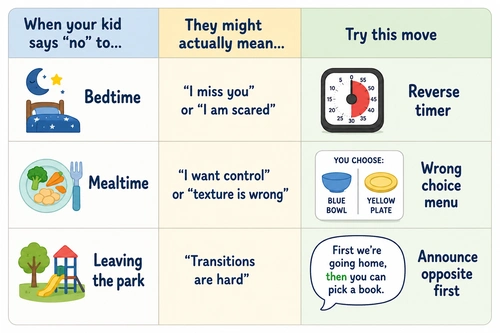
The game: next time, say “Hmm. Let me translate.” Then guess what they mean. Often, they will correct you,turning it into a genuine conversation.
The Closing Loop
Your kid will say “no” tomorrow morning. Maybe to breathing. That is not failure; that is practice. You do not win by crushing their spirit. You win by dancing with it until it gets bored. Pick one move. Try it. When your brain whispers “this is stupid,” smile. What seems ‘stupid’ is precisely what a little expert in opposites never expects
