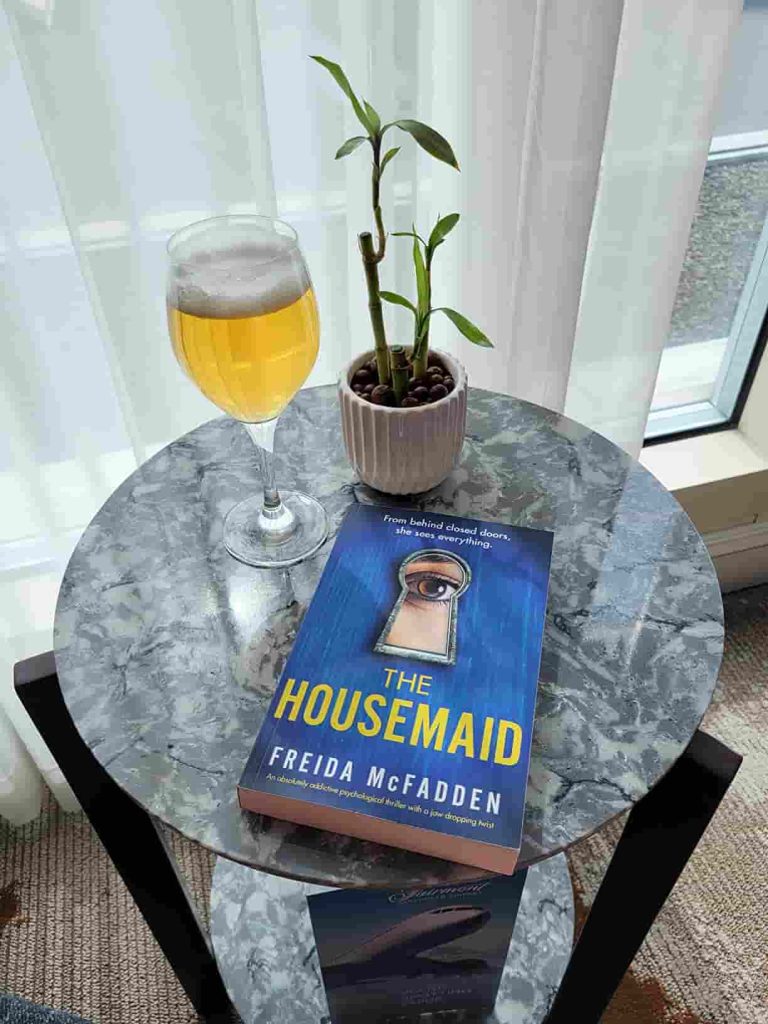
It took me three days to finish reading this classic mystery novel,The Housemaid . At first, I was drawn in by the bold color contrast of the cover—that piercing, watchful eye. After finishing it, I found the story itself equally thought-provoking.
In this labyrinth of unreliable narration, the “madwoman” may never have been mad, and the true victim might be someone else entirely.
In 1979, The Madwoman in the Attic introduced a classic concept: in 19th-century women’s literature, the “madwoman” served as a projection of female desire and resistance suppressed by patriarchal society. In Jane Eyre, Bertha Mason was locked away in the attic and labeled mad, yet the truth was that she was a victim—imprisoned by her husband and silenced.
In The Housemaid, this imagery is doubled. Millie lives in a small room in the attic of a mansion that can only be locked from the outside; it is not a bedroom, but a prison cell. Meanwhile, the mistress of the house, Nina, is also trapped—trapped within the identity of Mrs. Winchester, trapped within the facade of a perfect family, and trapped within the narrative woven by her husband, Andrew. Her mood swings and controlling nature are precisely the mask imposed on her by this invisible “attic.”
McFadden allows readers to see two “attics” simultaneously: one locking up the maid, the other locking up the mistress. It is not until the story’s conclusion that we realize these two attics are, in fact, one and the same.
At the beginning of the novel, Millie is consistently viewed by everyone as a person with a criminal record, someone who needs to be monitored. But the truth is that her “crime” stems from a past intimate relationship; she was once used by a man and made into his scapegoat. Her predicament reveals a cruel reality: for some women, the past is like a label that can never be torn off. Her legal sentence may have ended, but the social punishment has never ceased.
For most of the novel, Nina is portrayed as an irrational person: she repeatedly litters the room so that Millie has to clean up after her, treats her daughter strangely, displays extreme mood swings, and behaves erratically. Her husband, Andrew, perfectly plays the role of the respectable husband tormented by his mad wife. It isn’t until the latter half of the story that readers learn the truth: Nina’s “madness” is a survival strategy.
She developed this covert coping mechanism under Andrew’s control; her unusual behavior toward her daughter was meant to protect, not harm; and her harsh treatment of Millie was an attempt to drive her away to keep her safe.
To me, this is the most beautiful twist in the entire book—the person we viewed as the “madwoman” is actually the most lucid one. The person we viewed as the “victim” is, in fact, the perpetrator.
The novel’s most moving twist is the shift from confrontation to alliance between Millie and Nina.
They were natural enemies—mistress and maid, exploiter and exploited. But they discovered that Andrew’s seduction of Millie mirrored his tactics toward Nina. He sought to drive a wedge between the two women, pitting them against one another to solidify his control.
When Millie and Nina exchanged information and pieced together the truth, they engaged in a “conversation in the attic”—two women trapped by the same man finally breaking down the barriers between them.
What makes The Housemaid truly remarkable is how the narrative itself rewrites the story.
The novel shifts between the perspectives of Millie and Nina, but neither narrator is to be trusted—Millie hides her past, while Nina’s account is cloaked in “madness.” Each chapter reveals new information, forcing the reader to reevaluate everything that came before. Tense plotlines intertwine with unexpected twists.
But what truly gave me a sinking feeling was this later twist.
Just as you’re reveling in the happy ending where the psychopath finally gets his comeuppance, the appearance of Andrew’s parents delivers the most chilling scene in the entire novel: That little boy—Andrew—with an absent father and a strict mother, whose baby teeth were forcibly pulled simply because he hadn’t taken proper care of them, was left crying helplessly.
The broader society in which we live often defines success solely in terms of money, status, and outward decorum,while ignoring the cultivation of inner character. How many such “successful” people have we seen—those who appear glamorous on the outside but are twisted and barren on the inside?
The label “crazy woman” essentially implies that this woman cannot be trusted. Yet McFadden deliberately has two women—whom we cannot fully trust—tell the story; this in itself is an act of defiance.
She lets us experience firsthand what it means to be untrustworthy. The reason Millie and Nina’s narratives are so suspect is precisely because they have long been suppressed, doubted, and defined as abnormal. She does not use an external perspective; instead, she lets them speak for themselves.
Fortunately, the ending offers us some solace. Both Millie and Nina have stepped out of their respective “attics”—Millie has left the mansion, and Nina has left Andrew. Their ability to leave the “attic” stems not from the awakening of a single person, but from the collaboration of both.
This represents the deepest continuation of a literary tradition: in 19th-century versions, the fate of the “madwoman” was often death—Bertha burned down Thornfield Hall, and herself along with it. In The Housemaid, however, the “madwoman” survives and joins forces against the one who locked them away in the attic. That door, which could only be locked from the outside; that key, which everyone believed was in the hands of the powerful—when the two “madwomen” realized they were bound by the same lock, that lock shattered.
The moment I closed the book, I couldn’t help but glance at the cover once more—that eye no longer seemed so terrifying.