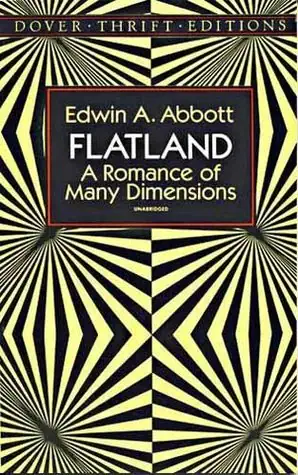
I picked up this book expecting a cute Victorian math story. Shapes talking. Circles acting elitist. Squares having little crises. And it is that. But it’s also unexpectedly sharp and unsettling.
The narrator is a Square. He lives in a two-dimensional world called Flatland. He’s a respectable middle-class citizen. He has a wife. She’s a Line Segment. That’s its own kind of nightmare. He hates irregular shapes, as society judges you by the numberof sides you have-more sides mean higher status. Circles are the priests. They aren’t really circles. They are polygons with so many sides they look round. They run everything. Women are straight lines. They are seen as dangerous and stupid. They are forced to constantly emit a “peace-cry” so they don’t accidentally stab someone. It’s satire, but it stings.
One day, the Square has a dream. He visits Lineland, a one-dimensional world. Points and lines live there on a single line. They cannot imagine left or right. The Square tries to explain two dimensions to the king of Lineland. The king calls him a madman.
Later, a Sphere from the third dimension visits Flatland. The Sphere tries to show the Square what “upward, not northward” means. The Square cannot see it. He only sees a circle that changes size. He thinks the Sphere is using magic or lying. Eventually, he starts to understand. There must be a third dimension. He asks the Sphere: what about a fourth? The Sphere gets annoyed. “You flathead, there is no fourth dimension.” The Square realizes that even the enlightened Sphere has a ceiling.
The ending struck me profoundly. The Square tries to preach about three dimensions back in Flatland. He gets imprisoned for life. The book ends with him in a cell, years later, still hoping someone will understand.
I read this in one sitting on a Sunday afternoon. It’s short, about 130 pages. I kept putting it down just to stare at the wall. This isn’t really about geometry. It’s about how each of us lives in a Flatland of our own beliefs. Although we laugh at the Lineland king for failing to imagine a seconddimension, we are often that king ourselves when confronted with realitieswe cannot perceive. We are also the Sphere. We are proud of our own third dimension. We refuse to consider a fourth.
The worst part is the Square’s imprisonment. He’s not a hero. He just saw something real. He tried to tell people. He got locked up for it. Abbott wrote this in 1884. It critiques Victorian society, class, gender, and religion. Today, it reads as a warning about how we treat anyone whose experience doesn’t fit our known dimensions.
I finished the book thinking about a conversation with my uncle years ago. He’s a physicist. He was explaining string theory over bad coffee. I nodded, but I didn’t really get it. I thought I did. The Square thought he understood the Sphere, but he didn’t—not until the Sphere showed him. And even then, he couldn’t get past his own flatness.
You should read Flatland. It’s short. It’s funny. It’s weird. But it’s also a reminder. Next time you’re certain you’re right, pause. The person you’re arguing with might not be stupid. They might be living in a dimension you haven’t seen yet.
