You say something small. They respond. Suddenly your face heats up, your voice rises, and you are saying things you will regret in ten minutes. Then the shame hits. Why do you snap so fast? I asked 62 people who struggle with quick anger. Their answers split into three camps.
Cast your vote.
- Option A: Your anger is a shield for older pain you never processed.
- Option B: Your body is chronically overstimulated, and anger is the release valve.
- Option C: You never learned a different script for conflict, so your brain defaults to fire.
Real stories below. No theory. Just what worked for people who used to scare themselves.

Option A: Anger that covers up old hurt
Angry people are often just sad people who got tired of crying. I learned this from my own life. For years, I would explode at my partner over tiny things. A dish left on the counter. A response that took too long. A tone of voice I did not like. I broke a coffee mug once by throwing it into the sink. The worst part was I could not explain why. I just felt this hot wave and then it was too late.
One night, after yelling at my partner for something stupid, I sat on the bathroom floor and finally asked myself the real question. Why was I so angry all the time? I started thinking back. My father had a temper. He never hit us, but he would go silent for days after a small mistake. I learned that anger meant withdrawal. And withdrawal felt like abandonment. So I grew up promising myself I would never go silent. Instead, I went loud. Every small frustration became a scream because I was terrified of being ignored. Once I saw that pattern, the anger did not disappear, but I stopped blaming my partner. I started saying “I am not actually mad at you. I am scared of being dismissed.” That single sentence changed everything.
A quick self check for Option A. When you get angry, do you immediately feel a wave of exhaustion or sadness right after? That is a sign that anger is a mask.
Three ways to test this.
- First, the next time you feel the heat rising, pause and ask yourself: “What am I afraid of losing right now?” Control? Respect? Safety? Write the answer on your hand if you have to.
- Another method, set a weekly thirty minute appointment with yourself. Label it “old hurt review.” Just sit and remember one time you felt humiliated or dismissed as a kid. Do not fix it. Just feel it for five minutes.
- Last, try a two sentence journal before bed: “Today I got angry when… The softer feeling under that was…” Do this for seven nights. The pattern will show itself.
Option B: Your body is overwhelmed
Some anger has nothing to do with psychology. It is purely physical. Too much caffeine, not enough sleep, constant phone notifications, loud open offices, traffic, background noise. Your nervous system stays on yellow alert all day. Then a tiny trigger arrives, a child asking for juice, a partner asking a simple question, and your system flips to red.
A real story. A woman named Priya came to me saying “I am a horrible mother. I yelled at my five year old for dropping a spoon.” She was not horrible. She was sleeping five hours a night, drinking four cups of coffee, and working twelve hour shifts as a nurse. Her body had no recovery time. We did a simple experiment. No caffeine after 2 PM. Bedtime at 10 PM for five nights. And a ten minute walk outside with no phone before dinner. On day six, her son dropped a spoon again. She picked it up and said “it is okay.” She cried afterward, not from anger, but from relief. Her anger was never about her child. It was about a body that had been drowning in stimulation for years.
Here is a table showing common physical triggers and how they turn into anger.
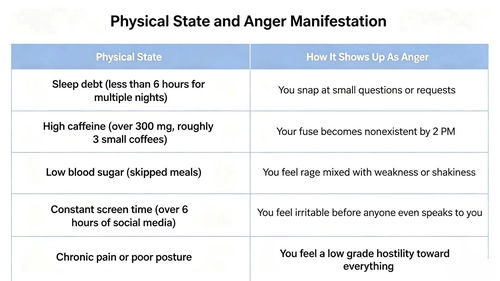
A quick test for Option B. Take one full day off from caffeine, social media, and loud environments. Go to bed by 10 PM. See if your anger drops by half. If yes, you have a body problem, not a character problem.
Three actions to try.
- First, audit your caffeine. Switch every other cup to decaf or water for three days. Notice what happens to your anger at 4 PM.
- Second, install a wind down alarm on your phone for 9 PM. When it goes off, dim your lights and stop all screens. Do this for four nights straight.
- Third, eat protein within one hour of waking. Low protein breakfasts like cereal or toast cause a blood sugar crash by mid morning, and crashes feel like rage. Try two eggs or Greek yogurt for five mornings.
Option C: You never learned a different way to handle conflict
This one is uncomfortable but honest. Many of us grew up in homes where yelling was normal. Or where silence was the only acceptable response. So you never saw a middle path. Your brain only has two files: explode or shut down. Getting angry easily is not a moral failure. It is a skill deficit. The good news is, skills can be learned.
A story that proved this to me. My neighbor Tom, a retired firefighter, used to scream at his teenage son for leaving lights on. He hated himself after every fight. Tom had been raised by a father who screamed first and asked questions never. Tom did not need therapy for trauma. He needed a script. We practiced one simple line: “I am getting angry. Let me take sixty seconds.” He wrote it on a sticky note on his fridge. The first time he tried it, his son looked shocked. Then his son said “okay.” Two months later, Tom told me “we have not yelled in three weeks.” He did not change his feelings. He changed his response.
Another example from a client named Jasmine. Jasmine would get furious when her coworker interrupted her in meetings. She would either go silent or snap back. We built a short menu of alternative phrases. “I was still speaking.” “Let me finish this point.” “I will come back to you.” The first time she used “I was still speaking,” her voice shook. But the meeting continued. No explosion. No shame spiral. She realized that anger was not her personality. It was her only tool. She just needed more tools.
A table of alternative scripts for common anger triggers.
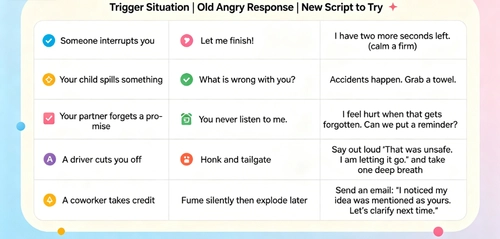
How to build your own script menu?
Pick one recurring anger situation from the past week. Write down what you actually said. Then write one alternative sentence that is calm and clear. Keep it on your phone lock screen for three days.
Another way, practice the new script out loud in the car alone. Say it five times. Your brain needs repetition to override the old fire alarm.
Last, after any anger episode, ask yourself not “why am I so bad?” but “what phrase would have worked better?” Collect those phrases in a note called “my calm tools.” Review it every Sunday night.
So which one is your real root?
Here is the flow I have seen work on dozens of people. Start with Option B for three days. Fix sleep, caffeine, and food. If your anger drops significantly, you are done. Keep going.
If not, move to Option C for one week. Pick one trigger, learn one new script, practice it. Most people see change in four to five days.
If you still feel that hot explosion rising, Option A is your deeper door. The anger is protecting something older and softer. A therapist or a honest conversation with a trusted friend about past pain will move more weight than any breathing technique.
Your anger is not the enemy. It is a messenger in a very loud costume. Stop yelling at the messenger. Start reading the message.
