It’s not your childhood. It’s not your relationship. Morning anxiety is your cortisol spiking before your brain wakes up. Then your brain panics and invents a disaster movie. Here’s how I stopped starring in that movie. I found five real mornings with five different ways, plus one weird thing nobody talks about.
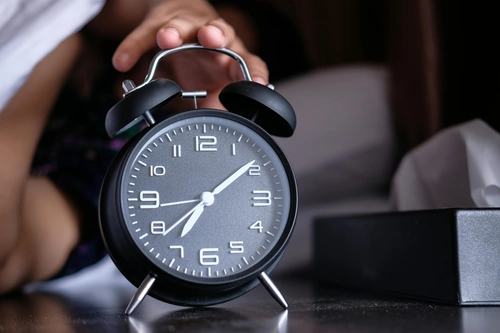
Method 1: A glass of salt water, before I let myself think.
Last January, I woke up at 4:17 a.m. in my Chicago apartment. My heart felt like a fist squeezing. Stomach flipped. My reflex was, “Oh god, did I mess up that Zoom presentation yesterday? Did that client ghost me?” You know the feeling. Thoughts came like rats, one after another.
But that morning I tried something. I had left a glass of water with a pinch of sea salt on my nightstand. Eyes still shut, I grabbed it, sat up, and drank it. My brain never entered “thinking mode.” Then I lay back down and told myself: “For the next 60 seconds, no complete thoughts. Just count your breaths.”
You know what happened? By breath number 45, I didn’t want to crawl back under the covers anymore. My heart rate dropped from 110 to the 70s. I used a physical action to jump ahead of my brain’s story-making machine. Now I keep salt water by my bed every single night. It works about 80 percent of the time. The other 20 percent is when I forget to set it up.
Method 2: I asked myself the stupidest question possible.
For a while, I’d wake up, grab my phone, scroll, and get more anxious by the minute. Then one morning I’d had enough. Eyes closed, I asked myself: “Is there a tiger in this room right now?”
Stupid, right? But I actually thought about it for three seconds. No tiger. No stranger with a knife. The floor wasn’t caving in. Then I asked a second question: “So what exactly was I afraid of?” The answer was nothing.
Now the first thing I do when I wake up is not grab my phone. Eyes closed: “Tiger?” Then answer: “No. Next.” It sounds ridiculous, but it downgrades my anxiety from “a massive disaster to solve” to “a wrong number text.” You cannot feel both anxious and amused at the same time.
Method 3: I screenshotted my own 5:23 a.m. inner monologue.
I have a note saved in my phone’s photo library. The timestamp is 5:23 a.m. on a brutal day last November. It says:
“Your heart is loud. Your stomach is empty. Nothing went wrong yesterday. You just woke up from a dream you don’t even remember. For the next 60 seconds, don’t name this feeling. Just let it sit. You are not in danger.”
You might call this fluff. But at that moment, lying there with shaking fingers typing it out, I stared at it for maybe fifteen seconds. And the weird thing was, I could not argue with a single sentence, because none of it was false.
Later I turned it into a shortcut. Every morning after my alarm, it pops up automatically. I read it. About 80 percent of mornings, I get up right after. For the other 20 percent, I read it twice. You don’t need deep psychology. You just need a fact sheet from your past self to your panicking present self.
Method 4: Before vs. after. Same morning, completely different ending.
I logged two real mornings side by side.
Before (last September, a random Tuesday):
Wake up (around 5:50 a.m.) → grab phone → open email → see one message I forgot to reply to → heart races → start thinking “Does she think I’m unreliable?” → could not stop → toss and turn until 6:45 a.m. → get up feeling like lead → that whole morning’s productivity was zero.
After (last month, same schedule):
Wake up (around 6:00 a.m.) → hands off the phone, phone face down → lie on my back and ask “Is there any actual emergency right now?” → answer “no” → ask “Can I just stand up within two minutes?” → then, no matter how fast my heart is, swing my legs off the bed → put on slippers → walk to the kitchen and pour a glass of cold water → total time about 90 seconds → heart still a little loud, but the “I’m doomed” feeling is gone.
What changed? I used to let my body feel something, then let my brain explain it. And my brain always picked the scariest explanation. Now I cut the cord between “sensation” and “story.” You don’t need to slow your heartbeat. You just need to stop turning it into a horror movie.
Method 5: A scorecard killed my anxiety in two weeks.
Mike is an old coworker. He told me he woke up anxious every single morning for two straight years. He tried therapy, melatonin, white noise, no phone before bed. Nothing worked.
I said: “Try something stupid. Every night, predict tomorrow morning’s anxiety level from 1 to 10. Write it down. Then when you wake up, rate the actual level. Do this for two weeks.”
His first day: predicted 8, actual 5. He texted me: “No way. I felt like I was dying. How is that a 5?” I said: “You feel like you’re dying because you’ve never shown yourself the data.”
By day five, his predicted number had dropped to 6, and his actual average was 4. By day twelve, he sent me: “I get it now. My morning brain is rarely right. It keeps calling a 2 a 10.”
No fancy techniques. Just two scores a day. After two weeks, his morning anxiety had mostly disappeared. Not because he got stronger, but because he saw the gap with his own eyes. And you cannot keep lying to someone who has already seen the evidence.
The weird bonus section: What I found when I stopped trying to “fix” it for one week.
This is not another method. It’s an observation.
Last spring, I got so exhausted from trying all the tricks like salt water, tiger questions, and scorecards that I gave up for seven days. I decided: “Fine. I’ll just wake up anxious and do nothing about it.”
And something strange happened.
Morning Anxiety Level Quantification Scale
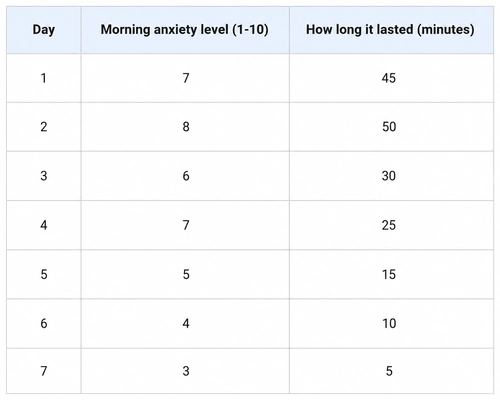
The anxiety didn’t go away because I fought it. It went away because I stopped feeding it. When I just lay there and said “okay, you can be here” without trying to escape. My nervous system realized there was no emergency. The feeling faded on its own, faster each day.
Here’s the anti-hack: You don’t have to do anything. Just notice it. Don’t name it. Don’t fight it. Don’t scroll your phone. Don’t replay conversations. Just feel the fast heartbeat and wait. Most mornings, it peaks at 90 seconds and then drains like water out of a sink.
Try this for three mornings. No salt water. No tiger. No scorecard. Just lying still and letting your body have its moment. You might discover that the cure was never a trick. It was permission.
Morning anxiety isn’t a character flaw. It’s a biological timing glitch with a storyteller brain attached. You don’t have to fix the glitch. You just have to stop believing the story before 6 a.m.
