Let me say something that might make you uncomfortable.
You love your child. You would do anything for your child. But sometimes, whether in the kitchen, the car, or late at night, you feel afraid of your child.
The hitting. The biting. The throwing. The words your six-year-old says could shock even an adult. My son, at age seven, put a hole in the wall because I asked him to put his shoes on. He swung a metal water bottle at my face and missed by two inches. He told me he wished I was dead – and meant it, at least in that moment.
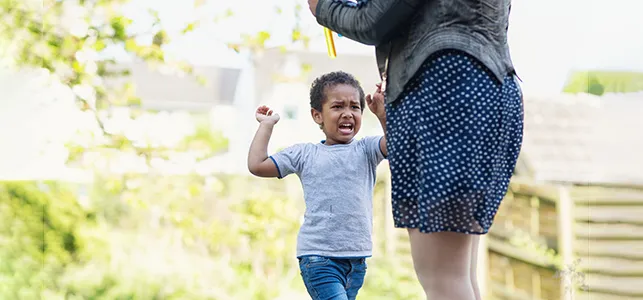
And I remember standing in the hallway afterward, heart pounding, thinking: I am the parent. I am the adult. I am not supposed to be scared in my own house.
Here’s the first thing you need to hear: You are allowed to protect yourself. So, how to protect yourself from a violent child?
The Solution
After years of therapy, training, and trial-and-error, I learned a framework. It’s not about restraining your child. Here’s the framework. Four moves. Learn them in order.
Move One: The Body First Rule
Your instinct when a child becomes violent is to use words. “Stop it.” “Calm down.” “You’re hurting me.”
Stop. Words don’t work during extreme agitation. Their brain’s language center is offline. You are talking to a wall.
The body first rule: Ensure physical safety before speaking.
This means:
- Step back. Create distance.
- Put furniture between you and them if you can.
- Turn your body sideways (smaller target, easier to protect your face).
- Keep your hands up but relaxed – not aggressive, just available to block.
Practice this when you’re calm. Literally rehearse it. Stand in your living room and practice. Make it muscle memory. Because when the moment comes, your thinking brain goes offline. Your body has to know what to do.
Move Two: Three Sentences Only
Once you have physical safety, you can try words. But only three sentences. Any more than that and you’re feeding the fire.
- State what you see, without judgment. “I see you’re really upset.” Not “you’re being bad.” Not “stop hitting.”
- State the boundary, clearly and quietly. “I won’t let you hit me.”
- Offer a replacement behavior, not a threat. “You can hit the pillow or you can stomp your feet.”
That’s it. Three sentences. Then stop talking.
If they keep swinging, go back to Move One. Distance. Protection. You don’t need to win the argument. You need to survive the next sixty seconds.
Move Three: The Exit Strategy
Here’s the thing nobody tells you: sometimes the safest thing you can do is leave the room. Long enough for the storm to move through without you as the target.
The rule: If you are alone with a violent child and you cannot safely de-escalate, you step out. You close a door between you. You stand on the other side and breathe.
This feels wrong. It feels like abandonment. It feels like losing.

It’s not. It’s triage. You cannot help your child regulate if you are bleeding. You put your own oxygen mask on first. That’s not selfish. That’s how you stay alive to help them five minutes from now.
What to say as you leave: “I’m going to step outside for a minute. I’ll come back when we’re both safe.” Then go. Don’t negotiate. Don’t explain further. Just go.
Move Four: The Aftermath Protocol
The violence ends. The house gets quiet. And then what?
Most parents do one of two things: they either collapse into guilt and overcompensate (ice cream, extra screen time, pretending it didn’t happen), or they go hard on punishment (grounding, yelling, “you’ll never touch a screen again”).
Both are wrong.
The aftermath protocol has three steps:
- Check yourself first. Are you injured? Do you need a minute? Take a moment. You are not a robot; being hit by someone you love hurts, both physically and emotionally. Give yourself five minutes to feel whatever you feel.
- Reconnection, not punishment. When your child is calm again (could be five minutes, could be an hour), you go to them. You say: “I love you. That was hard for both of us. Let’s figure out what we do next time instead of hitting.” Focus on the behavior, not the child; you’re on the same team.
- The repair conversation happens later. Not in the aftermath. Later. When everyone has eaten and slept. That’s when you talk about consequences, plans, and what needs to change. You cannot teach in the middle of a tornado.
Actually Remember
Put it on your fridge: You are not a bad parent.
If the violence is frequent, extreme, or getting worse – if you’re hiding bruises, if you’re afraid to be alone with your child, if you’ve called the police or thought about calling them – you need professional help. Therapists who specialize in childhood aggression exist. So do residential programs, parenting coaches, and crisis lines. Use them.
You don’t have to do this alone. And you don’t have to get hit.