I still think about this book at weird times: when a plane goes overhead, when the wind drops and everything goes quiet. That’s how it gets you — not with big explosions, just with the silence afterward.
Peter Heller’s The Dog Stars is about a world after a flu pandemic killed most people. No government, no electricity, no gas stations. A man named Hig lives on an abandoned airfield in Colorado with his dog Jasper and a violent survivalist neighbor named Bangley. They have a Cessna. Hig flies it to scout for supplies. Bangley stays on the ground with a rifle. Anyone who gets too close, they kill.
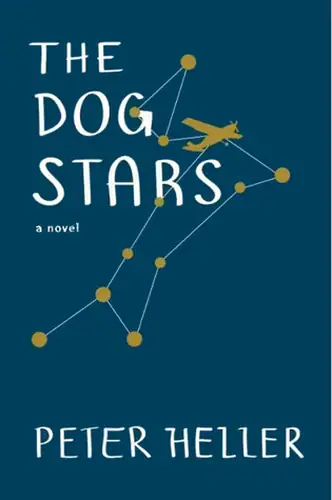
But Hig doesn’t want to kill anyone. He used to be a pilot, but also something like a poet. He notices the way light hits a field of grass. He talks about the mountains like they’re old friends. His wife died early in the outbreak, and he hasn’t stopped grieving for her. What he really wants is just to hear another human voice that isn’t Bangley’s.
The voice of the book is what got me. Heller writes in short, broken sentences. Sometimes no verb. Sometimes just a fragment. It feels like someone talking to himself while trying not to fall apart. Here’s an example: “I love the dog.” Four words, flat, but they hit harder than any paragraph about loyalty.
“I used to think I wanted to be remembered. Now I just want to live until tomorrow.”
The middle of the book slows way down. Hig hears a voice on the radio, a faint broadcast from Minnesota. He decides to fly north to find it. Bangley tells him it’s a trap. Hig goes anyway. The journey takes forever, and Heller describes every river bend, every broken bridge, every field of fireweed. Some readers get bored here. I didn’t. The slowness is the point. After the world ends, there’s no rush. No one is coming to save you.
What surprised me most is how tender the book is. Hig finds a young woman named Cima and her father living in a cabin. He doesn’t attack them. He doesn’t try to take their stuff. He just wants to sit by a fire and hear another human voice. The romance that grows between him and Cima is not sexy or dramatic. It’s just two lonely people who stop being lonely. That’s more realistic than any action scene.
I read this book while recovering from a normal flu, not the pandemic kind. But lying in bed with a fever, feeling weak and cut off from everything, I understood Hig better: the fear, the wanting to see one more sunrise, the stubborn hope that something good is still out there.
If you want guns, zombies, and nonstop action, this isn’t your book. If you want a quiet, sad, beautiful meditation on what it means to keep going when almost everything is gone, read it. Hig doesn’t save the world. He doesn’t even save himself in a big heroic way. He just keeps living. That’s a victory left.
