When I was little, I always thought that “what adults say” is naturally right. Teachers, parents and elders seem to know more about the world than children. Later, As I grew up, I realized many people are determined not because they understand, but because they never doubt themselves. When I read The Poisonwood Bible, this feeling kept popping up in my mind. On the surface, it tells the story of an American missionary family who went to Congo to preach, but what really depressed me was the power of “self-right” in the book. Many tragedies are not due to malice, but because some people always believe that they represent the truth.
The story opens with the Price family following father Nathan to the Congo. A staunchly stubborn Baptist preacher, Nathan is fully convinced that he has come to save the local people. Bringing along his wife and four daughters, he tries to impose American religion, social order and values upon this foreign land. He refuses to learn the local language and makes no effort to adapt to the climate, culture, or way of life. He merely repeats his religious doctrines over and over, as if speaking louder would force others to accept his beliefs.
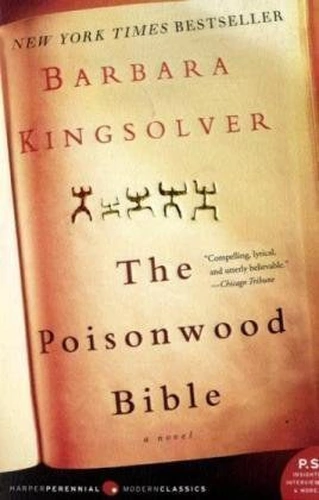
When I read this book, the most painful thing was that Nathan didn’t feel cruel. He even thinks that he is “sacrificing” and “dedicating”. There is a detail in the book that I have always remembered. He insisted on baptizing the villagers in the river, but the locals kept reminding him that there were crocodiles in the river, which was very dangerous. Nathan didn’t listen at all and still insisted that “true faith” should overcome fear. When I read that, I suddenly realized that sometimes the most terrible thing is not violence, but a person who firmly believes that he will never be wrong.
Barbara Kingsolver portrays a more complex reality: how power can masquerade as goodwill. Nathan believes that he is spreading civilization, but he has never thought about why others must accept his world instead of understanding other people’s world. That high-minded attitude reminds me of many similar moments in reality.Family members used to make decisions for me in the name of “for your own good” — choosing my major, mapping out my future path and so on. Back then I could hardly argue, for they seemed far more experienced. Later I realized that well-meaning intentions like these are often nothing but a form of control. Many people do not listen to your true needs; they only strive to mold you into someone they can comprehend.
I was also deeply impressed by the alternating narratives of the four Price daughters, who view the Congo and their father in vastly different ways. Some begin to doubt him, others submit obediently, while others gradually come to see that the root of the problem lies not in the Congo itself, but within their own family. Leah, once her father’s most devout admirer, undergoes the most dramatic transformation. She awakens to the fact that all the truths she was raised to believe rest on arrogant assumptions — that everything Western and American is inherently more advanced and civilized. Her decision to settle down in Africa later on is driven by more than just love; it is essentially a journey to re-learn how to perceive the world.
The true brilliance of The Poisonwood Bible lies beyond mere discussions of religion. It delves deep into how difficult it is for people to truly understand one another. More often than not, people hurt others unintentionally simply because they are trapped in their own perspectives. Nathan spent all his energy trying to transform the Congo, yet he never truly saw it for what it was. Even the book’s title carries sharp irony. Due to his mispronunciation, what Nathan meant to say “Jesus is precious” came out as “Jesus is poisonwood tree”. This linguistic blunder serves as a powerful metaphor for the whole story: when people refuse to embrace foreign cultures, the salvation they think they bring may well turn into harm.
By the end, I felt that the discomfort of this book isn’t in the conflicts themselves, but in realizing how easy it is to live within our own ‘correctness. We always feel that we are more sober, rational and know more about what is good than others, but in many cases, this certainty itself may be a kind of blindness. Especially when a person never doubts himself, the harm he brings is often the deepest.
Closing the book, I recalled countless moments in my life when I was utterly convinced I was in the right. In my younger days, I was quick to correct others, assuming they just failed to see things clearly. With time, I have learned that there are rarely absolute answers to most interpersonal conflicts. Rather than rushing to change others, we ought to first acknowledge that our own vision of the world is inevitably incomplete.
What The Poisonwood Bible has etched firmly in my mind is not the sweltering heat of the Congo, religious conflicts or family misfortunes, but the lingering unease throughout the whole story: are humans ever capable of fully understanding another world? Perhaps total understanding will always be out of reach, but we can at least learn to question our own so-called “truths”.
