“Have you finished your homework yet?”
Your child shrugs.
Ten minutes later, you ask again.
Another eye roll.
You’ve nagged your child repeatedly, yet they still refuse to get started. You are far from alone. Many kids put off homework and make up excuses to avoid studying. Most parents respond by nagging, raising their voice or taking away their phones — yet these tactics often lose effectiveness over time.
A reluctance to study is not simply laziness. It means some underlying need is unmet. Below are five actionable strategies you can start using right away.
What to Say When Your Child Refuses to Study (Stop Nagging, Start Doing This)
The more you press them, the less willing they become.
A mother shared her experience on a parenting forum. Her child would roll his eyes and walk off whenever she asked if he had finished his homework. A child therapist suggested she stop nagging entirely and instead say, “Let me know when you’re ready.”
She decided to give it a try. That evening, she held back all questions. About half an hour later, he wandered into the kitchen and asked what he should work on first.
This connects to educational psychology. Frequent questioning can trigger a defensive reaction. Many kids experience feeling controlled, and their instinct may lean toward resistance rather than cooperation. Some children begin to take more ownership of their work when they feel they have a say in the process.This aligns with the self-determination theory: people have an innate need for autonomy. Take that away, and rebellion often follows; restore it, and many children are more likely to cooperate.
What to say instead: Avoid: “Go do your homework now!” Try: “Let me know when you plan to start.”
If they reply “Later”, calmly ask for a rough time frame — keep your tone gentle, not interrogative.
One father recalled a tough moment: he held his tongue for forty minutes while his child read comics. He nearly lost his patience, but persisted. Eventually, the boy put the comics down and said he would start his work. The father simply nodded in reply, fighting the urge to gush.
Remember: stepping back is not giving up. It is letting your child take ownership.

How to Break the Starting Barrier (Shrink the First Task to 2 Minutes)
Children often refuse to begin because tasks feel overwhelming.
It is often not laziness. Faced with a full page of math problems or a long assignment, many children’s brains tend to shut down out of intimidation. Children have limited working memory and attention resources; the bigger the task, the harder it is to start.
A parent shared a relatable story online. Her daughter would slump over the desk and claim she could not write essays. The parent changed her approach: she only asked the girl to write the title. Once done, she told her she could take a break. Surprisingly, the daughter kept writing on her own.
Simplify tasks to get them started:
- Turn “Finish all math homework” into “Do just the first problem”
- Turn “Memorize ten words” into “Read the first word”
- Turn “Pack your schoolbag” into “Take your books out first”
Starting is often the hardest part. Once children get moving, momentum tends to build naturally. Getting started can feel nearly impossible, but once begun, momentum often builds naturally — much like pushing a heavy stone.
Another mother noticed her son disliked assigned schoolwork but enjoyed reading freely. Instead of pushing him to do exercises, she said, “Read for five minutes first, then we’ll talk.” Five minutes turned into ten, then fifteen. She realized her son did not hate learning — he hated being ordered around.
How to Stop Power Struggles Over Homework (Offer Choices Instead of Commands)
Kids resist not the work itself, but the phrase “you have to”.
One teen put it plainly online: “Homework has nothing to do with my life.” This sentiment lies at the root of many family arguments over study time. The issue is not inability, but resentment over being told what to do.
When you demand immediate action, children often push back. When you give them options, many feel more in charge and may cooperate more easily.
Offer small, meaningful choices:
- “Would you rather do math first or English?”
- “Shall you start in five minutes or ten?”
- “Do you want to use a blue pen or a black one?”
A therapist shared an extreme case: a seventh grader refused to do any homework at all. Taking away her phone, canceling activities and hiring a tutor all failed. Together, they agreed to stop daily battles and allow natural consequences to play a larger role. The girl scored poorly on a test soon after. Instead of breaking down, she went to her mom and asked for help making a study plan. The parent shifted from enforcer to helper.Natural consequences work best when the stakes are manageable and the child is old enough to connect actions with outcomes.
This is not neglect. It lets children experience the natural results of their choices. Sometimes, they will never move forward unless you take a step back first.
What to Say When Your Child Says “I Don’t Want to Study” (Name the Feeling First)
What they feel matters more than logic in that moment.
Telling them how important studying is can sometimes make them feel misunderstood. You need to validate their emotions first. Brain science offers a clue: when children are emotionally resistant, their rational thinking centers often become less accessible.
How to respond:
- “Sounds like you’re feeling stuck.”
- “You really don’t want to do this right now.”
One parent asks her child a simple question before study time: “On a scale of 1 to 10, how much energy do you have left?” If the answer is 3, she suggests something easy: “Let’s just open your books then.” This approach keeps the peace entirely.
In many cases, hostility tends to fade once feelings are acknowledged. A family therapist once said: when emotions run high, children need understanding far more than solutions.
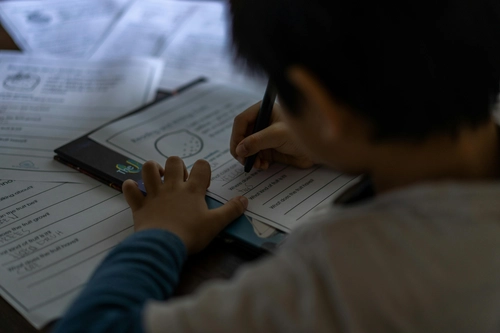
How to Create a Homework Routine That Works (Train the Brain with a Starting Ritual)
Brains resist sudden orders, but respond well to familiar cues.
You do not need to shout to get them to study. Build a short, consistent pre-study routine to signal the brain it is time to focus. Over time, the routine itself becomes a cue that it’s time to focus.
Pick one simple ritual to stick with:
- Clear your desk, pour a glass of water and take three deep breaths
- Play the same soft piece of music every time before starting
- Use a little catchphrase together: “Three, two, one — let’s begin.”
One family has a quiet routine: every evening at 7 o’clock, the dad knocks twice on his child’s bedroom door and says, “Time to get to work.” The knocks alone act as a neutral reminder, just like a school bell.
Rituals turn “Mom is making me study” into “It’s time to study” — transforming conflict into habit.
Quick Check: Why Your Child Still Won’t Study (Even After Trying These Methods)
The above tips can help address many common study avoidance issues. If you see no improvement after two weeks, check which category your child falls into:
- Fear of failure: They avoid work to escape mistakes and criticism (a sign of perfectionism)
- Overwhelm: The task feels too big, and they do not know where to begin
- Lack of purpose: They question why they need to study
- Emotional distress: Trouble with peers or teachers affects their mood and willingness to learn
- Underlying conditions: Attention difficulties, reading issues or persistent emotional struggles
The first three can be improved with the strategies above. For emotional troubles, set aside time to talk openly. For developmental or learning concerns, seek professional support.

When to Stop Trying DIY Strategies and Seek Professional Help
Reach out to experts if you notice any of the following:
- If the problem persists despite consistently applying several strategies
- Unexplained physical symptoms such as frequent headaches, stomachaches or nausea
- Complete refusal to go to school, not just skipping homework
- Self-harm, ongoing low mood or sudden angry outbursts
These are not bad behaviors or parenting failures. Consult a counselor or pediatric doctor in a timely manner.
Final words
Most children do not hate learning — they hate being forced to learn.
The harder you push, the more many children tend to pull away. Give them space to learn from their own missteps, and they will often come around. Kids grow more resilient when they believe abilities can be improved, instead of thinking they must be perfect all the time.
Your main job as a parent is not to force them to finish homework each day. It is to let them know you still believe in them, even when they fall behind.
Next time frustration builds and you are about to lose your temper, try saying: “Let me know when you’re ready. I’ll wait.”
Pause and stay quiet. You may find that silence is often far more powerful than shouting. What every child truly needs is not someone breathing down their neck, but someone who believes in them.
FAQ:
Why does my child refuse to study even though they’re smart?
Some smart kids fear failure because they are used to succeeding. Not trying feels safer than trying and getting something wrong.
Should I punish my child for not doing homework?
Punishment usually backfires. Try natural consequences instead — let them explain to the teacher.
My child only studies when I sit next to them. Is that bad?
It’s a start, but fade out gradually. Use “let me know when you’re ready” to shift responsibility back to them. If your child still hasn’t started after the agreed time, calmly revisit the conversation.
How long before I see improvement?
Give each method 5–7 days of consistent use. If nothing changes after two weeks, consider deeper issues.
What if my child says “I don’t care about school”?
Sometimes children who say “I don’t care” are protecting themselves from the fear of failure. Try naming the feeling underneath rather than arguing with the statement.
