You’ve definitely been there. During the rush hour, you drove a traffic jam on the road for twenty minutes. It was hard for the car to move, and a car next to it suddenly slanted in front of you without turning on the lights or honking the horn. Your foot stepped on the brake, and your heart jumped fiercely. A hot anger rushed from the chest to the top of the head. You hold the steering wheel tightly, and your thumb has pressed to the edge of the horn.
Or, you push open the door and see your partner throw the wet towel on the bed. You have said it a hundred times. At that moment, you didn’t want to talk. You just wanted to throw the towel into the trash can.
Or, when the child comes home from school and you ask him how he is doing today, he walks into the room without raising his head and closes the door with a “bang”. You stood in the corridor and suddenly felt like an invisible person. That kind of irritability is not because of the child, but because you don’t know why you are so easily ignited.
If you are familiar with these scenes, this article is written for you.
3 hidden signals that make you inexplicably irritable
Look at the following ones. How many did you win?
1. Overreact to small things and regret it later.
The child just put the water cup on the edge of the table, and you instantly shouted, “Put it away!” ; The takeaway guy is 5 minutes late, and you want to give a bad review; your colleague sent an emoticon in the group, and you think he is targeting you. After getting angry, you thought, “Am I up to it?”
2. I feel that everything around me is very “annoying”
It’s not aimed at someone. When I browse social media, I feel that everyone is showing off; when I hear the sound of others eating, I feel harsh; when I see a hair falling on the ground at home, I feel so annoyed that I want to demolish the house. The whole world is dancing on your nerves.
3. The picture of “smashing things” often appears in my mind.
You haven’t really done it, but your brain has rehearsed countless times: pushing the computer off the table, throwing the mobile phone against the wall, and smashing the steering wheel. Those violent pictures came quickly and realistically, which scared you.
If you get more than two, please remember:
you are not bad-tempered, you are just overloaded. Your body is not attacking others. It is telling you with the last voice of “anger”: I can’t stand it, help me.
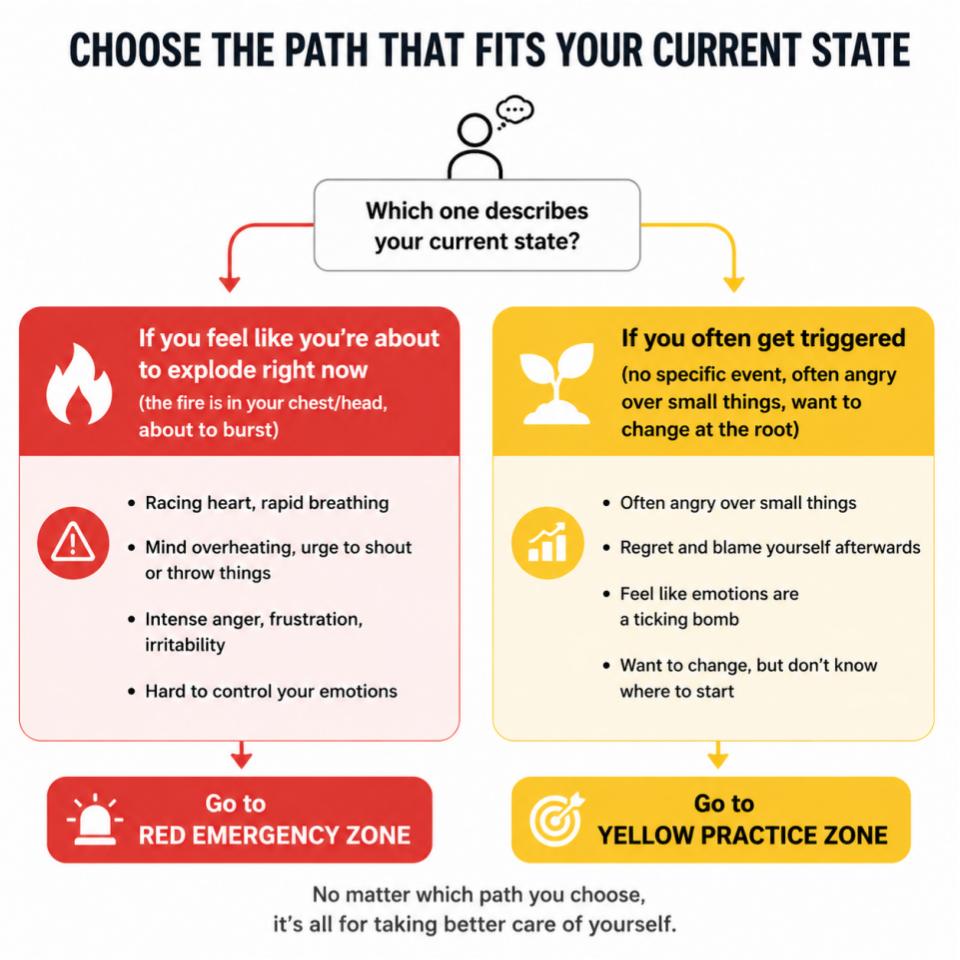
Now, choose a path according to your current state.
- If you are about to explode at this moment (the fire is on your chest/head, and it will explode at any time) → Jump to the red emergency area
- If you are usually easy to explode (no specific events, but often angry with small things and want to change from the root cause) → jump to the yellow exercise area
Red first aid area – You are about to explode. Release the fire within 60 seconds.
Why doesn’t “take a deep breath” use to you?
When you are angry, your body enters the “fight mode”: adrenaline soars, muscles tense, and heartbeat accelerates. At this time, any method that requires you to calm down is like trying to make a car at 100 kilometers per hour stop in an instant – impossible, and even make you more frustrated.
The first thing you need to do is to physically expel the energy that is ready for battle.
The following three methods, supported by neuroscience and somatic therapy research, can be done anywhere without any props.
Action 1: Adversarial thrust
Find a vertical and sturdy plane, the wall, the inside of the door, the side of the table, and even the edge of the bed.
Put your hands flat and push forward with all your strength, as if you were going to push the plane down. Keep this maximum force for 10-15 seconds. You will feel the muscles of your arms, shoulders and even abdomen begin to tremble. Then he suddenly withdrew all his strength, let his body droop naturally, and exhale for a long time.
If you don’t have an object to push: clasped the fingers of the hands in front of the chest, squeezed hard to the middle, and suddenly loosened after the same 10 seconds.
Why it is effective: This action calls the muscle group that was originally ready to “attack” in the battle mode, so that the accumulated physical energy can find an outlet. Sudden release will trigger the “completion” signal of the nervous system.
Action 2: Pressure shaking
Have you ever observed animals? A deer that escaped after being hunted will stand in place and tremble violently from head to toe for a few seconds, and then walk away as if nothing happened. It’s not fear, it’s that they are completing the stress cycle. Human beings have this instinct, but they are suppressed by the education of “to be calm”.
Method: Stand up straight and bend your knees slightly. Then allow your body to tremble freely like a chill, starting from the legs, and let the shaking spread naturally to the buttocks, abdomen, shoulders and arms. Don’t deliberately control the amplitude, just give your body a permission: “You can shake.” It lasts for about 1 minute.
If the space or occasion does not allow large shaking: only shake your hands for 15 seconds as if you had just washed your hands and dried them.
Why is it effective: Jitter can directly “clear” the residual tension in the muscle fibers and interrupt the physiological cycle of anger. Many people will sigh unconsciously after shaking, which is the sound of pressure release.
Action 3: Impact action
Use fast and rhythmic movements to consume excess energy.
- Stomp your feet: stomp your right foot 5 times in place, and then stomp your left foot 5 times. Every time it’s like stepping on the floor.
- Mini jump: If space allows, do 10 open and close jumps. If there is not enough space, do a small jump in place, and the sole of the foot is 5 cm above the ground.
If you can’t move while sitting: put your feet flat, hit the ground hard with your heels, and quickly pat your thighs with your hands.
Why is it effective: These actions directly burn adrenaline and stimulate the ontological sensory system at the same time, so that the brain switches from the “emotional brain” back to the “body brain”.
After doing any of the above actions
You will feel that your heartbeat has slowed down, and your body will change from “tight” to “weak”. If you take a deep breath again at this time, you will find that it really works, because you have finished the discharge.
Red first aid is completed. If you are often irritable for no reason, please continue to enter the yellow exercise area below.
Yellow exercise area – You are usually easy to explode and want to change from the root.
Why do you often get irritable?
The method of the red emergency area is to extinguish the fire temporarily. But if you are ignited by small things every day, it means that your nervous system is in a “default alert” state for a long time – just like a mobile phone with too many programs in the background, which will get stuck and hot at any time. It’s not a character defect, but your body forgets what it feels like to be safe.
The long-term solution is to actively give the brain a “I’m safe” experience every day. This method is widely used in neuroscience and clinical hypnosis, and is called “safe visualization exercise”.
Exercise task: 5 minutes a day “Safe Scene Imagination”
How to do it (do it again):
Find a quiet place and close your eyes. Don’t think “I want to relax”, but do a multi-dimensional scene construction:
Choose a scene that makes you feel absolutely safe. It can be a seaside, a forest, a snowy mountain, a room in your childhood, or even a place you can fully imagine. Then mobilize all senses to fill this scene:
Look: From which direction does the light come from? What is the color and texture? What objects are around?
Listen: the sound of waves, the wind, the rustling of leaves, or complete silence.
Smell: the smell in the air – salty, sweet, humid, dry.
Touch: What are you stepping on on the soles of your feet? What is the temperature when the air blows through the skin?
You can even add flavors: the salty of seawater, the bitterness of pine needles, and the sweetness of hot cocoa.
Time: 5 minutes every day. It can be after waking up in the morning, before going to bed, or during a lunch break.
Tracking: tick the calendar every day. For 7 consecutive days, you will begin to notice the change.
What if I can’t imagine it?
- Use the mobile phone to play a natural sound (waves, rain) as a guide.
- Remember a real place you have been to that makes you feel comfortable, even if it’s just a corner of a cafe.
- If you can’t think of anything, simply close your eyes in the dark and repeat to yourself: “There is no danger at this moment, I just need to breathe.”
Why is this method effective?
Your brain is not good at distinguishing between real and vivid imagination. When you spend 5 minutes a day letting your brain pretend to be in a safe environment, it will gradually reduce the stress baseline. A few days later, the same thing (being stuffed, the child closes the door, wetting the towel), you will still be irritable for a moment, but the fire can’t be burned. It will turn off by itself in a few seconds.
Finally, I will give you a “memory anchor”
It’s about to explode → counter-thrust / pressure shaking / impact action
It’s easy to fry at ordinary times → Imagine a safe scene for 5 minutes every day
You don’t have a bad temper. You’re just living with an overloaded nervous system that’s been crying out for rest and comfort.
Start with one tiny move today: try the 60-second stress release action when anger strikes, or set aside five quiet minutes tonight for your safe scene imagination.
Be gentle with your emotions, and slowly, you’ll regain peace and calm inside.