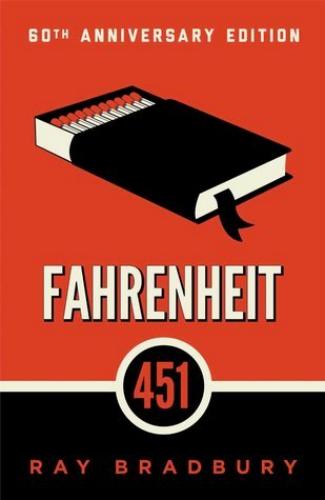
In the process of reading Fahrenheit 451, I kept thinking of a question: this book was written in 1953, when television was just becoming popular and the Internet was far from being born, but Ray Bradbury had accurately sensed something of the future.
What he wrote is not the technology itself, but the change of technology on the inner state of people, which makes me feel very powerful. The firefighters in the book do not burn houses, but books. Fire is no longer a tool for protection, but a weapon to destroy ideas. This setting itself is impactful enough, but what I care more about is the reason why those people no longer need books.
Bradbury did not write the future as a horror story of totalitarian oppression. On the contrary, the people he wrote voluntarily gave up books. Because books make people uncomfortable, books are full of contradictions, uncertainty and pain. And those always-happy programs on the TV screen, those interactive walls, and those voices that make people feel that they are accompanied are what people really want. Montag’s wife, Mildred, lives in front of three TV walls every day. She talks to the virtual family on TV and is not even willing to really communicate with her husband. One night, she swallowed a whole bottle of sleeping pills. Montag called two medical staff. They used the machine to clean her stomach, and the whole process was as skillful as washing a car. These two people are not even real doctors, but so-called technicians. There was almost no emotional rendering when Bradbury wrote this scene, and this indifference itself was more powerful than any sensationalism.
I’ve been wondering why this book is more disturbing today than ever. Because what we are facing now is not the prohibition of books, but the total defeat of attention. The book requires you to do only one thing for a period of time. It requires you to follow a complex ideological vein to the end. You can’t jump in the middle, play at double speed, or have second thoughts.
But our daily life has been cut into countless extremely short moments. Short videos are switched every fifteen seconds, and the information flow of social media is always refreshing. We are used to escaping to the next exciting point at any time. A book is a wall that you don’t want to move. It won’t cater to you. You have to walk through it by yourself.
What makes Bradbury really sharp is that he grasps the line between happiness and pain. Society eliminates all unsettling things, leaving behind pure and harmless happiness. Ethnic stories can’t make people uncomfortable, and complicated history can’t make people uncomfortable. Those dark, struggling and incomparable parts of literature are all edited or disappear directly. People get everything they want, without offense, confusion, and thinking that can’t be digested in the middle of the night. Then one day, they find that they can no longer understand poetry, can no longer stand a book longer than three pages, and no longer want to have a complete and uninterrupted conversation with the people around them.
Reading the part where Montag secretly collected books and began to read, what impressed me most was not the shock of knowledge, but a physical discomfort. He would have a headache, be irritable and want to smash things while reading. This is so real. Our concentration ability is like a muscle, which will shrink if it is not used for a long time. Retraining yourself to endure the density and rhythm of a book, to tolerate it giving feedback less immediately, and to accept that it will not reward you every thirty seconds — this is a kind of confrontation in itself. Bradbury wrote this confrontation with a physical sense, not the nobility of the spirit, but the instinctive resistance of the body.
At the end of the book, Montag fled to the suburbs and met a group of exiled scholars. These people don’t hide books. They keep the contents of the books in their minds, and each of them is responsible for reciting a work. Montag remembered the book of Ecclesiastes. Some people said he remembered Plato, and others said that he remembered Darwin. When the war broke out and the city turned to ashes, these people began to walk in the ruins, thinking that maybe one day they could write those words down again. The ending has religious compassion and solemnity, but not only that. Bradbury is actually saying that books are not a combination of paper and ink. Books are things that exist in the human brain. As long as there are still people who remember and are willing to repeat it, it will not disappear completely.
After reading this book, I was caught by a clear feeling: not sadness or anger, but a sober fear that is hard to say. What we are afraid of is not a specific enemy or a kind of censorship system, but that we ourselves are willingly becoming Mildred. We fill all the free time and cover every second of silence with endless fragmented information, so that the brain does not have free opportunities and does not let ourselves face the dark room without programs to watch.
Those people in the book don’t read because they can’t stand the quiet and loneliness. As for us, we are still buying books, staying in front of the bookshelf, and showing the reading progress on social platforms. But can we really still read books? Can we do only one thing at a time, only face a book at a time, without switching, not taking photos, not sending them out, and just stay with those words?
This question is neither a counter-question nor a lament. It’s just a fact that needs to be faced. Bradbury is not writing about the distant future. He is writing about this moment, at the other end of this flow of information.
