A few days ago, I made an appointment with my best friend. She sat opposite me.Her eyes were in a trance, she couldn’t even hear me talking to her clearly. I asked her what was wrong. She sighed and said, “I’ve been driven crazy by anxiety recently. Although I’m so busy every day, I still feel that I haven’t done anything well. The first thing I did when I woke up in the morning was to think about the report to be done today, the meeting to be held, and the customers to be followed up. Even if I had lunch at noon, I was still thinking about the afternoon’s work in my mind. I lay in bed at night and tossed and turned for two or three hours. The more I thought about it, the more I panicked. The more I panicked, the more I couldn’t sleep, and even lost a lot of hair.
I thought to myself: Isn’t this the way I used to be? You may be the same as her – obviously there is nothing big, but you are always entangled in inexplicable anxiety; you try your best to get rid of it, but anxiety is like a shadow. If you go, it will go, and if you stop, it will stop, exhausting you physically and mentally. In fact, we are all wrong. Anxiety is not our enemy. Fighting anxiety has never been a solution to the problem. Only by learning to accept it can we truly coexist peacefully with it.
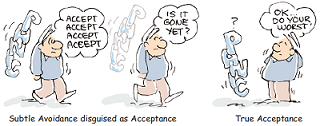
Today, I will share with you 4 practical methods. If you follow them, you can slowly reconcile with anxiety.
Method 1: “Label” anxiety
The reason why anxiety makes people collapse is that it is a vague “group of emotions”. If you can’t see it clearly, you will amplify your fear. Only then can you slowly accept it.
When I got home from work, I was irritable and couldn’t say what I was in a hurry. The more I thought about it, the more confused I became. I stopped what I was doing and took 1 minute to say and write down the specific content of my anxiety.
Before the meeting, I was inexplicably flustered, my mind was blank, and I was worried about making mistakes → I whispered my anxiety to myself and told myself that I was just worried about things, not that I couldn’t do it.
Specific steps:
- Find a quiet corner (or in front of the bathroom or desk), stop all movements, close your eyes and take two deep breaths to feel your emotions;
- Say softly to yourself (or write on paper): “I’m very anxious now. What I’m anxious about is… ( For example: tomorrow’s meeting is afraid of mistakes, worried that customers are not satisfied with the plan, and afraid of not being able to complete the monthly goal), the more specific the better;
- Finally, add a sentence: “What I’m anxious about is this matter. It’s not that I can’t do it. This matter can be solved slowly.” After the labeling was completed.
Method 2: “Gave time” for anxiety
The more you escape from anxiety, the more anxiety will chase you; take the initiative to give it an exclusive time, neither suppressing emotions nor being kidnapped by emotions, so as to seize the initiative.
When you are led by anxiety at work, you can’t do anything → set an exclusive time of 15-20 minutes for anxiety, only allow yourself to be anxious during this period, and concentrate on doing things for the rest of the time.
I’m troubled by anxiety on weekends, and I can’t calm down even if I don’t want to do things → fix the exclusive anxiety time, and switch to simple little things as soon as the time comes, so as not to be kidnapped by anxiety.
Specific steps:
- Set a fixed time period every day (for example, from 8:00 p.m. to 8:15 p.m., avoiding work, eating and sleeping time), and set it as your “exclusive time for anxiety”
- During this period, you don’t have to suppress yourself. You can sit in a daze, complain, brush related anxiety points (such as brushing the background of work, things you want to worry about), do whatever you feel comfortable, and don’t judge yourself;
- When the time comes, immediately stop all thoughts related to anxiety, close the relevant page, do a simple little thing (such as pouring a glass of water, wiping the table), forcibly switch the state, do not overtime, do not delay.
Method 3: “Be friends” with anxiety
We always regard anxiety as an enemy and try our best to get rid of it, but the more we fight, the more we will consume it; try to treat it as a “visiting friend” and allow it to exist, but we can slowly calm down.
Late at night, insomnia, anxiety surging, the more I think about it, the more panicked, the more I can’t sleep → Don’t force yourself to sleep, accompany anxiety to do a little thing that doesn’t need to use your brain, and slowly calm down.
When you are alone, anxiety suddenly comes, and you feel uncomfortable all over → don’t fight anxiety, accept its existence, focus on the little things at hand, and let the anxiety slowly weaken.
Specific steps:
- When anxiety comes, don’t say “don’t be anxious” to yourself, but say “I know you’re here, it doesn’t matter, I’ll accompany you for a while”;
- Find a little thing that you don’t need to use your brain and can do it (such as folding clothes, wiping the table, washing the cup), focus on the movements of your hands, and don’t deliberately think about anxious things;
- If anxiety emerges again in the process, don’t be irritable. Tell yourself, “It doesn’t matter. It’s still there. I’ll continue to do my thing.” Gradually, you will find that anxiety will quietly weaken.
Method 4: “Reduce the burden” on anxiety
A lot of anxiety comes from “thinking too much and doing too little”. Dismantling the big things behind the anxiety into small things and doing them step by step, the anxiety will naturally be slowly relieved.

Looking at a pile of things to be done, the more I think about it, the more anxious I become, and fall into the internal consumption of “thinking more and doing less” → dismantling big things into small things that can be completed in 10 minutes, and starting with the simplest one.
In the face of deadline anxiety, I didn’t dare to do it → disassemble the task, focus on the next little thing, finish one thing and draw one thing, and regain the sense of control.
Specific steps:
- Take out a piece of paper (or mobile phone memo) and write down the things that make you anxious (such as “3 articles and 2 reports to be submitted next week”);
- Disassemble this big event into small things, such as “3 articles = write 1 outline today, write 1 first draft tomorrow, revise and finalize the draft the day after tomorrow; 2 reports = check the data tomorrow morning, sort out the typesetting tomorrow afternoon”, and each small thing can be completed in 10-20 minutes;
- Don’t think too much, just focus on “completing the current little thing”. After completing one thing, you will gradually reduce anxiety and regain a sense of control.
After dinner that day, I sent these four methods to my best friend.
After about a week, she sent me a voice message. The voice didn’t sound as deep as before: “When I can’t sleep at night, I won’t force myself. Just lie down and tell yourself that it doesn’t matter if anxiety comes. I’ll stay with it for a while. I don’t know when it will fall asleep. I’m very happy for her to hear what she said. It’s not because she “overcame” anxiety, but because she finally stopped fighting with herself.
Anxiety consumes us the most, not the anxiety itself, but the strength we use to fight it. The more you try to push it away, the more it sticks to it; when you stop and look at it, it is not so scary. It will still come. But your relationship with it has changed – from an enemy to an occasional guest.
The next time it comes again, try to say to it, “Oh, here you are. Sit down. I’m busy.”
You will find that it sits for a while and then leaves by itself.