Common sense says: crazy people should be locked up. Normal people handle things outside. Doctors are clearer-headed than patients. Guards are freer than prisoners. That logic sounds fine, right?
Anton Chekhov spends a little over a hundred pages tearing it all apart. Ward No. 6 is about something like this: a doctor gets sent to an asylum by his own colleagues — for being too sane. Before he goes in, he’s a man of status. He owns a nice coat. Reads Tolstoy. Believes that suffering can be overcome with willpower. After he goes in, he dies in a few days.
Chekhov isn’t writing a horror novel. He’s writing a world where logic is flipped upside down — where clear thinking becomes a crime, anger is a symptom, and silence is health.
Who’s really the madman?
There are two men in this book. One is named Ivan Gromov. The other is Andrey Yefimitch Ragin.
Ivan Gromov is a “madman” locked in the ward. He was born into an aristocratic family and his mind is sharp. But he makes one fatal mistake: he tells the truth about how filthy the world is. So they label him with “persecution delusion” and throw him into Ward No. 6. Guard Nikita’s fists and the rusty bars on the windows — that’s all the “treatment” he gets.

The other man is Andrey Yefimitch Ragin. He’s a doctor in the same hospital. The picture of a “normal person.” He reads a lot of books. Believes in Tolstoy’s “don’t resist evil.” Thinks it’s better to accept suffering calmly than to fight it. Every day he puts on a clean uniform, nods and smiles at his colleagues. No one thinks anything’s wrong with him.
But slowly, he starts talking to Ivan Gromov. They both love reading. They argue about the meaning of life. And as they talk, Andrey Yefimitch Ragin starts to realize — those “crazy words” actually make sense. Until one day, his colleagues decide that “this doctor isn’t right anymore.” So they strip off his coat and his title and throw him into the very ward he used to manage.
From doctor to patient. All it took was one honest conversation. Chekhov lets a “madman” teach a “normal person” to see the truth of the world. Then sends the “normal person” straight to hell.
Ward No. 6 isn’t in the hospital
When Chekhov writes about this ward, his pen is cold as a scalpel. He describes rusted roofs. Rotting steps. Gray walls that carry the kind of despair you only find in hospitals and prisons.
But as you read, you realize — he’s not just writing about a run-down building. He’s writing about all of tsarist Russia. Ward No. 6 is a small cage. And the world outside is a bigger cage. Guard Nikita is a veteran. He truly believes his job is to beat people. Because otherwise, there would be no order.
Doesn’t that remind you of people who tell you: “Don’t say too much.” “Don’t cause trouble.” “Just be patient”? They’re not malicious. They’re just used to it.
Here’s what’s really terrifying. It’s not the violence. It’s not the tyranny. It’s the numbness Chekhov writes about — the kind everyone shares. Everyone knows the conditions in Ward No. 6 are inhumane. But nobody cares. Everyone knows Ivan Gromov’s words make sense. But nobody supports him. Why? Because caring is dangerous.
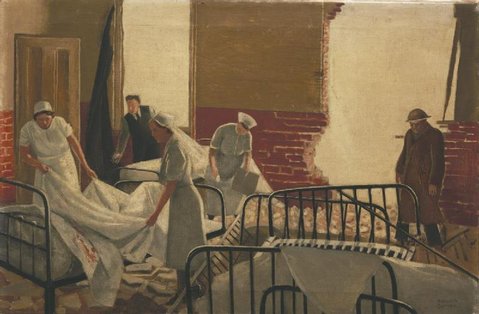
This is the X-ray Chekhov takes of 19th-century Russian intellectuals. And the shadow on the film says: Sanity is the original sin.
Pain is proof you’re alive. Numbness is death
Sometimes I think Ward No. 6 should actually be called Ward No. 1. Because after you read it, you understand — this ward isn’t ranked sixth. It’s ranked first. It’s inside your heart. Inside your daily choices. Inside every moment you keep your mouth shut.
You believe you’re standing on the free side of the bars. But really, you’re just living in a better-decorated ward. The walls are painted white. The guards wear suits. The club has been replaced by a gentle phrase: “Don’t overthink it.”
More than a hundred years have passed. Guess what? This ward is still here. Only now the windows have nicer frames. The guards are more polite. And “normal” is harder to spot than ever.
Open Ward No. 6. You only need a hundred pages. But after you close it, you’ll find that one question follows you everywhere:
Do you really mean the things you say — or have you just not been sent there yet?