Reading The Razor‘s Edge made me slowly shift from envying Larry to doubting him. This time, Maugham wasn’t just an observer on the sidelines. He seemed to be projecting some desire of his own onto Larry, something he couldn‘t say out loud. What was that desire? I still hadn’t figured it out after I turned the last page.
Larry watched a friend die saving him. After he got back to Chicago, he couldn‘t live a normal life anymore. His fiancée Isabel wanted social events, jewelry, and a decent house. She couldn’t understand why he had to go “idle.” They broke off the engagement. Larry went to Paris, then to coal mines, farms, India, and finally came back to the United States to drive a taxi. Maugham doesn‘t make him a saint. Larry is always gentle, polite, even a little dull. He just doesn’t do what other people think he should do. And that kind of uncooperativeness confused the people around him more than any outright rebellion.
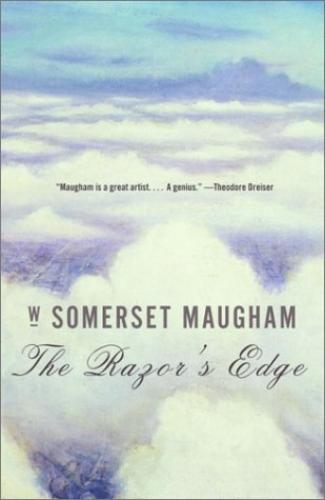
When I read about Larry, I envied his almost natural determination, the way he never felt the need to explain himself to anyone. But then uneasiness crept in. What did his pursuit actually get him in the end? On a mountaintop in India at sunrise, he experienced some kind of mystical enlightenment, a feeling of oneness with everything and spiritual freedom. But after he came back to ordinary life, he was still lonely. He came and went as he pleased, carried no luggage, and didn‘t seem to care about anyone. Was that relief or escape? Maugham doesn’t give an answer — and that‘s exactly the most honest thing about The Razor’s Edge. It doesn‘t arrange a bright happy ending for spiritual seekers the way so many novels do.
The title comes from an ancient text: “The edge of a razor is hard to cross; thus the wise say the path to salvation is difficult.” Larry might have actually crossed over, but I care more about the people who stayed where they were. Isabel got everything she wanted, but she was hit hard by her daughter’s death in old age. Her uncle Elliott lived his whole life chasing invitations. On his deathbed, his biggest worry was that he‘d been left off the guest list for a party. Maugham writes Elliott brilliantly, with a warmth that’s almost cruel. He just shows you that everyone picks one way of living and then pays the full price for that way.
Reading this book didn‘t suddenly make me cheerful. On the contrary, it made me see more clearly that no matter which path you choose, there will be downsides. Larry’s freedom means giving up deep connections. Isabel‘s pragmatism always comes weighed down with material things and vanity. Neither side of the razor has a perfect place to stand. The so called path to salvation might not be the big moment of crossing the blade, but the day to day realization that there is no absolute salvation, and yet you still have to live.
At the end, Maugham says with a mocking tone that everyone in the story got what they wanted — which is obviously the opposite of the truth. What really stayed with me was the narrator’s own position. He writes a version of himself into the story. As a writer, he understands everyone, but he can‘t truly belong to any kind of life. He admires Larry, but in the end he doesn’t take that path himself.
After you cross the razor‘s edge, there’s no flat, easy land of happiness waiting for you. It‘s still rough, lonely walking. And most people, including me, don’t even have the courage to try crossing. We read Larry‘s story like looking at a piece of clothing through a window that we can’t afford. We think it looks nice, but deep down we know we‘ll walk into the warmer store next door. That’s not weakness. It‘s just a choice. The important thing is not to pretend that you chose the road you didn’t take.
