When I was a kid, my mother made me dig a hole in the yard to cure my inability to sit still. It wasn’t for planting anything. I just dug randomly. It didn’t matter how deep I went. Then I filled it in and dug again. After half an hour I got bored and just squatted by the pit counting ants. Back then I didn’t know there was a punishment in the world called digging a hole, digging a five-foot deep hole every day under the sun without being allowed to stop.
Louis Sachar’s Holes is exactly that kind of punishment. A bunch of juvenile offenders get sent to Camp Green Lake in the desert. They’re supposed to be reformed, but really they just dig a hole every day. The warden says digging builds character. But every kid knows she’s looking for something. More than a hundred years ago, there was a teacher named Katherine Barlow. She fell in love with Sam, a boy who sold onions. Because of racist laws, Sam was killed, and Katherine turned into a cruel outlaw named Kissin’ Kate Barlow. After she died, her treasure was buried somewhere in the desert, and Camp Green Lake was built right on top of it.
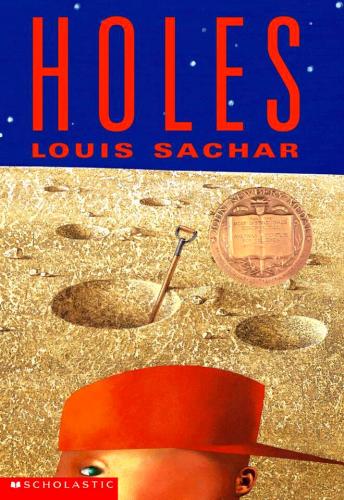
The main character is Stanley Yelnats. That name comes up over and over because the Yelnats family has been unlucky for generations, and it all traces back to Stanley’s great-great-grandfather who owed a pig to a gypsy woman. The curse has followed the family ever since. Stanley gets falsely accused of stealing a pair of shoes and gets sent to Camp Green Lake to dig holes every day. The first thing he digs up is a lipstick tube with the initials “KB” on it. He doesn’t know what it means, but you do. Sachar slowly weaves together three timelines, Katherine and Sam from over a hundred years ago, the outlaw Kissin’ Kate from fifty years ago, and Stanley in the present, like twisting a rope. Every time someone digs a hole, another piece of the truth comes up.
Halfway through, I realized the book is actually asking a question: can a family ever break a curse? Stanley’s great-great-grandfather said something that got passed down through the generations: “I promise to carry that pig up the mountain.” That’s not literal. It means that one person’s debt has to be paid by the people who come after. Stanley digs holes in the desert every day. He doesn’t know if he’s paying off the debt or just digging up what the debt even was.
There’s a kid in the book named Zero. His real name is Hector. He’s the quietest and most bullied kid at Camp Green Lake. He can’t read or write, but he carries Stanley for miles across the desert to find water when Stanley is dying of thirst. And Stanley teaches him to read. Two kids that the whole world thought were worthless find an abandoned boat out in the desert, which was Sam’s boat, and they drink from a spring, which was where Sam grew his onions, and they finally dig up the treasure chest. Right when the warden is about to catch them, a lawyer shows up and says Stanley has been proven innocent. He’s free.
But what got to me in this book wasn’t those coincidences. It was when Stanley and Zero were digging a hole and one of them got too tired to keep going, so the other one took over. They just took turns digging, because one person can’t finish a five-foot deep hole by themselves, but two people can. They just took turns digging, because one person can’t finish a five-foot deep hole by themselves, but two people can. I remember when I was a kid, I helped a neighbor boy move a really heavy cement slab. We were both out of breath and neither of us said a word. After we moved it, we just squatted on the ground and drank water. That kind of silent understanding is stronger than any big speech.
Sachar wraps up the curse pretty neatly. Stanley carries Zero up a mountain, and they put the lipstick tube back into the treasure chest on Sam’s boat, and that breaks the curse. The Yelnats family stops being unlucky, and Zero finds his own family. At the end, Stanley gains ten pounds after he gets home. His mom is really happy. Zero goes to school and starts in third grade.
The ending seems too perfect, but I didn’t think it felt fake when I read it. Because Stanley and Zero went through enough in that desert. They drank muddy water, they had yellow-spotted lizards all around them, they were covered in blisters and dirt. Sachar made them earn that ending. It wasn’t luck. They climbed up on their own.
After I finished the book, I squatted down on the kitchen floor that night to look for a chopstick I had dropped. When I squatted down, I thought about digging a hole, and I realized that the view from squatting is different from standing up. You notice the dust in the cracks of the floor tiles and the dirt under the cabinets. Stanley dug holes in the desert for so long. What he saw wasn’t the treasure. It was the sand underneath the sand. Every shovel was the same, but every shovel was different. What he learned wasn’t “never give up.” It was that one shovel after another, just the digging itself, is already a way of living.
