A child makes a small mistake and suddenly says: “I can’t do it.”
You begin by encouraging them. Praise them and tell them how smart and wonderful they are. But when the next difficulty comes, their confidence disappears again.
Because real confidence isn’t built by constant praise. Children build it step by step. They face small failures and frustrations. Then, they start to believe, “I can actually handle this.”
Sometimes, a child who looks unconfident is missing something else. It’s emotional safety.
Things parents say that destroy confidence
| What parents say | What the child may hear |
| “It’s not that hard. Just try again.” | “You shouldn’t think this is hard.” |
| “You’re so smart. You just didn’t focus.” | “You didn’t try hard enough, so it’s your fault.” |
| “I believe in you. You can do it.” | “If you fail, I’ll be disappointed.” |
| “Other kids can do it. So can you.” | “You’re not as good as others.” |
| “You’re great. This little thing won’t stop you.” | “You shouldn’t be struggling with this.” |
| “You did it so well last time.” | “Why are you doing worse now?” |
| “Mom believes in you. Just try a little harder.” | “You’re still not trying hard enough.” |
| “You’re a good kid. Don’t say that about yourself.” | “Your feelings are wrong.” |
How Low Confidence Shows Up in Daily Life (and What Doesn’t Boost Confidence)
Not every child says “I can’t do it.” Sometimes low confidence looks like:- Quitting a game after losing once
– Refusing to try anything new unless they already know they’ll succeed
– Crying or getting angry over small mistakes
– Constantly comparing themselves to other kids
– Saying “never mind” before even starting
– Needing repeated reassurance before doing simple things
If you see these signs, it’s not about laziness or lack of effort. It’s about a child who hasn’t yet learned that mistakes are safe.
Why encouragement alone doesn’t build confidence
When my son was little, he got stuck halfway through building a Lego set and said, “I don’t know how to do this.” I said, “You’re so good at this. You can figure it out.” He put the Legos down and never touched it again.
That moment stayed with me. I realized something important. When we tell a child they’re “smart” or “great,” they might worry. Next time they face a challenge, they could think, “What if I can’t do this? Does that mean I’m not really smart?” The “let me try again” thought gets pushed aside.
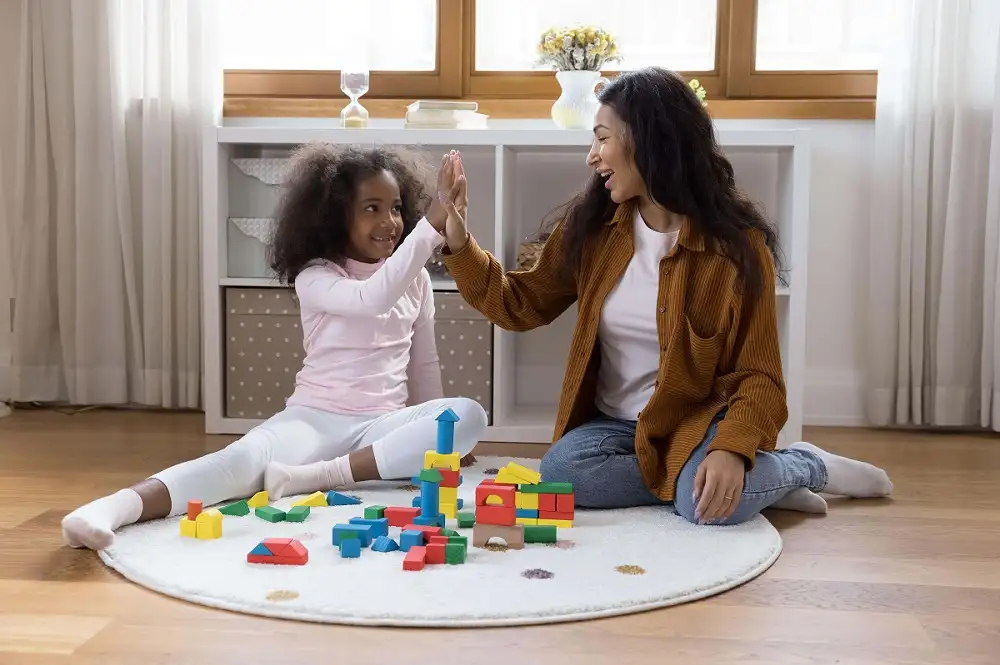
A lot of parents face the same struggle. You praise your child often, but they still shrink back when things get tough. Praise and encouragement can lift a child’s spirits right away. However, those feelings often don’t become deep beliefs. Children need more than being told “you can do it.” They need to experience it and prove it to themselves.
Here‘s something from psychology that helps explain why. Confidence often comes from a child getting through something that didn’t go smoothly. A math problem they got wrong and then fixed. A block tower that fell twice before it stood steady. Those small moments leave a mark: “I can handle this kind of thing.”These small experiences are what gradually boost confidence in children.
Praise itself isn’t wrong. When your child does something well and you feel happy for them, that’s fine. It’s just that we might think of praise as a small sign along the road — it points the way, but it can’t walk the path for the child.
What Actually Helps Boost Confidence in Children
Here are things you can actually do. Pick one or two that feel right for your child.
1. Let them solve small problems on their own
When your child says “I can’t,” don’t jump in right away. Wait five seconds. Let them sit with the problem. If they still struggle, ask: “What’s one small part of this you can try?” Not to fix it for them. To let them feel the shift from “I can’t” to “I’ll try one thing.”.
2. Teach them what to do after a mistake
Confidence isn’t about never failing. It’s about knowing what to do when you fail. Teach your child a simple recovery script: “That didn’t work. Let me try something else.” Say it out loud when you make mistakes too. Children learn from what you do, not what you say.

3. Play games where losing is normal
Board games are perfect for this. When your child loses, don’t say “winning doesn’t matter” — because to them, it does. Just set up the pieces and ask: “Want to play another round?” That’s it. No lecture. Over time, they learn that losing isn’t the end. It’s just part of the game.
4. Notice effort, not just results
Instead of “You’re so smart,” try: “I saw you tried three different ways before you figured it out.” Instead of “Great job,” try: “You kept going even when it got hard.” This is not empty praise. It’s a real observation. And it teaches children that effort is something they can control.
- Let them teach you something
Switch roles. Let your child explain something they know and you don’t. A video game move. How to fold a paper airplane. A fact about dinosaurs. Ask real questions. When they explain it to you, they hear their own competence. That feeling is more solid than any compliment.
- Build a tiny daily habit of noticing what went right
At dinner, ask: “What’s one small thing that seemed like it might go wrong today, but turned out okay?” It doesn’t have to be deep. One sentence. The benefit is subtle. Children gradually learn to notice the small, real moments that are truly good.
Some children don’t lack confidence; they lack emotional safety
Let’s go back to the opening line.
Sometimes when a child says “I can’t do it,” it’s not really about their ability. They might be wondering: “If I mess up, will you still feel the same way about me?”
When a child thinks they must perform well to gain approval and love, they become cautious. No trying means no failing. No failing means no losing that love.
So a hidden path to building confidence often involves more than just praise. It also involves letting the child feel: you mess up, I’m still here. You cry, I’m still here. You say “I can’t,” I’m not going anywhere.
That sense of “you’re here no matter what” gives a child the courage to take risks out in the world. Confidence isn’t about believing you’ll never fall. It’s about believing that if you fall, someone will help you up — or that you can get up yourself.
That might be the best thing we can give our children.