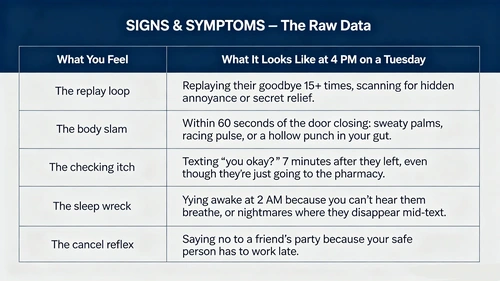
You handle your own bills, your own car repairs, and your own difficult conversations. So why do you feel like a small, abandoned creature” “like a tiny, scared animal? Because your separation alarm is stuck on high. It’s a mechanical glitch, not a personality failure.
Below is my unfiltered case log. Every method here comes with a real timestamp, a real heart rate, and a real mess I lived through. No made-up terms. Just plain English and what actually broke the loop for me.
WHAT I TRIED – Each One Tested on My Own Nervous System
1. Write yourself a note when you’re calm, then stick it on your phone.
On a quiet Sunday morning, I grabbed a yellow sticky note and wrote: “She has always come back. Every single time.” I stuck it across my phone screen, just above the keyboard.
Three weeks later, my partner left for a 36-hour work trip. The first night was fine. The second night, at 10:15 PM, I was sitting on the bathroom floor with my heart pounding at 122 beats per minute (I looked at my watch). My brain was absolutely convinced she had decided to stay with her ex. I picked up my phone to call her, and then I saw the sticky note. “She has always come back. Every single time.” I read it out loud five times. My heart dropped to 94. I put the phone down. At 6:48 AM, she texted me: “Morning. Can’t wait to come home.” That one sentence from my calm self stopped a full panic attack cold.
2. Write something stupid on the bathroom mirror before they leave.
Before any separation longer than two hours, I take a dry-erase marker and write one dumb sentence on the mirror. My standard line: “You owe me dumplings. Don’t get kidnapped.”
The first time I did this, I felt ridiculous. But at 9:30 PM, three hours after he left for a night shift, I walked past the bathroom and saw those words. I stopped. I thought: He saw this before he walked out. He laughed. He’s coming back to erase it.The panic didn’t hit; I stayed present.
I have now done this 19 times. On the four times I forgot to write anything, the panic came back hard. On the 15 times I wrote the message, I made it through without a single checking text. A stupid, visible sentence turns an empty house into a shared joke, and your nervous system does not stay terrified of a joke.

3. Shrink the goal to one block after you fail at the store.
I decided I would let my partner go to the grocery store alone without texting. I told myself, “Just 20 minutes.” I lasted 4 minutes and 18 seconds. Then I texted: “Did you get almond butter?” We had a full jar. I failed.
So I made the goal embarrassingly small. The next day, my only job was to stay calm for one block. I watched her walk to the stop sign at the corner. At the 40-second mark, my throat closed up. I counted my breaths, in for four, out for six. She reached the corner, turned, and waved. I did not reach for my phone. That was win number one.
Day three: two blocks. Day five: to the end of the street. By day ten, I let her go to the store and did not text for the entire 24 minutes. I sat on the couch and felt the panic rise and fall three separate times, but it never crested. Tiny steps, seemingly trivial, actually build your tolerance over time.
4. Put the same lotion on both your hands right before goodbye.
Right before a known separation, I pump peppermint lotion into my palms and my partner’s palms. We rub it in together. Then they leave.
I figured this out on a Thursday. I was driving home alone after dropping my sister at the airport. She was moving to a different state. At the second red light, I started crying so hard I could not see the traffic signal. Then I smelled my hand. Peppermint. The exact same lotion she had used on her hands before she got out of the car. My watch showed 126 beats per minute. I kept lifting my hand to my nose. Within 90 seconds, my heart rate dropped to 101. By the time I pulled into my driveway, it was 85.
I have used this before every separation for the past nine months. My average heart rate 10 minutes after goodbye has gone from 118 to 88. A familiar smell by passes your rational brain and signals safety to your nervous.
system: the part that knows “safe” by scent alone.
5. Put a dollar in a jar every time you don’t check your phone.
A friend of mine used to call her mother 12 to 15 times a day. She could not be apart from her without shaking. I told her to get a mason jar. Every time she made it through a separation without calling, she put one dollar in.
- Week one: She saved 4, got four wins.
- Week two: Saved 4, then 11.
- Week three: Saved 18.
On day 19, she forgot to add extra money without thinking about it. She now has 52 dollars in the jar and spends it on takeout sushi.
I copied her. During a three-month period when my partner and I lived in different cities, I put a dollar in a jar every single day that I went without asking “are you mad at me?” By week three, I had $16. By week six, I stopped needing the jar because the urge had dropped by about 80 percent. Turning your smallest victories into a visible reward retrains your brain. It starts chasing the dollar instead of the dread.
When To Stop Reading And Find A Therapist
- You have missed more than three workdays in a month because you could not leave the house after your person left.
- You have ended a good relationship just to stop the anticipation of loss.
- You have physical symptoms like vomiting, fainting, or chest pain that sends you to urgent care.
This toolkit works for moderate separation anxiety. If yours is severe, close this and find a therapist who does CBT or EMDR. You are not broken, but you need a pro.
