If confidence could be built through praise alone, a lot more girls would believe in themselves. She may hear others praise her for being smart, talented, lovely or capable, yet sit there convinced she is not good enough. She can earn excellent grades, make the team and win compliments, but still fear falling behind her peers.
One thing many parents notice is that girls who struggle with confidence are often incredibly hard on themselves. They replay mistakes long after everyone else has forgotten them. They compare themselves to classmates who seem more talented, more confident, or more successful. Sometimes they hear praise from the people around them and still quietly think, “If they really knew me, they wouldn’t say that.”
That is why confidence is rarely built through praise alone. A girl who already doubts herself does not need bigger compliments. She needs words that help her see herself more clearly. The good news is that small conversations can have a lasting impact. The right words won’t erase self-doubt overnight. Instead, they help her build a stronger mindset—the belief that she can handle challenges and bounce back from setbacks. Most importantly, they keep her moving forward when things get tough.
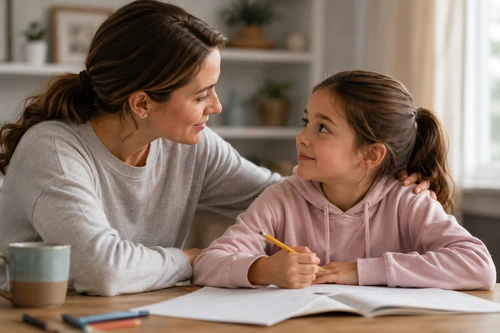
What to Say When She Feels She’s Not Good Enough
Low confidence is not always a sign that a girl thinks poorly of herself. Sometimes it is a sign that she expects perfection from herself. One evening, a ten-year-old girl sat at the kitchen table staring at the same math problem. She rubbed the eraser so hard that the corner of the worksheet began to tear. She erased and revised the same math problem over and over, leaving pencil shavings scattered across the surface. Eventually she set down her pencil and muttered, “I’m just no good at this.”
Most parents would rush to comfort her with lines like “Don’t say that” or “You’re so smart”. These words come from a kind heart, but they fall on deaf ears when a child is overwhelmed by frustration. At that moment, she only focuses on failing to meet expectations, not her strengths.
Try saying:
“You kept going even when it got frustrating.”
“I noticed you didn’t give up after making a mistake.”
Why It Works
From an early age, one thing I’ve noticed is that many girls are far harder on themselves than the adults around them. A teacher may forget a wrong answer by the next lesson. The girl who gave it often remembers it for weeks. A small slip-up, a wrong answer or an underwhelming result can make them question their own value. Vague praise has little effect here. A child who already feels defeated will easily brush off remarks like “You’re brilliant”. Observations focused on her efforts feel genuine. They do not dismiss her feelings, but remind her of undeniable truths: she is trying, she has not given up, and she keeps pushing forward.
According to psychologist Carol Dweck, children are more willing to take on challenges. This happens when adults focus on their effort rather than results. They learn that abilities can be developed over time, rather than being fixed from birth. This mindset builds steady, long-term confidence far better than empty compliments.
Tiny Reminder: What a child needs most is not to be told she is wonderful, but to have her hard work truly seen.
What to Say After She Makes a Mistake
Most girls are not devastated by mistakes. They are devastated by what they think the mistake says about them.
Last summer, I attended a student performance at a community hall. After the show, a girl walked out from backstage twisting the folded event program in her hands. By the time she reached the parking lot, the paper was covered in creases, clutching her event program tightly. Her mother walked beside her, and neither said a word all the way to the parking lot. Just before reaching the car, the girl whispered, “I knew I wouldn’t get picked.” I later learned she had auditioned for a solo singing part. She practiced diligently every day after school for weeks, so the rejection was disappointing. What troubled her most, however, was the self-doubt that followed.
Try saying:
“It’s okay not to know the answer yet.”
“Most people need a few tries before they figure this out.”
“Getting stuck doesn’t mean you’re doing it wrong.”
Why It Works
For many children, the hardest part of failure is not the event itself, but the self-criticism that follows. They tend to equate doing something poorly with being a failure as a person. Many parents notice the same thing: when kids are trapped in shame and regret, their brains emotions over problem-solving. That is why advice often lands poorly in such moments. She needs to feel understood.
When you acknowledge her disappointment, she feels heard. If you then help her separate a single incident from her identity, she will recover much faster. She comes to understand that failure is an experience, not a label. One mistake can never diminish her worth, nor limit what she can achieve down the line.
Tiny Reminder: Help her understand this: you may make mistakes, but you are not a mistake.
What to Say When She Doubts Herself
Self-doubt has a terrible habit: it erases evidence.
A friend’s daughter was preparing for a school presentation. The night before, she was practising her speech at the table. Halfway through practice, she slid her note cards across the table. One fell onto the floor. She stared at it for a second and left it there. “I’m not going to do this,” she said. When asked why, she replied, “I’ll mess it up.” Just a few months earlier, she had gone to summer camp completely on her own. The year before that, she had learned to ride a bike. She had overcome plenty of scary challenges already, yet those past victories slipped her mind when faced with something new.
Try saying:
“You don’t have to finish it perfectly to make progress.”
“Every time you practice, you’re building the skill a little more.”
Why It Works
Psychologist Albert Bandura found that confidence grows through experience. Children believe they can do hard things when they’ve done hard things before. It comes from personal experiences that prove to yourself: “I can really do this.” Many parents tell nervous children to “Believe in yourself” or “You’ve got this”. These are well-meaning words, yet they can feel abstract to someone stuck in self-doubt. What she lacks most in that moment is the very sense of belief others urge her to have.
Guiding her to revisit past successes works far better. Memories of learning to ride a bike, delivering a speech or making new friends serve as solid proof. She stops merely hoping she will succeed, and recognises: I got through all those scary moments before, and I can do it again.
Tiny Reminder: True confidence does not mean never feeling afraid. It means knowing you can keep moving forward, even when fear is present.

Final Thoughts
Confidence does not mean a child will never feel scared, never fail, or always excel at everything. It is an inner conviction: even when things do not go as planned, I can learn, adapt and keep moving ahead. You do not need a long, inspiring speech to lift a girl out of self-doubt. More often, it is enough to let her feel understood, seen and accepted.
Many people assume confidence grows from praise. In truth, it takes root in quieter moments. It happens when she feels heard after a setback and accepted despite mistakes. Gradually, she discovers how brave and resilient she truly is. Parents’ words hold immense power. A single sentence cannot change a child overnight. Instead, everyday conversations slowly become her inner voice. So next time a girl loses faith in herself, there is no need for rousing speeches or perfect answers. Sometimes the simplest words carry the greatest strength.
Sources Referenced
Dweck, Carol S.
Mindset: The New Psychology of Success
Bandura, Albert.
Self-Efficacy: The Exercise of Control
Frequently Asked Questions
- Does praising a girl help build confidence?
Praise can help, but the type of praise matters.
Research suggests that praising effort, persistence, and courage is often more effective than praising intelligence or talent alone. Children who hear comments such as “You kept trying” tend to develop more resilience than children who only hear “You’re so smart.”
- Why does my daughter have low confidence even though I encourage her?
Many girls are naturally self-critical.
They may compare themselves to classmates, focus on mistakes, or set unrealistically high standards for themselves. Confidence is not built through encouragement alone. It also develops through experiences of overcoming challenges and learning that mistakes are a normal part of growth.
- How can I help my daughter believe in herself?
One of the most effective strategies is helping her remember challenges she has already overcome.
When she doubts herself, ask questions such as:
- “Have you faced something like this before?”
- “What helped you get through it?”
- “What would you tell a friend in the same situation?”
Past successes provide concrete evidence that she is capable, even when she does not feel confident in the moment.
- Can the right words really improve a girl’s confidence?
Not overnight.
A single conversation rarely changes how a child sees herself. Confidence usually grows through hundreds of small interactions over time. The words you use today may become part of the way she talks to herself tomorrow.
That is why consistent, supportive conversations often matter more than the occasional motivational speech.
