This is not a book you can breeze through. It took me nearly three weeks to finish—longer than I expected. But the more I read, the more I appreciated it; no wonder Bauman called it his favorite work.
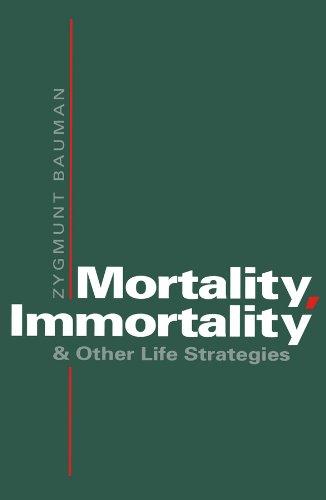
Do we fear death? It seems we do, yet it also seems we don’t.
Do we fear the dissipation of consciousness, or do we fear living a life that leaves no trace? Working tirelessly, cultivating relationships, chasing meaning—aren’t we all just seeking solace for a life that will eventually fade away?
Bauman pinpoints the crux of the matter: what we fear is never death itself, but the end of meaning. We fear that a lifetime of effort will come to nothing, that we will be forgotten as if we had never existed, and that our unfulfilled wishes and unspoken affections will ultimately vanish into thin air.
While reading this book, I repeatedly found myself in a state of flux: I’d think I’d grasped it, only to be plunged back into confusion; just as I’d made sense of a concept, the next page would blur it all again. At first, I suspected it was my own fault, but the more I read, the more I felt that this sense of instability was an experience the book deliberately sought to create. Bauman constantly interprets the same concept from different angles, overturning the understanding I had just established. This process of confusion is much like death itself—uncomfortable, yet it is precisely this discomfort that made me feel I was truly engaging with the text.
This sense of confusion is, in fact, the true state of modern life.
What Bauman is truly concerned with is: How does modern society deal with death?
We hand it over to hospitals, institutions, insurance, and procedures, making it disappear from daily life. Yet death has not gone away; it merely exists in a different form: as a responsibility that has fallen back on each individual. You are responsible for your health, your lifespan, your choices, and your failures. Thus, fear is no longer a fleeting emotion but becomes a persistent structural reality.
One of my favorite concepts is this: in modern society, the fear of death has been privatized. In ancient times, death was no different from daily life; in the Middle Ages, religion took on the burden of death; but in the modern era, death requires each of us to process it alone. In Bauman’s words: “It has become a major scandal, a resolute negation of everything, a reproach and a challenge.”
At this point, I actually feel a bit relieved. It’s not that I’ve suddenly come to terms with it, but rather that I’ve realized this era is all too skilled at making us bear everything alone.
Within this structure, people have developed various “life strategies.” Work, planning, consumption, self-discipline, intimate relationships—these everyday arrangements, seemingly unrelated to death, all attempt to offset a deeper sense of unease. They are neither hypocritical nor futile; they simply can never be fully effective. Bauman does not mock these strategies; on the contrary, he makes us realize that it is precisely because they are insufficient that we are so exhausted.
We are required to take responsibility for the finitude of life. You must be healthy, successful, and leave a mark—yet no one tells you that accepting the inevitability of loss itself is also a form of courage in life.
Bauman says that every era’s attitude toward death is a mixture of fear, submission, despair, and reluctance. The coping mechanisms we rely on to survive may never truly conquer death, but it is precisely this inadequacy that gives life its weight.
Are you afraid of death? I admit, I am particularly afraid of it. Waking in the middle of the night, the thought that one day I will vanish completely—the sense of emptiness and the fear of the unknown—keeps me tossing and turning. When someone passes away suddenly, or in news stories about strangers, death appears frequently in my field of vision. A friend once told me that sometimes, when she thinks about the day she too will face this, she is so terrified she cries.
Most of us have felt this anxiety about death; we just don’t know how to face it.
Bauman said that we cannot define death, because it represents the ultimate void, the absolute nothingness. Perhaps death is not a problem that needs to be fully understood; our generation is destined to live without answers. We cannot eliminate fear, but we can allow this thought to exist—without immediately seeking meaning, and without forcing ourselves to be positive, just as long as we do not let fear turn into self-reproach.
In an era that no longer teaches us how to face death, feeling afraid is itself proof that you are living life with intention. When meaning is temporarily absent, gently setting the question aside is, in itself, a way to keep living.
If you, too, have ever been startled by thoughts of “the end” in the dead of night, this book will not offer you empty platitudes. It will give you a mirror—and a profound sense of courage.
