I used to have a hard time reading Sagan; I always felt her stories moved too slowly, and her characters were too lost, fragile, and lonely. The people in her stories were excessively “imperfect,” even going so far as to challenge my moral boundaries at times. I knew she was a brilliant, sensitive, and deeply moving writer, but for a long time, I simply couldn’t get into her work. Even after forcing myself to read two of her books, I still couldn’t truly appreciate her genius. It wasn’t until La chamade came along that I suddenly “saw” Sagan, and I felt compelled to run toward her without hesitation.
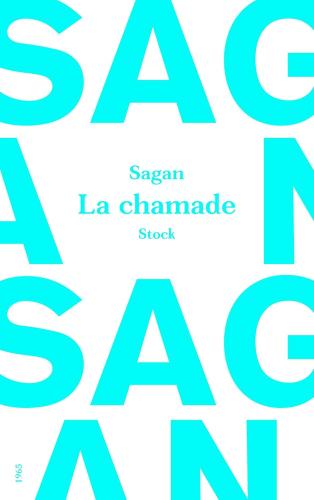
In truth, I envy and yearn for the steadfast love and passion shared by Lucile and Antoine, yet I also feel heartbroken for Charles. What a remarkably level-headed person he must be to handle everything with such composure.
This novel continues Sagan’s signature themes: love, confusion, and the existential void. Only this time, the protagonist she portrays is acutely aware of her own descent into ruin—yet it is precisely this lucid descent that creates the most poignant contradiction.
As I read, I kept wondering: Can love serve as the sole spiritual salvation in our distorted lives? When I was young, I firmly believed that love could transcend everything and stand above all else. Sagan offers a pessimistic yet reasonable answer, yet she renders it so dreamlike, beautiful, and deeply moving.
Lucile lived a life of luxury and idleness with the wealthy Charles. At a dinner party, she met Antoine, a publishing editor, and after falling into a feverish passion, she chose to leave. But just six months later, the passion faded; she grew weary of the meager and monotonous life and ultimately returned to Charles.
Antoine and Passion
In La chamade, she uses the changing seasons—spring, summer, and autumn—to depict the emergence, frenzy, and eventual end of a Parisian romance. Emotions shift with the seasons, yet the four seasons of love know no winter.
“Frenzy is the sound of a heart surrendering when it falls in love.”
The freedom she portrays is sensual, spontaneous, and even somewhat “irresponsible.” Her characters always possess a touch of reckless innocence and courage; their burning desire for life stems not from rational calculation, but from the instinctive impulses and temptations of existence.
Caught in the vortex where love and free will are inextricably bound, the refusal to possess or assume responsibility has become the guiding principle for the story’s protagonist—and indeed, for contemporary people—in their approach to love and marriage.
Charles: Another Philosophy of Love
When Lucile asked Charles to break up with her, he said to her:
“You must understand that I love you. Don’t think I’m seeking comfort from you, and don’t think I’ll forget you or replace you. I’m no longer at an age where I swap people around.”
He forced a smile.
“You see, Lucile, you will come back to me: I love you for who you are. Antoine loves you so he can be with you. He wants to be with you to find happiness—that’s how people his age think. But I—I want to make you happy, regardless of my own happiness. All I can do is wait.”
“Besides, he’ll end up blaming you—maybe he’s already doing so—blaming your nature: your hedonism, your carefree attitude, your excessive timidity. He’ll surely come to hate what he calls your weaknesses and flaws. He doesn’t understand yet that these are precisely what make a woman strong. It’s exactly this that men love in a woman, even if it might conceal the worst. He will come to understand this through you. He will come to know your joy, your wit, and your compassion—precisely because you possess all those so-called flaws. But by then, it will be too late. At least, that is what I believe. You will return to me. Because you know that I understand this.”
What kind of love is this? What kind of mature and composed man could utter such words!
Lucile—Laziness as a Way of Life
She still loved Antoine, but she no longer wanted to love him. She no longer enjoyed their life together, nor the reckless acts driven by a lack of money, nor the monotonous days. She preferred a life of leisure and idleness.
Lucile isn’t “acting out”; she is “choosing not to.” Sagan’s brand of freedom is sensual, spontaneous, and irresponsible. In the end, she chose comfort over passion—is that a form of clarity?
Opening this book on a journey, I’m still hit by that familiar, Sagan-esque scent—a blend of cigarettes, alcohol, and sleepless nights.
I’m utterly captivated by Sagan’s concise prose. This spirit of French literature never overuses adjectives, yet she makes me feel the burn of every glass of whiskey and the weight of every glance.
In real life, isn’t there a man like Charles in every young woman’s life? In the frenzy of love, do we ever think about the future? Most of the time, there’s no going back. In the reckless days of youth, who cares? Even if all that remains is melancholy…
When your younger self meets another man, your heart pounding wildly with passion, would you choose to break away from the one by your side and throw yourself headlong into the ecstasy of love? Or would you choose to restrain the flames of love rising within you, letting them die out bit by bit as they consume you?
She showed me that a soul can dance so lightly along the boundaries of morality. Reading her novels became the most rebellious thing I’ve ever done.
