I first read Animal Farm one afternoon when I had time to kill. The café was noisy. The table next to me was talking about stocks. I just had this little book — a little over a hundred pages, easy to flip through. Later someone came over, pointed at it, and asked what it was about.
I thought for about three seconds and said, “A bunch of animals overthrow the humans and then turn into humans themselves.” They smiled and said that doesn’t sound any different. And that’s exactly the point. You can guess the ending from the start. This book makes you watch it go bad, step by step, with your own eyes. And at every step, you think: Yeah, that makes sense, or I’d probably do the same thing if I were them.
That afternoon, I couldn’t stop thinking about the horse named Boxer. He’s not a bad horse. He works so hard, really believing he’s building a new world. I left the book in the café afterward. Not because I didn’t like it — but because it doesn’t belong on a quiet shelf. It belongs in the places where people lie awake at night.
The pig named Napoleon is more like a real politician than some real politicians.
You’ll recognize the animals in this book the second you meet them. There’s a pig named Snowball. He’s full of ideas about how to make the farm better — drawing up plans, leading meetings, arguing over every rule. The other pig is named Napoleon. He doesn’t talk much. But he has some mean dogs.
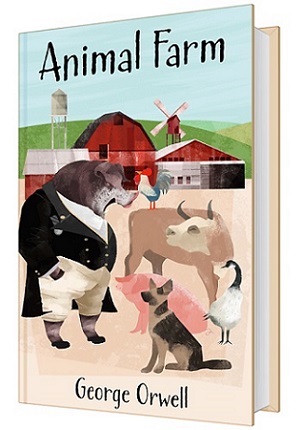
One day, Napoleon sets the dogs on Snowball and chases him off. No one ever sees Snowball again. After that, Napoleon starts drinking. Does business with the human farmer next door. Sleeps in a human bed. And issues a stream of orders — each one telling others what to do, none of them telling him what to do.
Then there’s the horse named Boxer — the biggest, the strongest, and the least suspicious. His only motto is “I will work harder.” He believes that sweat means loyalty, and loyalty means justice. George Orwell doesn’t write about tyrants throwing tantrums and smashing things. He writes about how power turns someone into a tyrant — and how every step of that process feels perfectly reasonable.
Nobody thinks he’s becoming worse. Napoleon himself believes he’s just making hard decisions. The farm gets more “efficient.” The slogans get louder. But nobody asks where all those extra bags of grain in the barn went.
The seven commandments shrink down to one — and you can watch it happen.
The old pig, Old Major, carves the Seven Commandments on the barn wall. The biggest line says: “All animals are equal.” The words are painted in white, visible from far away. But the animals can’t read. Only the pigs can. So whatever the pigs say becomes the rule. That’s just how it works.
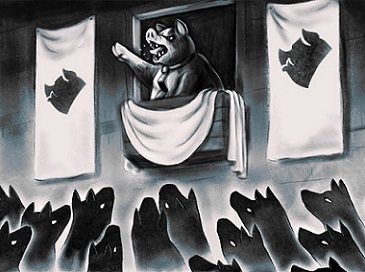
First, the pigs start eating apples and drinking milk, because “we need the strength to manage you.” Then they increase their own food rations, because “we work late at night.” Later, they start sleeping in beds. Some animals point out, “The Seven Commandments say you’re not allowed to sleep in a bed.” The pigs reply, “We’re not using sheets — so it’s not really a bed.”
Every change has a reason. Every change technically doesn’t break the Commandments — because the Commandments have been quietly edited. In the end, an old mare strains her eyes to read what’s written on the wall. The seven commandments have become one. Just one sentence left:
“All animals are equal, but some are more equal than others.”
That sentence didn’t appear out of nowhere. Each word was added slowly. Each revision went through a vote, and nobody opposed it. Sound familiar? You’ve seen it happen while scrolling your phone. While sitting in meetings. While listening to the news.
This book punches through the paper screen — and then you realize the room you’re sitting in has no exit.
It doesn’t belong on a shelf.
You might think a story about animals on one farm has nothing to do with you. You clock in at work. You scroll your phone after work. You’re not starting a revolution. You’re not electing a dictator.
So let me ask you something. Have you ever seen “we agreed to share it equally, but you took the biggest piece first”? Have you ever seen “the rules are written right there, but the power to interpret them isn’t in your hands”? If you’ve seen those things, then this book is for you.
George Orwell doesn’t ask for much — just that you hesitate for one extra second the next time you hear “we’ve all agreed.” The next time you see “for the greater good,” ask yourself what it really means. Orwell just took the play that human beings have performed over and over and squeezed it into a little over a hundred pages. You should pick it up — even if you think it doesn’t apply to you — because you’re already one of the actors.
Animal Farm isn’t long. You can finish it in an hour or two. But after you turn the last page, those characters won’t leave you. You’ll think of Napoleon at a meeting. You’ll think of Boxer when you see a hardworking coworker. You’ll think of that wall when you read some grand announcement.
George Orwell can’t give you an answer. He just hands you a pair of glasses. It’s easy to look away. But once you’ve read this book — it’s time to really look.