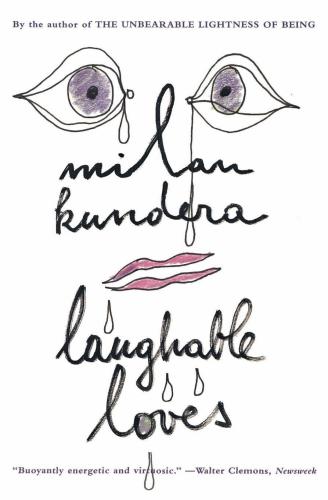
I have always liked Milan Kundera’s writing style very much. The calm, almost cold analysis, with a light sense of humor, can always make readers feel chills while laughing. Laughable Loves is his only collection of short stories, which consists of seven independent yet echoing stories. The “laughable” in the title is not humorous, but absurd: when love loses its seriousness and becomes a game, it will show a devilish smile. I saw an introduction on a reading website that accurately hit my feelings: “Welcome to this world without humor but laughter!” I did laugh out loud in many plots, but behind the laughter is something beautiful that is broken. So I laugh, but I’m not happy.
Each of these seven stories tears up a different aspect of love. Some start from a casual lie to see how it rolls into an uncontrollable disaster; some write about a middle-aged man’s philosophy of hunting for beauty, where chasing itself becomes the purpose, and it doesn’t matter who the target is at all; some let a couple play a role-playing game, but the game swallows the real person; some happen in the hospital lounge, where doctors take advantage of drinking to talk about sex and love, but the more they talk, the farther they go; some make a woman realize who she really loves after the death of her husband; some show a womanizer ten years ago now full of boredom and routine; and there is a young man who pretends to believe in God for love, only to get completely lost in lies. Seven paths point to the same question: If love is no longer serious and becomes a game, will it become the devil’s laughter? Kundera didn’t give the answer. He just threw the question to the reader and then turned away.
Among the seven stories, I was most impressed by “The Golden Apple of Eternal Desire.” Martin, a married man in his forties, took his friend “me” to hunt for sex. Martin has a theory called “tagging” and “hooking up”: record the women who can be seduced one day anywhere at any time. But the absurdity is that he doesn’t really care about success or failure. He loves his young wife, is afraid of her, worries about her, yet uses deception to maintain his marriage. He promised his wife to play cards with her every Saturday night, so on the way to hunt, he is determined to go home as soon as it is time. What on earth is Martin chasing? Not a woman, not sex, not conquest. There is a sentence that points to the essence: “Martin is already in a situation of absolute pursuit.” The pursuit itself has become the purpose, and it doesn’t matter who the target is. He is obsessed with this action, because the action is still there, which proves that the embers of youth have not been extinguished. This is a game that he knows is useless. The book then asks: “Is it because it is useless that I will refuse to play this game?” This sentence silenced me for a long time.
Another golden sentence that makes me chew over and over comes from the reasoning in the book: “Once people take something too seriously, then trust will push it to an absurd point.” This is almost the methodology of the whole book. The men and women in the story are either too serious or not serious at all, but either ending is absurd. The role-playing couple in “The Hitchhiking Game” is the best example: the boy really treats his girlfriend as a slut, the girl tries to play that role, and finally the boy says, “You have always been that slut.” The game engulfs real people. This is exactly what Kundera wants to warn us: be careful of role-playing and routines, which will destroy real connections.
For today’s readers, this warning is especially important. We display refined photos and elaborate profiles on dating apps. We learn various chat skills and push-pull speech techniques. We follow the preset scripts in love reality shows. We are more and more like the couple in “The Hitchhiking Game,” playing a “better self,” but gradually forgetting what the real self looks like. Kundera is not responsible for saving us. He is only responsible for letting us see the absurdity of this situation. Then you decide whether to continue playing or not.
When I close the book, it is an ordinary night outside the window. I know that tomorrow I will still go to work normally, talk to people normally, and face those true or false emotions normally. But at least, the next time I fall into a relationship struggle, I will think of Martin’s absolute pursuit, the crying girl in the hitchhiking game, and the assertion about trust and absurdity. Then I may laugh, not a happy laugh, but the kind of laugh that sees through something yet can do nothing about it.
Laughable Loves. I laugh, but I’m not happy.
