Late one night after working overtime, I collapsed on the couch and opened this book. An hour on the subway, thirty-something emails replied to, my boss tagged me three times in the group chat. I only planned to flip through a few pages before sleeping. Then I looked up and it was already 2 a.m. In the book, Maugham said something that made me sit bolt upright on the couch. He said that reading should be enjoyable. If a book makes you feel miserable, throw it away and pick up another one. I stared at that line for a long time. All these years, how many “must-reads” had I forced myself to slog through? How many times had I doubted myself in front of classics I just couldn’t get into? Maugham’s words were like a hand reaching into the trap of “you must finish this book” and gently pulling me out.
Maugham’s sharp tongue,specifically tearing apart the sacred packaging of classics
This book has three parts: how to read, how to read the classics, and how to view an author’s life. In the first part, Maugham dropped that line that made everything clear to me. Skipping is also a skill. No one says you have to read every single word of a book you don’t like.
The second part is the main event of the book. Maugham takes more than a dozen classics — War and Peace, The Red and the Black, Wuthering Heights — and dismantles them one by one. He dismantles the plot, dissects the characters, and uncovers what the author was going through. when they wrote that book. The section on Tolstoy stayed with me the most. Tolstoy was a great novelist, but as a husband and father, he was terrible. His wife had to hand-copy War and Peace six times, while he wrote in his diary that his wife didn’t understand him enough. Maugham’s tone when writing these things carries a kind of forgiveness that comes from understanding. Maugham seemed less interested in preserving literary greatness than in showing how messy the people behind those books really were.
Why Reading Felt Like Relief
The title of this book is Books and You. Late that night after working overtime, I opened this book not because I wanted to learn something, but because I wanted to escape for a while from that day filled with messages, emails, and meetings. Maugham understood this feeling. He said that in real life, there are too many unsolvable problems, too many relationships you can’t quite manage, too many grievances you can’t bring yourself to say out loud. You open a book. You step into someone else’s world. You go through their life with them. Then you bring those experiences back to your own world. Somehow, it makes your own life feel a little more manageable afterward.
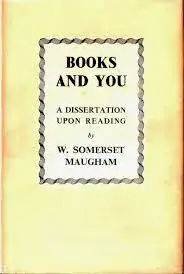
In the book, Maughamrepeatedly emphasizes one point: reading is a private experience. Just because someone else says a book is good doesn’t mean you have to like it. That’s completely normal. His purpose in writing this book is only to make you trust your own judgment. If you think a book is good, then it is good. It doesn’t need any authority to back it up. This sentence made me stand in front of my bookshelf for a long time. Maugham gave me permission: if you don’t like it, don’t read it. When it comes to reading, first and foremost, be true to yourself.
After reading this book, my bookshelf changed
After finishing this book, I did one thing. I took down the books on my shelf that I “should read” but had never actually read. I replaced them with books that “I want to read.” This action was small, but for me, it was a liberation. Maugham made me understand that the essence of reading is not completing a task. It’s recognizing parts of yourself in what you read. What you see in a book is not the author’s soul. Sometimes what stays with you in a book says more about your own life than the author’s.
This book itself is also a very easy read. Maugham’s prose flows as smoothly as his novels. Each chapter is short — perfect for reading one chapter before bed or flipping through a few pages on the subway. His sense of humor hides between the lines. It’s not showy, but when you read it, you can’t help but laugh out loud. This book won’t teach you how to read a hundred books a year. It won’t give you a must-read list. It won’t tell you what utilitarian benefits reading has. It only does one thing: it makes you believe again that reading is a joyful thing. Late that night after working overtime, I found my refuge. It wasn’t far away. It was right in my hands.
