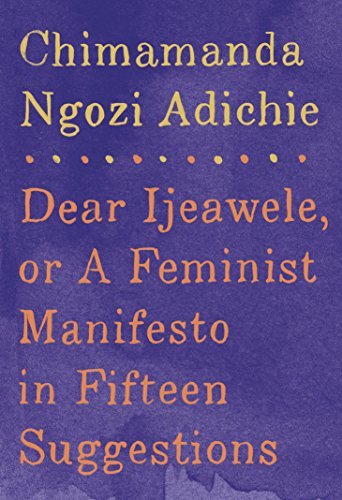
Dear Ijeawele isn’t thick. Fifteen suggestions. You could finish it in one afternoon.I picked it up in a bookstore. First page. Didn’t put it down. Not because Adichie said something earth-shattering. Because of what she said. I felt like I’d been waiting for years.
Your feminist premise should be: I am important.
She wrote that against the idea that “feminists must do something.” You have to believe your own existence matters. Before anything else. I read that page on the subway. Almost missed my stop. Not because it was too deep. Because it was too direct.
Growing up, all I heard: “you should be sensible.” “You should think of others.” “You should be good.” No one ever told me: first, I am important.
Don’t treat marriage as an achievement.
Read that sentence twice. First time: nonsense. Second time: it felt like nonsense because it’s so right — and we can’t live up to it.
How many female friends start getting asked “do you have a partner” after twenty-five? After thirty, everyone just expects marriage. Adichie says marriage is one part of life. Not the whole. Fine if you marry. Fine if you don’t. The real question: do we actually dare to think that way?
Don’t treat ‘like a girl’ as an insult.
She tells a story. Little girl runs fast. Someone praises her: “runs like a boy.” The girl doesn’t get it. She asks her mom: running fast is running fast — why does it have to be like a boy?
That reminded me of a dinner party. A boy knocked over a glass. Someone laughed: “Why are you as clumsy as a girl?” Whole table laughed. I didn’t. Because I knew what was hiding inside that smile. When a word gets used as an insult, the person being insulted isn’t the only one hurt. Every girl who hears that word knows she’s been placed on the side of “wrong.”
Teach her to love, and not just to be loved.
Adichie says a lot of girls are raised to be “good at being loved.” Learn to be considerate. Learn to accommodate. Learn to give. But not how to protect their own boundaries.For example,if your daughter doesn’t want her cousin touching her hair, support her saying “no.”
When I was little, a relative pinched my face. Smiled: “Auntie pinched you because she likes you.” I didn’t dare say it hurt. That would have been “rude.” I closed the book for a while on that page. Not because I was moved. Because I was angry. No one ever told me back then: I don’t have to let someone touch me if I don’t like it. No matter who they are.
Last letter. Adichie says: please give this book to your daughter. But more importantly, please live like this book yourself.I thought she’d write some big, grand conclusion. She stopped right there.She’s right.A girl doesn’t need to be lectured into a certain shape. She needs a model. An adult woman who lives uprightly in front of her. Words come second. What her eyes see — that’s what really matters.
