When I finished turning the last page of Eyeliner, I subconsciously touched the eyeliner at the end of my eye, which I drew casually this morning. The line was not smooth, and even a little crooked. Before that, I drew eyeliner countless times, just treating it as a ceremony to go out. I never thought that this ink line, which I regarded as a decoration tool, actually hid the civilization code spanning thousands of years.
Instead of using obscure academic language, Zahra Hankir took me into the lives of different people with the sharpness and compassion of a reporter. In a specific story, I suddenly realized that eyeliner is never a superficial makeup embellishment. It is a self-imprint engraved between people’s eyebrows and a silent declaration across races, beliefs and times.
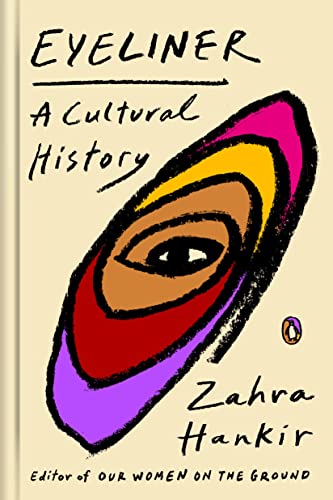
The process of reading this book is more like a journey of “breaking prejudice”. I originally thought that the history of eyeliner was just an iteration of the beauty trend, but I didn’t expect that Hankir could firmly bind this thin line with power, faith and identity. She avoided the hegemony of European and American beauty narratives and turned her eyes to those ignored corners.
I thought the Kohl eyeliner of ancient Egypt was just a decoration of the nobles, until it was mentioned in the book that its raw materials were mixed with lead, antimony and spices, which could not only resist the strong light of the desert, but also be regarded as a belief sustenance to “resist evil eyes”. Queen Nefertiti’s eyeliner is not so much a beautification as a visual expression of divinity and royal power.
The bar mitzvah eyeliner of a nomad girl in Chad is not a personal choice, but a recognition of the community; the eyeliner of Japanese geisha is hidden under the white powder, and the lines are sharp but not ostentatious. It is their awe of the profession and a secret space left for themselves in a programmed life. These details are the real records of Hankir’s visit to the world, which makes people convinced that eyeliner has never been simple.
When I closed the book, I couldn’t help recalling the past of drawing eyeliner, and finally understood the sentence in the book that beauty is never a uniform copy. When I was a beginner, I always practiced repeatedly with the tutorials of beauty bloggers, pursuing left and right symmetry and sharp lines. At that time, the eyeliner was my mask that I disguised, trying to integrate into the crowd by catering to secular aesthetics.
But after reading the story of the New York drag queen in the book, I completely changed my mind. Their eyes are exaggerated and strong, but they are never to please others, but to break the boundaries of gender and declare their own existence. This kind of perception does not arise out of thin air, but the vivid stories in the book slowly precipitate and ferment in my heart.
Hankir wrote in the book: Eyeliner carries the weight and the history of a thousand years, which is related to power, race, faith and community. I deliberately drew a horizontal line when I was reading this sentence and read it repeatedly. For a long time, women’s makeup has been labeled as superficial, and eyeliner has been misread, but no one can see the power behind it.
Ancient Egyptian women painted eyeliner to highlight their divinity and status and resist gender oppression; non-Western women adhere to their own eyeliner culture to identify with their own culture and resist aesthetic hegemony. These thoughts made me understand that eyeliner is never a simple tool to become beautiful, but a weapon for people to fight against mediocrity and stick to themselves.
What touched me most in the book was not the story of celebrities and nobles, but the bond between ordinary women and eyeliner. An old Lebanese woman insisted on drawing eyeliner all her life, even if her face was full of wrinkles and her life was poor. Her words moved me: Eyeliner is my respect for life. Even through hardships, I can still live elegantly and soberly.
This reminds me of my grandmother. In her old age, she would always gently outline the end of her eyes with an old eyeliner. At that time, I didn’t understand it. It was not until I finished reading this book that I realized that faint eyeliner was the old man’s love and persistence for life. This kind of resonance is the collision of real details and life experience in the book, which also makes me understand the value of this book.
Now, I pick up the eyeliner and no longer insist on drawing perfectly, but sketch at will. I know that this line hides the faith of ancient Egypt, the imprint of different civilizations, and my acceptance and love for myself.
The most precious value of Eyeliner is that it allows us to understand the weight of culture and the power of ourselves in a thin ink thread. May we all find our own “eyeliner”, draw from the soul, and live as we like.
