Imagine that a man in a washed-white uniform with hairy cuffs squatted by the tram track, staring at a few clusters of gray mushrooms with bright eyes, as if he had found a treasure hidden in the folds of the city.
This is Marcovaldo, the most untimely urban resident created by Calvino, and the lingering figure in my mind after reading Marcovaldo. After reading this book, I didn’t immediately think of any gorgeous comments. I just felt a softness in my heart and had an indescribable movement. I closed the book several times and couldn’t help thinking about whether we were all living in a hurry.
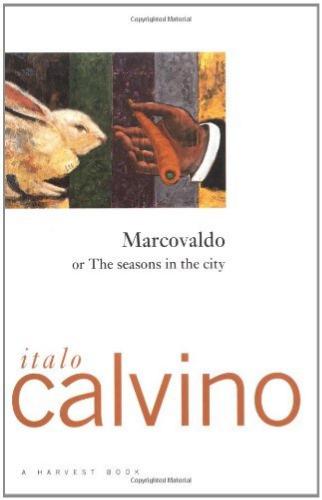
Most people are rushed forward by the neon lights and billboards of the city, busy making money and rushing on the road. No one would pay attention to the clusters of small mushrooms next to the tram track, let alone stop for a fallen leaf. But this poor porter is different. He always looks down for his own little beauty. This slowness made me see a lot of things that we ignore.
Calvino wrote about his life. There was no gorgeous rhetoric, but it was so fine that it could never be broken. Five years, twenty stories followed the cycle of spring, summer, autumn and winter. There were no big ups and downs, but each one made me sympathetic. I even think that if I were in his situation, living in a damp basement, and barely making ends meet with the money I earned, even a full meal that I can eat freely becomes a luxury, I would probably have been worn out by life long ago.
I seemed to be able to see that in the city in spring, Marcovaldo squatted on the roadside, brushing the dew-stained mushrooms with his fingertips. The gray-black fungus caps merged with the dark blue of his uniform. Behind him was a whistling tram, stirring a wind with the smell of soot.
In the summer afternoon, he chased a wasp across the asphalt road, and the sunshine pulling his shadow for a long time, sweat soaked his back, but he couldn’t stop the persistence in his eyes. The running figure was like a beam of stubborn light on the hot gray road.
In the autumn evening, he picked up chestnuts under the ginkgo tree in the park with his pocket. The golden leaves fell on his shoulders, in stark contrast to the tiredness on his face. The supermarket in the distance was brightly lit, and the goods on the shelves were full, but none of them belonged to this small worker.
Late at night in winter, he dismantled the billboard. The wooden boards were used as firewood, and the orange flame danced in the dilapidated stove, reflecting his wrinkled face. The neon lights outside the window were bright and extinguished, dyeing the night sky into an ambiguous pink-purple, but he looked at the false light, regarded the clouds as running sheep, and listened to the evening breeze as a natural whisper.
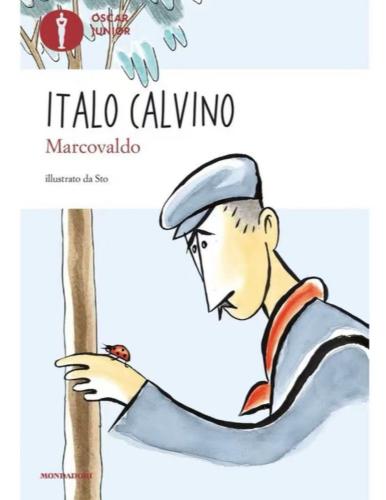
When I read these stories, I often laughed while feeling astringent. Marcovaldo is really poor, but he has never given up his expectations for good things. He would be overjoyed for a few clusters of mushrooms and treat each other gently for a stray cat, even if these beauties are worthless in the eyes of others. I suddenly felt that Calvino wrote not only about Marcovaldo, but also about each of us who ran around the city.
The colors in his pen, gray-black mushrooms, navy blue uniforms, and golden fallen leaves, is not deliberate embellishment, but the background of each of our lives. We are busy going to work, working overtime every day, busy dealing with all kinds of human affairs, busy chasing the so-called success, but we forget to look up at the moon above our heads, forget to pay attention to the fallen leaves on the roadside, and forget what we really want. Marcovaldo’s untimely is actually the most precious sobriety. He does not cater to worldly rules and does not compromise on a difficult life. Even if he is hit by reality again and again, he could still find the joy of living in a fallen leaf and a wisp of evening breeze.
We are always pursuing useful things, but we forget those seemingly useless fantasies and unrealistic expectations, which are the light that illuminates mediocre life. When the pages were closed, Marcovaldo’s figure still appeared in front of him. He squatted beside the tram track with light in his eyes shining.
I suddenly understood that life never needs to be so exciting, nor does it need to be so bright. It is enough to keep the tenderness of my heart and find my own little beauty in ordinary days.
