How can a person be sure their pain is worth remembering? Not the kind of complaint like “I’m so tired today” – I mean the kind that really gets engraved in your bones and turns you into a different person. You always feel it should have somewhere to go and become something: a poem, a revolution, or at least a listener. But most of the time it doesn’t.
Cyrus, the protagonist of Kaveh Akbar’s Martyr, is caught in exactly that problem. As a child, he watched his mother’s plane get shot down by the US military – the reason for her death was absurd: she was supposed to take another flight, but changed her ticket at the last minute. He grew up in Indiana, where no one around him knew any of this; his father never mentioned it, as if by not mentioning it they could pretend it never happened. But Cyrus remembers. He couldn’t tell whether he should be angry or sad about that – anger needs an object, sadness needs a ritual, and he had neither.
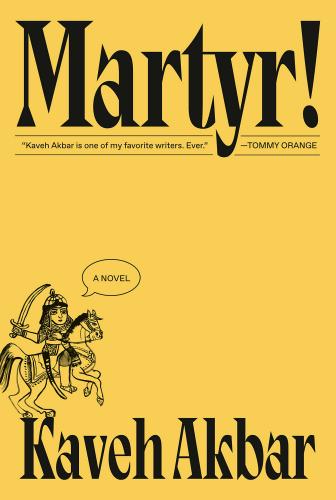
So he started drinking, ended up in rehab, and after getting out, became a poet. But he doesn’t write poetry for beauty; he writes to figure out one thing: what goes through the minds of those who choose to die, at the very moment of death. He studies martyrs – not soldiers killed on the battlefield, but people who actively walk toward death. He travels to New York to find an Iranian female artist dying in a hospital; she has painted a series about cancer and revolution, each painting screaming. He asks her, “Are you afraid of death?” She says, “What I’m afraid of is that after I die, no one will know that I was afraid.”
That sentence made me put down the book. I remember being sick and hospitalized once: I woke up in pain in the middle of the night and thought about calling a nurse, but I didn’t – calling wouldn’t stop the pain immediately. Still, the impulse to cry out made me realize I was still alive more than the pain itself did. That being afraid that no one knows I was afraid – that means I’m not ready to leave yet.
Cyrus sees a pigeon run over by a car in Central Park; another pigeon flies down and stands next to its companion’s body, not leaving. He stares at that pigeon for a long time, thinking it’s waiting for the body to get back up. Later he says it wasn’t the pigeon’s stupidity – the pigeon just couldn’t believe death could be like this: run over by a wheel, and then nothing left. I believe that image. When I was a child I had a cat; after it died, I kept its bowl and mat for a long time, always thinking it would come back. That’s not waiting for a miracle – it’s refusing to accept the ending of “nothing.”
In the end, Cyrus finds the female artist, but she doesn’t give him the answer. She says, “Your mother died, and you want her to be a martyr so her death wouldn’t be meaningless. But maybe her death was meaningless. The plane was shot down for no reason – it had no meaning. You spend your whole life looking for a meaning, and what you end up finding might be that there is no meaning.”
What’s most powerful about this book is that it doesn’t turn Cyrus into a hero. He doesn’t quit drinking, doesn’t write great poems, doesn’t find the answer that explains everything. What he does is begin to accept a fact: some things will never become meaningful, and you can only learn to live with them. Not by letting go – but by carrying them, and continuing to walk until you can’t carry them anymore.
I remember chatting with a friend once. She said that after her father died, she thought every day, “What if…” We were all silent for a while. Then she said: we know those “what ifs” are useless, but if we don’t think about them, it’s as if that person is really gone. Hearing that sentence, I remembered the way Cyrus stared at that pigeon.
Martyr is not a book that teaches you how to face death. It’s about how the living deal with a void – the void of “I can’t find the meaning.” That void is like the blank white canvas Cyrus sees in an art gallery; the security guard says it’s worth millions of dollars because it’s nothing, so you can imagine it as anything. But you know it’s nothing. And when you stand in front of it, all you can do is stand.
