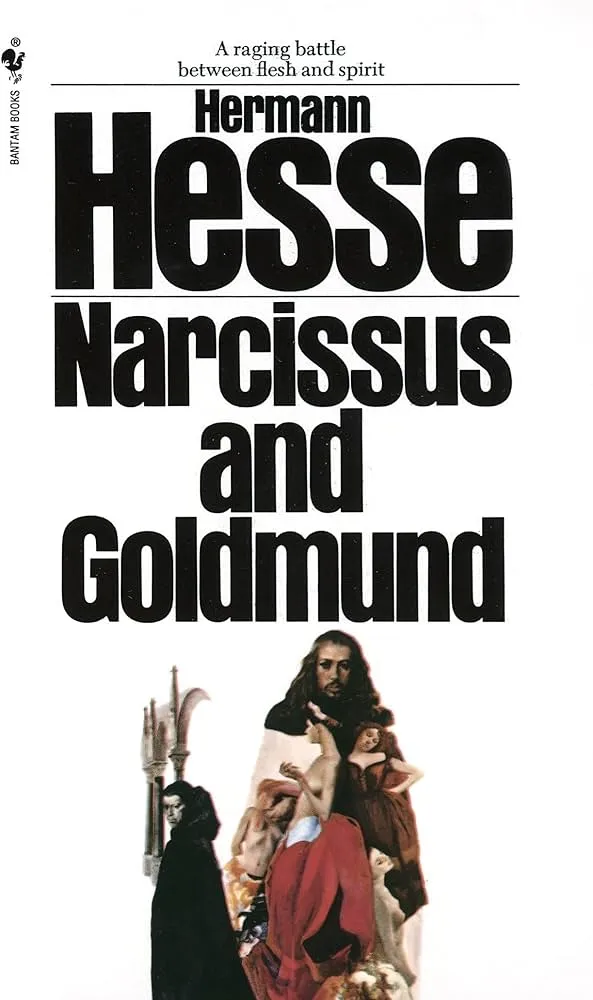
Before opening Narcissus and Goldmund, I thought I roughly knew what Hesse was going to write. A rational scholar. A sensual wanderer. Two lives. One theme. I thought it would be a book that explains things. A few pages in, I realized Hesse had no intention of explaining anything to me. He just throws two people in front of me and says: Look. They live.
Both paths lead to the end
Narcissus is the kind of person you both respect and fear. He became a monastery teacher at a young age. Every word he speaks is weighed before it leaves his mouth. He doesn’t need to go outside. The world inside books is enough for him to live several lifetimes. He can spend an entire morning working through a single Latin grammar problem. That kind of focus is itself a form of prayer. What Narcissus pursues is absolute spiritual purity—peeling away every worldly desire, layer by layer, until only reason and faith remain.
Goldmund is his complete opposite. This man smells the earth after rain. Notices the fine lines around a woman’s eyes. Remembers the taste of every good meal. After he leaves the monastery, he sleeps in barns, steals bread, falls in love with one woman after another. He runs from war. He dodges plague. Death brushes past his shoulder more times than he can count. He is afraid. But he never closes his eyes to the world. He imprints every scene along the road into his heart, then turns them into the face of the Madonna, the folds of an apostle’s robe, a gentle curve in a piece of wood.
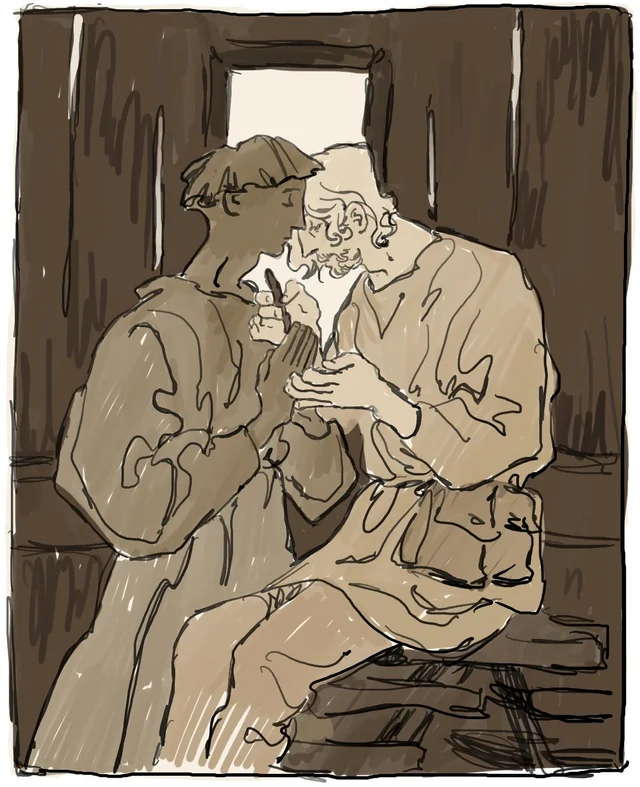
Before reading this book, I might have asked: who lived the right way, Narcissus or Goldmund? After finishing it, I understood. Narcissus lacks Goldmund’s warmth. Goldmund lacks Narcissus’s backbone. Together, they make one whole person.
Hesse’s pen is like a summer wind—gentle and strong at the same time
Reading Narcissus and Goldmund, I often forgot this was a novel written in the twentieth century. Hesse’s language is so clean. Clear like water running over stones. He writes about Narcissus in his monastery room, light falling through stained glass onto the pages of a book. That image is so still you’re afraid to breathe. He writes about Goldmund waking up in a forest, dew wetting his hair, sunlight shifting across his face through the leaves. You can almost feel that dampness and that warmth.
The atmosphere of this book is unique. It’s not a suspense story that makes you read straight through. Not the kind that chases you with a dense plot. It’s more like a long afternoon, sitting in the shade of a tree while an old man slowly tells you stories from his youth. Some of those stories are sweet. Some are cruel. Some stories make you laugh, others make you cry. You don’t need to rush. Time moves differently in this book, flowing gently rather than pushing you forward.
What moved me most was how Hesse writes about the act of artistic creation. When Goldmund carves wood, Hesse describes him running his hand over the grain, feeling the shape beneath the surface. He says every figure was already hidden inside the wood. Goldmund just removes the extra parts. I stopped reading there and thought for a long time. Creation isn’t making something out of nothing. It’s releasing something that already exists. That thought made me feel warm. It also made me feel grounded.
I started to rethink which half of myself I’m missing
If you’ve always had two voices fighting inside you—one telling you to live a stable, respectable, responsible life, and the other secretly envying those who dare to abandon everything and go somewhere far—then this book was written for you. Narcissus and Goldmund are not two fictional characters. They are the two forces inside every person. One wants to fly upward. One wants to dig deep into the earth.
The night I finished this book, I sat by the window. I looked out at the dark, heavy city. I thought about the words Goldmund says to Narcissus before he dies. He says he didn’t waste his life. He tasted every kind of pain. He carved every ray of light into his bones. As he spoke those words, Narcissus held his hand. That scholar who spent his whole life inside a monastery learned the final lesson from a vagabond. Living is not about choosing the right path; it’s about walking the path you chose all the way to the end—until something grows into your bones. That thing is called ‘spirit’ by Narcissus and ‘desire’ by Goldmund—Hesse says they are the same.