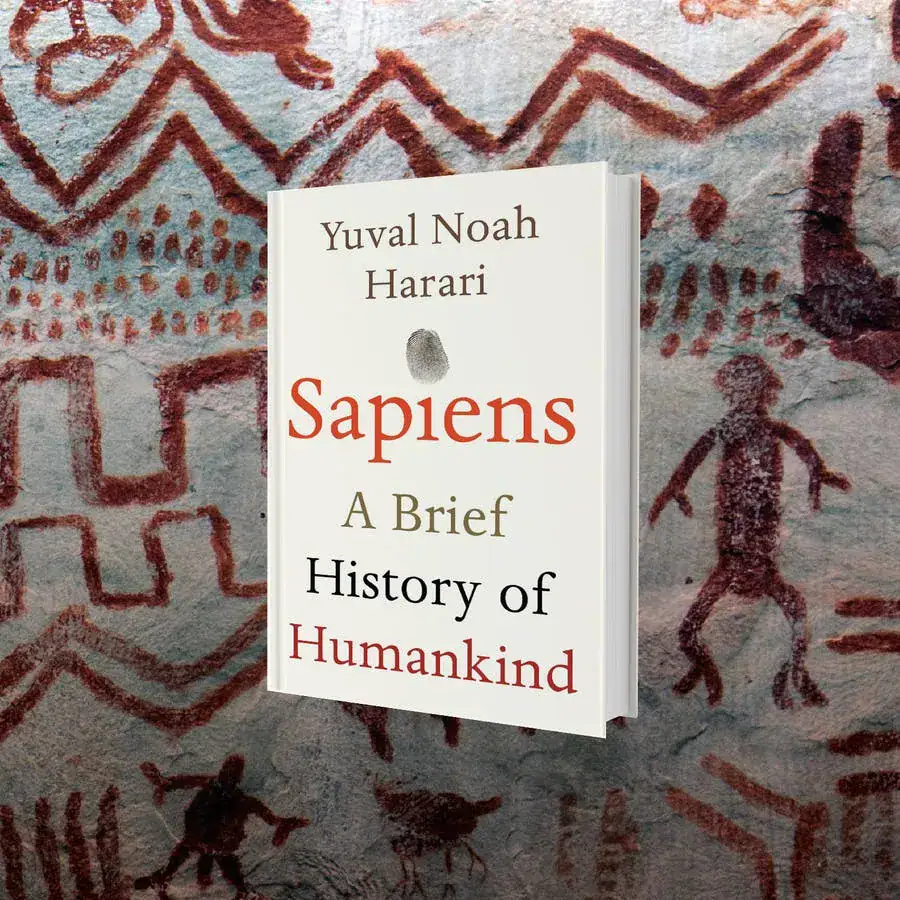
You might think a book called Sapiens—a history of humanity—would be one of those dry, heavy tomes stuffed with dates, place names, and archaeological jargon. But I promise you, Yuval Noah Harari’s Sapiens completely flips that expectation.
The first few pages pinned me to my chair. He asks you: one hundred thousand years ago, at least six different species of humans walked the earth. Why are we — Homo sapiens — the only human species left? And are we really better than those extinct neighbors? Reading that, I knew this wasn’t just another history book. It’s a thriller about one question: who the hell are we, really?
One. The Ability to Believe Fictional Stories — That Changed Everything
Harari drops an idea that made me sit bolt upright. The reason Homo sapiens conquered the world comes down to one thing: we believe in things that don’t exist.
Think about it. Corporations. Nations. Laws. Money. None of these things are physically real. They’re just stories we all agree to believe. Harari points out that a modern person might never meet their “head of state,” yet they’d die for that “nation.” He uses a brilliant little example. If I say, “There’s a banana tree over there,” a chimpanzee can understand that. But if I say, “There’s a banana tree over there, and the bananas belong to our tribe’s spirit”—only Homo sapiens can grasp that and believe it together.
That ability to believe fictional stories enables strangers to cooperate. It lets them build cities. And it lets them wage wars. Reading this, you start to question all the “common sense” you throw around every day. Are any of them actually real? Or are they just more stories?
Two. The Agricultural Revolution: History’s Biggest Con
Most people assume that moving from hunting and gathering to farming was progress. Harari tells this process like a horror movie.
He argues that we didn’t domesticate wheat. Wheat domesticated us. Wheat needs watering, weeding, protection from pests. It bent our spines, trapped us in fields, and actually dropped our quality of life. Archaeological evidence shows early farmers had worse bones, worse diets, and more infectious diseases than foragers.
Reading this part, I felt a flash of anger — at ourselves, for falling for it. What we call progress may have been a trade-off we never fully understood. But the real gut punch is what Harari adds next: we’re still stuck in that same pattern. We keep chasing “a better future,” willingly turning our present selves into tools. That challenge to our idea of progress hits hard—and leaves you quiet for a long time.
Three. The Aftertaste This Book Left in Me
After finishing Sapiens, I watch the news differently. Every time I see some brand’s market value evaporate, some political slogan flood social media, some new conflict erupt—I catch myself thinking: isn’t this just what Harari called “competing imagined realities”?
This book doesn’t hand you a stack of ready-made answers. But it’s like installing a new mirror in your mind. You start to see which pains are physical—hunger, injury—and which pains are just stories: shame, losing face, feeling looked down on. That shift in awareness, for me, was worth more than any practical tip. The book doesn’t make you smarter. It makes you clearer.
Four. Why I Can’t Help Trying to Shove This Book Into Your Hands
To be honest, I don’t think everyone has to read history. But I do think everyone should experience that moment of seeing themselves from far away. Harari is the guy who can grab you by the collar and lift you up high.
He makes you see that the KPIs you lose sleep over, the values you hold without question, the social rules you take for granted—on a scale of 100,000 years, they might just be a “short story” that recently became popular. That doesn’t mean that nothing matters. On the contrary. Once you realize that a lot of your chains are “real if you believe in them, lose much of their power if you stop believing in them”—that’s when you actually get the freedom to choose.
Reading this book felt like someone unlocked a door in my mind that had been locked. I’m only suggesting the journey. Whether you push it open or not—that’s really up to you.
