I don’t remember when I read The Giving Tree for the first time. At that time, I probably thought it was just a story about generosity. The tree gave everything to the boy, and in the end, only one stump was left. There were not many doubts, as if the story should have developed like this. Later, I read it again. At a certain age, I suddenly felt something was wrong. Later, that is, now, I find that I can no longer face this book with a single emotion.
The plot is so simple that it can be summarized in one sentence: a tree loves a boy, the boy keeps asking, the tree keeps giving, until he has nothing. But every word in this sentence can’t stand scrutiny. What is love? Where is the boundary between soliciting and giving? What is the companionship after nothing?
Shel Silverstein drew an almost cruel tenderness with the fewest words and lines. It’s neither cruel nor purely tender, but the gray area between the two, which makes it difficult to turn over calmly.
I noticed that every time I read that the boy returned to the tree, the first sentence he said was “I need it”, and my heart would shrink slightly. It’s not anger, it’s closer to a tired familiarity. The tree replied, “I’m very happy.” There is something hidden in that kind of happiness that I don’t want to admit, which is satisfaction and a kind of self-consuming completion.
When I was a child, I fully understood the contribution of the tree and thought it was the ultimate in love. Later, I began to blame the boy’s selfishness; and then I realized that these two feelings were actually two sides of a coin. Without the infinite giving of the tree, the boy’s selfishness would not grow like that; without the boy’s demand, the tree’s sacrifice would have lost its object. They made each other’s tragedy.
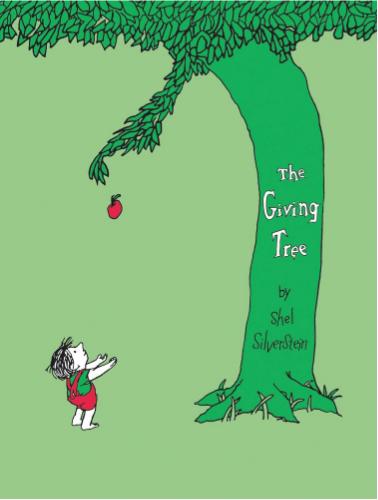
Silverstein’s illustrations are also very interesting. The posture of the tree changes with the progress of the story, from stretching the branches to bending down, and finally only a short stump is left. But the boy’s face is always blank, with no facial features and no expression. This blank made me think for a long time.
Maybe Silverstein doesn’t want us to treat the boy as a concrete and reproachable individual, but as an ordinary or even universal shadow. Everyone is this boy to some extent, and to some extent, this tree. In the relationship between people, giving and asking is never a black-and-white alternation, but a tangled ball of thread. When you pull, you will find that both sides are hurting.
What makes me most uncomfortable about this book, and what I think is really powerful, is that it does not give any preaching or solutions. It just presents a relationship, a relationship that many people have really experienced. Some people see the parent-child relationship from it, some people see the unilateral contribution in friendship, and some people see the extraction of people and nature. Either way, Silverstein refuses to provide a moral outlet.
The tree finally said, “Come on, boy, sit down and rest.” The boy sat down, and the story ended. It’s not reconciliation, it’s not repentance, it’s not compensation, it’s just finally quiet.
I don’t think this is an ode about unconditional love. On the contrary, it is a mirror that shows the consumption in the name of love. The tree has never asked the boy, what do you really need? The boy has never asked the tree, are you happy? They each act on their own understanding until one of them is hollowed out.
If I have to say what this book teaches me, it is that “giving” itself is not naturally noble. What needs to be examined is the way of giving and the way the recipient responds. Otherwise, love will become an empty word, which can hold all the harm.
I don’t want to put myself in the position of a boy or a tree. I’d rather stand by the stump, feel the wind blowing from the empty place, and then think about whether I can be neither that tree nor that boy in the next relationship.
