Ever had that moment when you swear you left your keys on the entry table, tear the whole house apart, and finally find them in the fridge?
Or you buy a stock because it “feels right,” only to watch it tank so hard you want to close your account. Don’t be so quick to blame yourself.
Nobel Prize winner Daniel Kahneman hands you a mirror. Inside your head live two characters. System 1 is fast, instinctive, always jumping to conclusions. System 2 is slow, rational, and frankly kind of lazy. Most of the time, the impulsive one is driving.
This isn’t just a book. It’s a firmware update for your brain. The way you look at your own decisions will never be the same.
System 1 and System 2: You Think You’re in Control. Your Gut Is Actually Interrupting.
There’s one study I read three times. Students saw a set of numbers, then guessed what percentage of United Nations members were African countries. The ones who saw bigger numbers guessed higher percentages—just because a large number had lodged itself in their head first. Kahneman calls this the anchoring effect. You’re not reasoning. You’re just following the first thought that showed up.
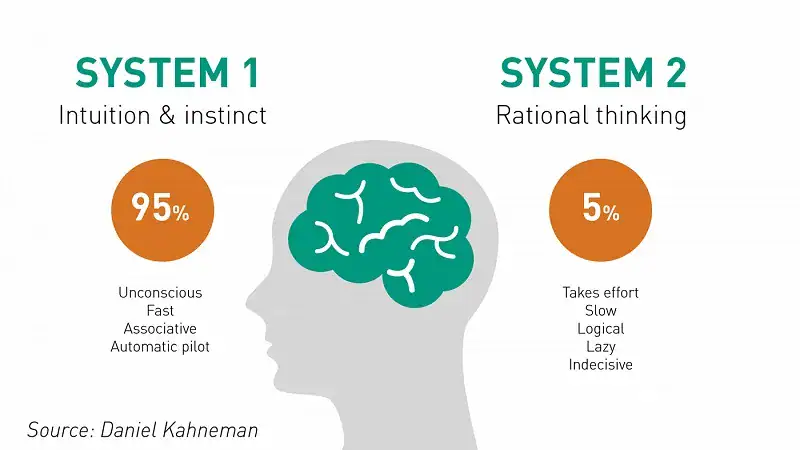
Here’s the painful part. System 2 could correct these mistakes, but it’s lazy. Unless you force it, it just nods along and says, “Yeah, sure, whatever you say.”
I felt a chill reading that. How many of my snap decisions, impulse buys, and first impressions of people were System 1 driving the whole time?
The Museum of Cognitive Biases: You Walk In Laughing at Others. You Walk Out Realizing You’re the One on Display.
Kahneman doesn’t do fancy jargon. He shows you experiments, tells you stories, and lets you feel the sting yourself. Take the availability bias. You watch a plane crash on the news and won’t fly for two weeks. Meanwhile, the drive to the airport—statistically far more dangerous—doesn’t even register with you. Or loss aversion. Losing a hundred dollars hurts way more than finding a hundred dollars feels good.
These biases aren’t someone else’s problem. They’re built into your hardware. Every chapter, I had to stop and replay the past week’s mistakes. Embarrassing. Liberating. Like finally holding the user manual—and the defect list—for my own brain.
This book won’t make you a saint. But it will make you a more aware human being.
You’ll Still Mess Up After Upgrading. But You’ll Smile and Recognize the Old Friend: System 1.
So after all this, can you make perfect rational decisions forever? Don’t kid yourself. Kahneman admits he still falls for his own gut. The real value of this book is a pause button. Next time you’re about to jump at a decision, a new voice appears in your head: “Wait. Is System 1 talking right now?”
That alone is enough.
I opened this book ready to laugh at myself. Somewhere along the way, I started forgiving myself instead. Those decisions I used to cringe at? They weren’t just my personal failure. They were the factory settings of the human brain.
If you’ve ever lain awake at night asking, “Why did I act like that?”—this book is for you. It won’t turn you into a superhero. It will just show you exactly how you’re wired. And next time, you can choose to be just a little bit smarter about how you decide.
