The loudest thing in the entire book Ninety-Three is not cannon fire. It’s a baby’s cry. The child is hidden by his mother in the crevice of a tower wall. Above his head flies the royalist flag. Beneath his feet sits the Republican powder keg. He knows nothing. He only knows hunger. He only knows to cry. His cry cuts through the smoke of gunpowder, through the shadow of the guillotine, through three different men’s versions of justice—and reaches my ears, more than a hundred years later.
With this sound, Hugo tells me: above all ideologies and flags, there is something more enduring and absolute: the will to survive.
Three men, three bullets
Each of the three main characters in this book makes me feel like I couldn’t possibly pick a side. The old aristocrat is the royalist leader. He is ruthless. He orders the massacre of Republican prisoners. He burns entire villages. You hate him. You grit your teeth. Then, in the last hundred pages, Hugo shows you this cruel executioner—abandoning his only chance to escape—in order to save three children trapped in a burning house. He turns and walks into the fire. On his body, no medals remain. Only the back of an old man.
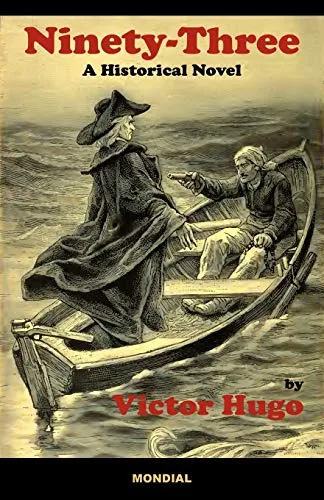
The young officer is passionate. He believes the revolution can bring a new world. But his faith cracks the moment he watches the old aristocrat save those children. Before the law, he should execute this traitor. Before his own humanity, he cannot pull the trigger. He makes a choice that everyone thinks is insane: he lets the old aristocrat go. Then he walks to the guillotine himself.
The revolutionary judge sends his own student to the guillotine. Because the law allows no exceptions. Then, the second the blade falls, he pulls out a gun and points it at his own heart.
These three men: one saves his enemy. One sets his enemy free. One kills the person he loves most.
In the fire of revolution, humanity always burns
Reading this book is like standing in the middle of a long, violent storm. Hugo’s writing carries that quality unique to nineteenth-century novels. The sentences are long. The rhythm is slow. But every paragraph hits like a hammer.
The scene that made my chest tremble most was the old aristocrat crawling into the fire. He finds the three children in the burning room. One of them is only two years old—so frightened that he cannot move. He carries one in each hand, grips the third child’s clothes in his teeth, and crawls out step by step. Flames fall from the roof. His hair catches fire. Smoke stings his eyes, making them barely open. He doesn’t let go. He doesn’t loosen his jaw. When he finally delivers the children to safety, he stands before the Republicans’ guns and says one sentence: “I have returned.” This man who killed without a second thought—in that moment, he becomes an ordinary old man. You cannot hate him. You cannot forgive him. You can only stand there watching him, your stomach knots in helpless awe.
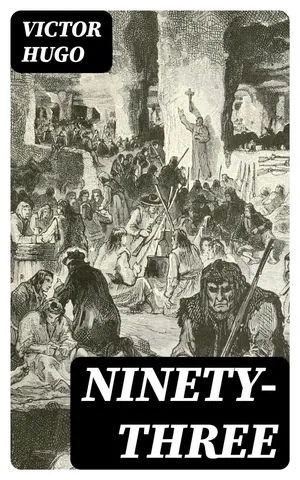
Throughout the book, Hugo keeps asking: What is the revolution for—liberty, equality, fraternity? But what if, in the process of revolution, we have to sacrifice liberty, equality, and fraternity themselves? The young officer speaks a sentence before he dies. He says: above the absolutely correct revolution, there is an absolutely correct humanitarianism. That sentence has been printed in this book for more than a hundred years.
The fire has not gone out
The royalists lost this war. The Republicans lost too. In the end, the one who won was the two-year-old child pulled out of the fire. He knew nothing. He just survived—to the last page of Hugo’s book. Hugo allows him to survive, to show us one truth: at the end of every war, the thing truly worth winning is never a castle or a guillotine. It’s a living child who cries, who gets hungry, who is afraid. He survived. That is everything Hugo wanted to say.
Afterward, I searched online for Ninety-Three. Some people had written long essays analyzing Hugo’s view of revolution. Some argued over whether the young officer’s choice was right or wrong. Some wrote eulogies for the revolutionary judge. Looking at those comments, I suddenly felt that Hugo had won. He has us, more than a hundred years later, still arguing over his characters. That argument itself is the best proof of his sentence. Above the absolutely correct revolution, there is an absolutely correct humanitarianism. We argue because we still care about that humanitarianism. And as long as we still care, the fire has not gone out.