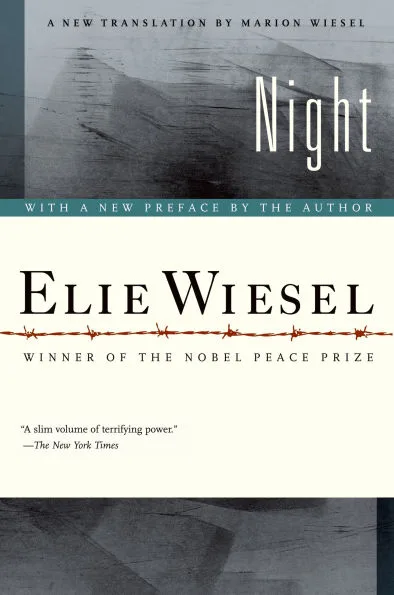
I’ve read many books about war. But I’ve never read a book like Night—one that left me unable to speak for two full days after finishing it. The author barely describes any bloody scenes. He simply uses a in a tone so calm it feels almost icy to tell the story of a fifteen-year-old boy put on a train from his hometown, and then at the gates of Auschwitz, watching his mother and sister walk into a crowd and never come back. In the book, he writes one sentence:
“Never shall I forget that night, the first night in camp, which has turned my life into one long night.”
This is his real experience. Not a novel. Not fiction. Every word on every page is a recollection etched into his body and soul.
A boy’s faith turned to ash in the smoke of the chimney.
When Elie first arrived at Auschwitz, he was still a Jewish boy who prayed over The Talmud. The first thing he saw that completely broke him was a group of prisoners—built like oxen—chasing a frail girl for sport. All of them were Jews. In that moment, he understood: here, even the victims tear each other apart.
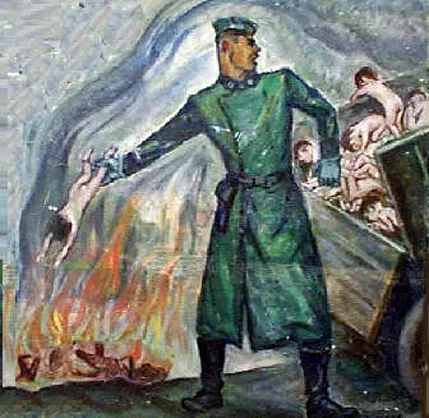
The passage that hurt me most was Elie describing watching his father being beaten, unable to speak up or step forward. He hated himself for his cowardice. But he was even more afraid of that slap landing on his own face. He kept asking himself the same question over and over: Where is God? Why isn’t He answering? Another prisoner gave him an answer. He said God is hanging on the gallows, swinging around the necks of millions. That answer didn’t make Elie feel better. It drained away whatever last hope he had left. A boy who had believed in God for fifteen years saw God’s final resting place in the smoke of the crematorium chimney. That smoke poured out from morning to night, day after day. And as it poured, it burned away every last one of his prayers.
Hunger and cold kill better than bullets.
The most terrifying passage in this book is not any execution. It’s Elie writing about how hungry he was. When he first entered the camp, his only thought was finding his father. A few days later, it became how to get half a bowl more soup. A while after that, he noticed that when he saw a dead prisoner’s bread thrown on the ground, his first reaction wasn’t disgust. It was an instinctive, almost uncontrollable greed. He was ashamed of the thought. But he couldn’t control it. Hunger stripped him down to an animal running on instinct alone. That feeling was more than any torture. Because it didn’t destroy his body. It destroyed the thing called “human.”
The book never stops to explain. It simply records what happened each day. Father growing weaker. His own bread growing smaller. Familiar faces disappearing one by one. He doesn’t cry out in pain, doesn’t accuse, and doesn’t shout at the reader, “Look how cruel this is.” It’s like laying out a row of stones. And then you look at the shape those stones make, and you know: a person used his last bit of strength to tell you—I am still alive.
Believing is the final resistance.
Before reading this book, I had watched many documentaries about the camps online. Black-and-white footage, survivor testimonies, numbers, maps, and timelines. I thought I understood that catastrophe. But Night made me realize: understanding data and feeling the pain on your own skin are two completely different things.
I believe Elie. I believe every word he wrote. And I believe everything he held back underneath those words. This book turned me into a different person. From now on, whenever I see news of any disaster, that child swinging on the rope will automatically appear in my mind. I will remember him—that is all Elie ever wanted.
I looked at the window next to my desk. Outside, the sky had gone completely dark. I thought about a word Elie repeats in the book: Never again. Never again will such a disaster happen. When he wrote that, I know he didn’t believe it himself.
Remember the child on the gallows. Remember the father being beaten. Remember the fifteen-year-old boy staring at bread and swallowing his own spit. He doesn’t need me to understand him.
He only needs me to believe him—and I do.