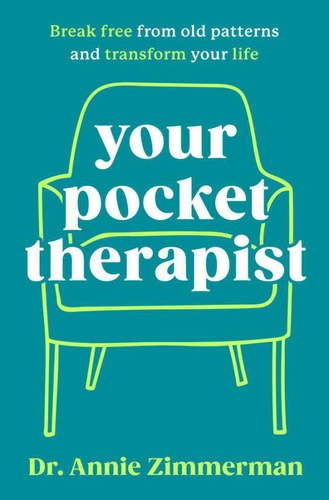
After finishing Your Pocket Therapist, I stared at the ceiling for a long time. This book has a strange effect-it makes you realize that many of the things you have always believed to be “who you are” may never have truly belonged to you at all.
Throughout the book, Dr. Annie Zimmerman repeatedly talks about the “inner critic” that lives inside all of us. It is the voice that tells me every day: Why did you mess things up again? Why can’t you be like everyone else? Are you just too sensitive? Dr. Annie explains that this voice was not originally ours. At some point, we borrowed something from someone, but never learned how to return it.
Reading this reminds me of when I was a child, I got second place in a test, and hid the paper deep in my schoolbag. That evening at dinner, I kept waiting for someone to say, “You did very well.” However, all I received was silence. The words “not good enough” slowly took root deep within me, until finally I believed they had become a part of me.
This book doesn’t try to teach readers “how to stop self-criticism.” Instead, it first asks an important question: Whose voice was it in the beginning? Dr. Annie argues that the version of ourselves we see as “broken” is often not the real problem. To be honest, all those messy worries we have in our hearts—like anxiety, binge eating, or repeatedly stumbling in the same bad relationship—are just symptoms. Like an iceberg, only a small part floats on the surface. What truly holds sway beneath the surface is the 90% of our subconscious.
I was deeply impressed by the story of Elva in the book. Her emotional expression is extremely depressed and she is emotionally shut down and numb. In later conversation, she recalled playing ball in the yard when she was a child, quarreling with her working father, and being scolded loudly. From that day on, she learned one thing: if she expresses her feelings, she will be scolded. She never took the initiative to choose this belief, but it followed her until she was in her thirties.
Dr. Annie is also very direct when discussing family influence and childhood development. She explains that the most important stage of brain development happens between the ages of zero and three. During that time, a child’s entire focus is on survival. For a baby, survival means maintaining a connection with their caregiver. In order to protect that connection, children unconsciously suppress any emotions that might upset their parents. They learn not to cry, not to express anger, and not to ask for too much. What looks like being a “good child” is often actually a primitive survival strategy. Even in adulthood, those suppressed emotions continue to shape the way people think, feel, and relate to others.
Dr. Annie also believes that true growth begins when children are finally able to recognize their parents’ limitations and allow themselves to feel some disappointment or blame toward them. Only then can they begin to separate their own identity from the emotional patterns they inherited growing up.
There’s a sentence in the book that I’ve read over and over again:
“You can love someone but still feel upset about them.”
This sentence challenged the idea that love and dissatisfaction cannot exist at the same time. We love our parents, but we also accept their imperfections. We allow our partners to be unfinished, and we allow ourselves to be as well.
My biggest takeaway from this book is that we all need healing. Healing doesn’t mean pain disappears. It means you learn to pause when it returns andrespond differently. Healing isn’t about becoming a completely different person; it’s about ultimately learning to distinguish which voices truly belong to us and which are merely borrowed for survival.
