Have you ever experienced such a weekend evening:
You cooked dinner and knocked on the child’s door. There was a muffled “wait a moment” inside. You could go again in fifteen minutes, but the door was still closed. You asked, “Shall we watch a movie together today?” He answered “whatever”, but through the crack of the door, you could see him repeatedly swiping his mobile phone in bed without clicking on anything.
The next morning, he went downstairs in a sweatshirt, with the hood covering his head to his eyes. You said, “The school bus is almost here.” He whispered, “I’m not feeling well. I don’t want to go today.”
You are not alone. Nearly one-third of 16-year-olds in the United States have experienced anxiety attacks in the past year, and their parents most often say, “How can I help him without making him feel that I am controlling him?”
This is the problem we need to solve next.
Self-examination list of 16-year-old children’s anxiety performance — 4 signs that are being quietly controlled by anxiety
1.Repeated confirmation on small matters – “Are you sure you don’t need to bring the computer tomorrow?” “Did you really ask the teacher for leave?” Even if you have answered three times.
2.The body is more honest than the mouth — every time they go out, they complain about stomachache and headache, but it gets better by the weekend.
3.Refuse any opportunity to be “seen” — don’t raise your hand in class, don’t join clubs, or even refuse to pick up takeaways, for fear of saying a word to strangers.
4.It’s hard to fall asleep, and it’s even more difficult to get up — staring at the ceiling at night and thinking about “will I make a fool of myself tomorrow”, you can drag out until the last second in the morning.
If your child has more than 2, please remember: it’s not laziness or rebellion, but his brain is ringing false alarms. The following 4 methods come from the practice of child psychotherapists and thousands of parents.
Method 1: List of “safe language” for parents — don’t say “you’re okay”, but say these 6 kinds of words
Core concept:
Anxious teenagers need to be recognized for fear + guaranteed safety + accompanied by action, instead of being persuaded to “okay”.
These 6 sentences can be memorized directly:
- Admit: “This feeling is really uncomfortable. I see it.”
- Safety anchoring: “Your body is safe now. Nothing bad is happening.”
- Accompany: “I won’t leave. We are together.”
- Small steps: “Just try for one minute. You can stop after one minute. You decide.”
- Health first: “Slow down your breathing first. Inhale…exhale…one more time.”
- Affirmation: “You just held on just now. It was difficult, but you did it.”
3 phrases that you should never say:
“You think too much” → change to “Your brain is pulling the alarm, let’s see if it’s a false alert”
“What’s there to be afraid of” → change to “Your fear is true, but the danger is not true”
“Don’t cry” → change to “It’s okay to cry. I’ll accompany you until the tears stop by themselves”
Examples of life:
16-year-old Ava trembled while waiting for treatment at the dentist’s clinic. Her mother squatted down and didn’t say “you’re okay”, but said, “I see you’re nervous. I’m here and won’t leave. Let’s do three slow breaths first, then just go in and sit for a minute, and come out after a minute, okay?” Ava gritted her teeth and did it. She didn’t come out a minute later, because she found that she was not so afraid after lying on the chair.
What you can do right away: write the above 6 sentences in the mobile phone memo and read them directly when you encounter the situation.
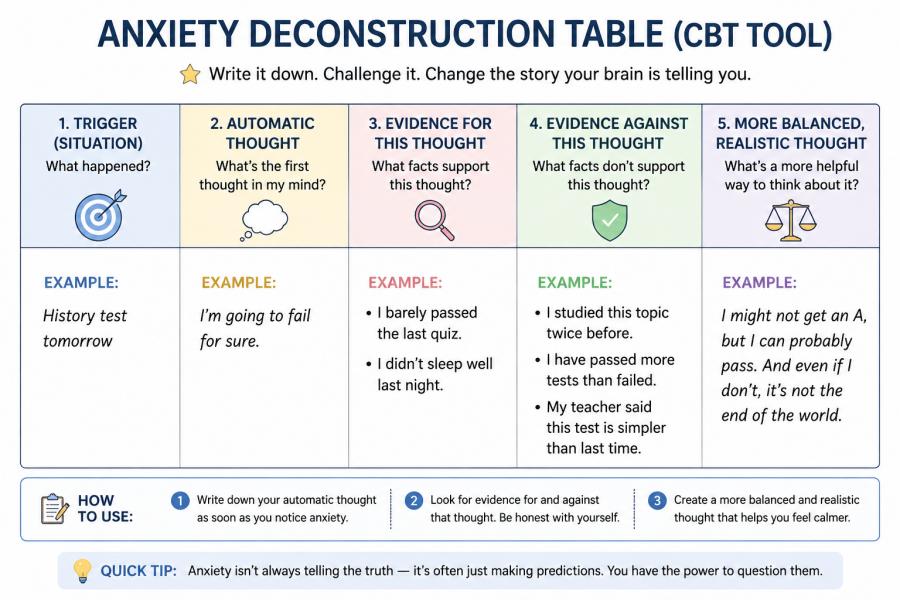
Method 2: Anxiety disassembly table (CBT core technology, 16-year-old children can operate by themselves)
Core concept:
Anxiety often comes from “automatic negative thoughts” in the brain. These thoughts are not facts, but habitual mispredictions. Writing down your ideas and finding evidence to refute them can effectively reduce the intensity of anxiety. This method has been proven to be very effective for adolescents in cognitive behavioral therapy.
Specific practice (can be printed out or saved in the mobile phone memo):Let the child fill in the following form quickly when he is anxious:
Key steps:
- Write down the “automatic idea” first (no matter how exaggerated it is)
- Then deliberately find evidence to object (this step is the most important)
- Finally, rewrite it as a “more balanced idea” (no need to be blindly optimistic, but to be true)
Examples of life:
16-year-old Maya has a stomachache before every chemistry class. Her mother asked her to use this form. Maya wrote down the automatic idea: “The teacher will definitely ask me questions I can’t answer.” Then she listed the evidence against it: “The teacher only called on me once in three classes last week; that time I answered correctly; there were still 5 students in the class who were not called on.” Finally, balance the idea: “Even if I am called on, nothing bad will happen if I can’t answer. I can say ‘I haven’t reviewed that much’.” After that, her stomachache was half relieved.
What you can do right away: help the child build a template of this form in the mobile phone memo, and ask him to fill it out next time he says “in case…”.
Method 3: Stop the “over-comfort cycle” — answer once, and then turn to calm down
Core concept: Children repeatedly ask the same “in case…” questions, and each detailed answer from parents actually maintains anxiety.
Specific practice:
- For the first time, when the child asks, “What if I’m late for the exam?” → Give a short answer: “Let’s set two alarm clocks and go out ten minutes earlier.”
- Ask the same question for the second time → “I have already answered. The answer hasn’t changed. Now let’s do a 10-second breath: inhale for 4 seconds, hold for 2 seconds, and exhale for 6 seconds.”
- Don’t punish or be angry, just stop verbal comfort and turn to physical relaxation.
Examples of life:
Every time 16-year-old Nathan goes to a new place, he will ask, “What if I get lost?” at least 6 times. His father used to open the map and explain repeatedly. Later, he changed his way: the first answer was “Turn on the navigation, you can use my mobile phone”. From the second time on, he said directly, “The answer is to turn on the navigation. Come on, step on the ground with me and step hard three times.” Nathan felt strange at first, but the number of repetitive questions dropped greatly after two weeks.
What you can do right away: When the child asks the same question for the third time next time, hold his hand, do 10 seconds of gentle physical movement, and then communicate.
Method 4: Family “slow down rule” — the fastest anti-anxiety relief is “no urge”
Core concept: Children who are urged constantly have a significantly higher level of anxiety than those who have experienced a single trauma. Because constant rushing will continue to activate stress hormones.
Specific practice:
- Set a “timeless time” every day: for example, 30 minutes after dinner, do not urge showering, homework or sleeping. Children can zone out, chat or look out the window.
- Change “hurry up” to “let’s take our time, we have time”.
- Have a “slow meal” once a week: cook together, eat together, and avoid saying anything with “you should” at the table.
Examples of life:
A California family found that their 16-year-old son Ethan often cried from anxiety on Sunday afternoon, worrying about school on Monday. His parents tried not to rush anything all Sunday morning: he stayed in bed until 10 o’clock, had breakfast for 40 minutes, and then lay on the sofa to watch the clouds. They didn’t urge him to “change your clothes quickly” or “do your homework quickly”. That afternoon, Ethan said to himself, “This Sunday, I didn’t have stomach cramps.”
What you can do right away: tomorrow morning, if the child gets up late, don’t say “hurry up”, but say “take your time, let’s see what we can do.”
You see, helping a 16-year-old anxious child does not require you to become a perfect and patient parent. On the contrary, you only need to remember these four key points:
- Use safe language (6 sentences instead of “you’re okay”)
- Keep an anxiety disassembly table (write it down, find evidence, and recognize irrational thoughts)
- Stop the comfort cycle (answer once, then switch to physical relaxation)
- Slow down as a family (no unnecessary rushing)

Finally, I want to say something to you who are reading this article:You are still looking for ways to help your 16-year-old with anxiety, which means that you are already a more responsible parent than you think.
Tonight, just try one method: say to the child, “This feeling is really uncomfortable, I see it”, or help the child create an anxiety disassembly table in the mobile phone.