The clock on the wall reads 8:00 p.m. The homework notebook has been open on the desk for forty minutes. The pencil is still sitting at the same spot on the first problem. Your child is twisting in the chair — poking the eraser, picking at the corner of the desk, saying he’s thirsty. You sit next to him, having taken six deep breaths, your fingernails digging into your palms. You know he’s procrastinating. And you also know what comes next — you push, he gets upset, you yell, he cries. By 10:00 p.m., both of you are exhausted. And the homework is still not done.

This scene plays out in your house every single night. You are not alone.
When your child procrastinates on homework, you think he’s being lazy. Bad attitude. Picking a fight with you on purpose. But today I want to tell you something you may have never considered: when your child procrastinates on homework, it’s not a character problem. It’s not an attitude problem. It’s his brain asking for a break.
Reason One: The prefrontal cortex is still under construction
There’s a part of the brain called the prefrontal cortex. Its job is to make plans, control impulses, manage time, and tell yourself, “Do the hard thing first.” Here’s the problem with this part of the brain — it doesn’t fully develop until age twenty-five.
A ten-year-old’s prefrontal cortex is only about half built. That’s like having a kitchen with the stove installed but no exhaust fan. The moment you turn on the heat, it starts smoking. You tell him, “Do math first, then you can play.” For an adult, that instruction is simple. For a child whose prefrontal cortex is still under construction — it’s like trying to run a truck on a road that hasn’t been finished yet.
A lot of the time, it’s not that he doesn’t want to do it. It’s that he doesn’t know how to make himself start. The switch that flips from “playing” to “working” — his brain hasn’t installed that switch yet. So he twists in his chair. That’s not laziness. That’s his brain searching hard for that switch — and not finding it.
Reason Two: Anxiety is running three background apps in his brain
You might think a child who doesn’t do homework just isn’t worried enough about it. The truth is the opposite — he’s too worried.
An anxious child sitting in front of homework has multiple things running through his brain at the same time: “This problem is too hard. I’ll never get it.” “If I can’t do it, will Mom be mad?” “I’m already wasting time, but the more I rush, the less I can write.” These background apps eat up all of the brain’s working memory. The processor space left for actually doing homework is just a tiny sliver. So you see him sitting there for forty minutes without moving his pencil. You think he’s procrastinating. But his brain has actually been running at full speed for forty minutes — just not on homework. On fighting anxiety.
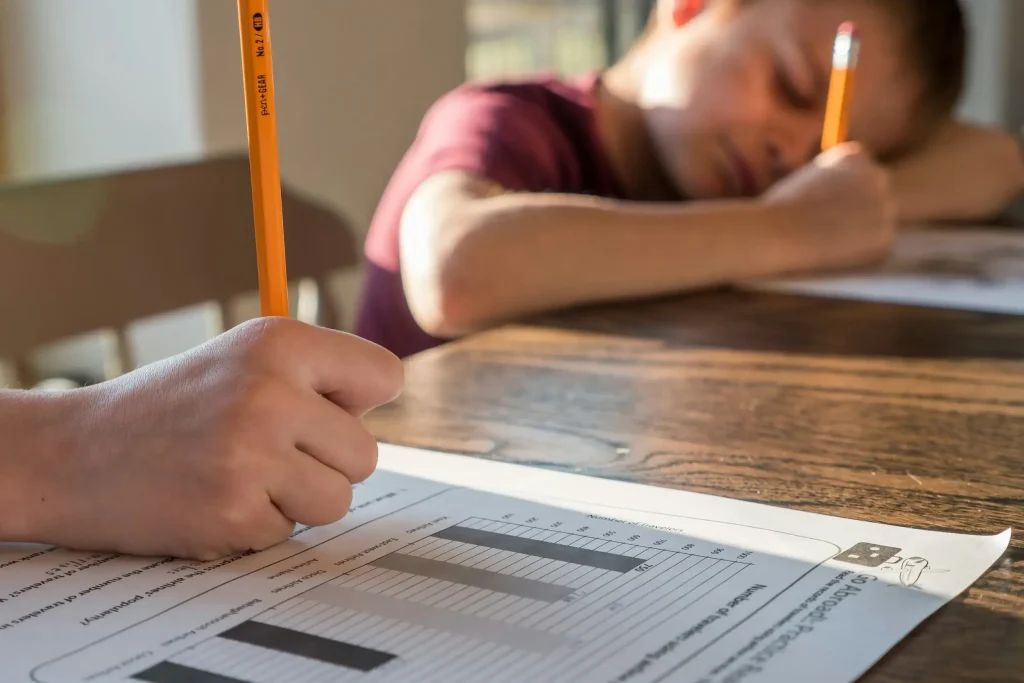
In psychology, there’s a specific term for this: task avoidance. When the pressure from a task exceeds a child’s tolerable threshold, the brain automatically kicks in an avoidance mechanism — get water, go to the bathroom, sharpen a pencil. These behaviors are not him trying to annoy you. They’re his brain protecting him, pulling him away from that anxiety-producing task.
Reason Three: He’s missing a “start-up ritual”
Adults start working by telling themselves, “I know this is important, so I’ll begin now.” A child’s brain doesn’t work that way. A child’s brain works on cues, transitions, and a visible signal that says, “Now we’re switching from that thing to this thing.”
In many homes, here’s what happens: the child walks in the door from school, and his backpack isn’t even on the floor yet. And you say, “Go do your homework.” He gets thrown from a completely relaxed state directly into a task that requires intense focus. No transition in between. That’s like pulling someone out of a swimming pool and telling them to put on a suit and walk into a business meeting. He can’t do it. Not because he doesn’t want to put on the suit. Because he’s still wet.
What’s often missing is not a reason — it’s a ritual. A small, fixed action, done at the same time every day, that tells him: now it’s starting.
So what do you do? Just two sentences.
- Change “finish the homework” to “do three minutes.” Three minutes — anyone can do three minutes.
- Sit down next to him and do your own “homework” — write the shopping list, answer emails, or read a book.
You now know the reasons. Your child procrastinates on homework because the prefrontal cortex is still under construction. Because anxiety is eating up his brain’s bandwidth. Because he’s missing a start-up ritual. You know what he’s actually struggling with now. And that’s enough.