That day, I sat in the office and stared at the three-line email on the screen for forty minutes. My fingers hovered over the keyboard but couldn’t type. A colleague walked by with a glass of water, and I instinctively turned my screen to the left—even though there was nothing secret on it. A voice kept repeating the same sentence over and over in my head: You’re finished. You can’t do anything right.
If you’ve had a moment like that—or if you’re in that state right now—let me first tell you: you are not crazy. You’ve just been hijacked by anxiety. And there is a way for the hijacked to regain the feeling of being “normal.”
Here are four methods I’ve tried and succeeded with. I hope they help you too.
1. Deal with the body first, then the brain
When you’re anxious, your brain lies to you. It tells you, “Danger is coming,” “You can’t do this,” “Things are out of control.” But you can’t reason with the brain. When you calm your body’s physical symptoms, your brain will follow your lead.
Next time you feel like you’re about to explode, don’t sit there thinking, I need to calm down. That won’t work. Stand up immediately, go to the bathroom, or find an empty corner. Then do one thing: hold your breath for four seconds, inhale for four seconds, and exhale for six seconds. The breath hold is key—this action pulls you back from the edge.
If counting seconds feels too hard, try this simpler version: use a straw (or press your tongue against your upper palate to make a small hole), and exhale only through that small opening. It should feel like slowly blowing out a distant candle. Do this three times, and your heartbeat will slow noticeably.
Note: Don’t take deep, chest-expanding breaths when you’re anxious. That will only make you dizzier and more panicked. If your exhale is longer than your inhale, your body will automatically switch to “safe mode.”
2. Pull one thread from the tangled mess
The worst part of anxiety is that it rolls all your problems into one ball. At the same time, you’re thinking: Unfinished work, Is something wrong with my body?, Am I a failure in life? Your job is to pull out the smallest, most specific, most controllable thread from that mess.
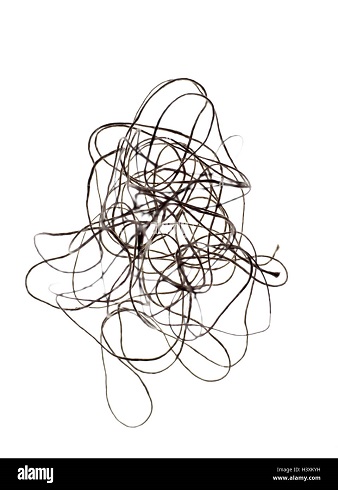
For example, if you feel like you’ve done nothing all day and you’re useless, don’t think, I have to finish all my tasks today. That’s the whole ball. Instead, walk over to a whiteboard or a piece of paper and write three words: “The first step.” Then write: Open the document and type the title. That’s it. You don’t need to write the content—just the title.
The three-line email I struggled with in the afternoon? I finally sent it using this method. I told myself: Just write the first word of the first paragraph. Is “Hello” enough? Yes. After typing that, I said, “Now I’ll fill in the date.” By the time I finished the date, I realized I’d already written half the paragraph without even noticing.
Note: The thread you pull must be ridiculously small. Break it down to “type one word” or “hang one sock on the sofa.” If even that feels like too much pressure, cut it in half again.
3. Build your daily anchor points
Anxious people fear uncertainty the most. Uncertainty keeps you on guard all day. So set up a few fixed, mindless, must-do “anchor actions” throughout your day—like safety ropes.
Here are the three anchors I set for myself:
- First thing in the morning, I don’t turn on my phone. I get out of bed, stand on the floor, and curl my toes three times. This action means: I’ve touched the ground.
- At lunch, no matter what I eat, I drink three sips of warm water first. Not a drink, not soup—just warm water.
- Before bed, I hang one of tomorrow’s socks on the doorknob. Yes, just one sock.
These things sound too silly to say out loud, but they work. Last week, I was so anxious my brain was foggy all day—but I still reflexively drank those three sips of warm water at noon. After those sips, I suddenly felt: At least I did one thing right. The world isn’t completely out of control.
Note: An anchor must be so simple you can do it without thinking. If you find yourself having to convince yourself to do it, it’s too complicated. Simplify it further.
4. Create limited, intentional chaos
Anxiety is, at its core, the fear of losing control. The more afraid you are of losing control, the harder you try to control everything—until you’re stretched as tight as a string about to snap. So deliberately do something every day that lets you “mess up” safely. This teaches your brain that not all loss of control is disastrous—and that some of it can even be fun.
For example, take a pen and paper. Don’t look at your phone or check any facts. Just write whatever comes to mind. Words can fly around, sentences can stop midway, and you can even draw a turtle. When you’re done, crumple it into a ball and throw it away.
My own practice is even simpler: in the shower, I deliberately turn the water to a slightly uncomfortable temperature (a little cooler than usual), point the showerhead at the wall, squat down, and stare into space for one minute. In that minute, I don’t ask myself to “figure anything out.” At first I felt silly, but later I realized that every time I “wasted” a minute like this, my whole body’s tension released like air from a vent.
Note: The word “limited” is crucial. Don’t let chaos become a real mess. Choose a completely safe, small setting to practice being out of control. Keep it between 30 seconds and two minutes. Any longer, and it might create new anxiety.
Now you have four methods.
But you might be thinking: I know all this, but the next time I’m anxious, I won’t remember any of it.
Yes, you’re right. So here’s the most important takeaway:
“Feeling normal again” is not a one-time fix. It is a small choice you repeat thousands of times.
You don’t need to become completely free of anxiety all at once. That’s impossible. All you need to do is pick the easiest, least effort method from the four, each time the wave of anxiety recedes. Maybe today you only take one conscious breath. That’s good enough. Maybe tomorrow you forget to breathe at all. That’s fine too. The day after, you pick it up again.