“It was the best of times, it was the worst of times.” I’d heard that line since childhood. Quoted everywhere. In every kind of essay. I always thought it was just a pretty piece of parallelism.
Then I opened A Tale of Two Cities. I read to the last page. Only then did I finally understand what Dickens was saying. A drunk, wasted man who believed he was good for nothing found the meaning of his entire life on the guillotine. The two cities – London and Paris – separated by the English Channel, by revolution and riot, by the scaffold and the prison. But Dickens joined them with a single sentence. He said: It is a far, far better thing that I do, than I have ever done.
He turned his own name into someone else’s tombstone
Sydney Carton is the most heartbreaking character in the entire book. When he first appears, he is a shabby lawyer’s assistant. Drunk. Wasted. His eyes full of the gray of self-abandonment. He is smart enough to win any case for his colleague, but too lazy to write his own name with care. He falls in love with a woman. Lucie.
But Lucie marries another man. Darnay. A Frenchman who gave up his noble title to teach in London. Darnay looks like Carton but is the opposite in every other way. Sunny. Honest. Responsible. Carton watches them together. No jealousy. No resentment. He just shows up at Lucie’s house now and then. Plays with her child. Reads stories to the little girl next door. He lives as a quiet shadow.
Then the French Revolution explodes. Darnay is sent to the guillotine. Carton bribes the guard. Switches clothes. Walks into the prison in Darnay’s place. Lucie never knows. All she will ever hear is that a man who looked just like her husband died on the scaffold. I put the book down and sat there for a long time. Stared at the ceiling for a long time. How can a person with nothing feel like he owns the whole world?
The revolution turned good men into beasts, and beasts into heroes
Dickens took no side when he wrote the revolution. He wrote the nobles exploiting the peasants. He also wrote the revolutionaries slaughtering the nobles. Madame Defarge is the most complicated character in the whole story. As a young woman, she watched her brothers tortured to death by a nobleman. From that day on, she became a blade. She knits in her wine shop. And in that knitting are the names of everyone to be sent to the guillotine. She is calm. Patient. A machine that never makes a mistake. She does not believe she is doing evil. She believes she is delivering justice.
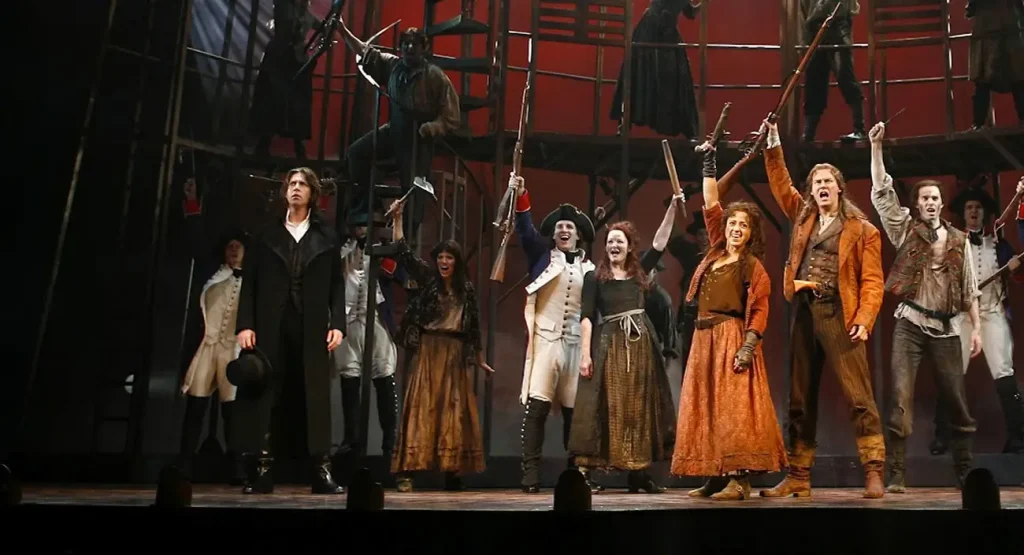
That character sent a chill down my back. Because her logic is airtight. She suffered. So revenge is justified. A nobleman killed her family. So she kills the nobleman’s family. That is also justified. But the little girl she sends to prison – that little girl did nothing wrong.
A fraction of a second of pain, for a lifetime of peace
I used to think sacrifice was noble. After reading A Tale of Two Cities, I realized sacrifice is not noble. It is a very concrete thing. Does it hurt? Are you afraid? Is it worth it? In the hours Carton waits to die in that prison – what is he thinking? Does he regret it? Does he think: that man Darnay, if I don’t switch places with him, he dies – and what is that to me? Dickens only writes that in his last moment Carton remembers a line from the Bible: I am the resurrection and the life. But when Carton says it, it becomes his own words.
The white blade hangs sideways from the wooden frame. Like a giant razor. I imagine a man lying underneath. The blade falls. It takes less than a second. Carton trades less than a second of pain for a woman’s entire lifetime. He thinks he got the better end of the deal. AndI sit at my desk,decades later. Crying for a man who is not real. A man with no tombstone.