My encounter with Mary was a stroke of fate. The moment I picked up A Vindication of the Rights of Woman, I sensed that these words, written over two hundred years ago, were not merely an echo of history—they would pierce my heart.
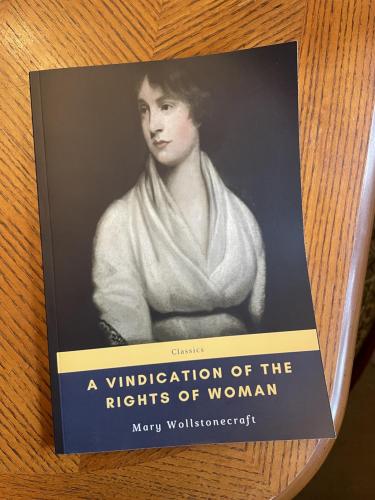
In 1792, the light of Enlightenment reason was illuminating Europe, yet it almost entirely excluded women. It was against this backdrop that Mary wrote a rational dagger aimed at gender prejudice.
Starting from the core of Enlightenment thought—reason—she argued step by step that women are not inherently weak, but have been shaped into such a state by education and social customs; reason is a natural endowment shared by both men and women, and women possess the capacity for reason just as much; therefore, education is the key to liberation, and women should study science, philosophy, and politics; marriage should not be “legalized prostitution,” but rather founded on equality and friendship; ultimately, women’s liberation is central to the progress of society as a whole—when half the population is deprived of its potential for development, society as a whole stagnates.
My life experiences have led me to strongly agree with Mary’s assessment. From centuries ago to the present day, women have been fed the lie that “fragility is a virtue,” taught that pleasing men and managing household chores are their life’s mission. We have been confined to a “greenhouse,” deprived of educational opportunities and the ability to think independently, gradually becoming ignorant, vain, and dependent—yet mistakenly believing this is how women are supposed to be. Marriage has become a “legal transaction,” and women are plastered with labels like “good wife” and “good mother.”
This is clearly a shackle deliberately constructed by society—depriving women of their right to development and turning them into appendages of men. As Mary put it: “I never wish for women to control men; I only wish for women to control themselves.”
Yet no pioneer can fully break free from the constraints of their own era. Beneath the brilliance of Mary’s ideas, there are three limitations I cannot overlook.
First, she has not yet stepped out of the “family” cage. She believed that women should receive a better education in order to become more virtuous wives, smarter daughters, and wiser mothers. In her vision, the family remains the ultimate destination for women. But women inherently exist as an independent gender—the family has never been the end goal, and remaining single is increasingly becoming the preferred choice for many.
Second, she devoted too much space to disparaging women and praising men. The book employs numerous stereotypes and even rather extreme language to describe the women of her era who were unable to break free. This “we are different from them” attitude inadvertently replicates the hierarchical mindset she sought to critique.
Third, she focuses more on hoping men will “grant” rights than on supporting women in “fighting” for them. From today’s perspective, this represents an overly moderate, reformist stance—true rights are never granted; they are fought for.
Overall, I agree with most of Mary’s assessments. But there is one question she has left me with—a confusion I cannot resolve myself. It feels like a thorn lodged in my thoughts, impossible to remove.
I like gentleness. I genuinely like this quality—not because it pleases anyone, but because it makes interactions comfortable and expression gentle. I once believed that gentleness could be a form of strength, not weakness.
But Mary tells me: the essence of gentleness and propriety is a form of enslavement. Society’s praise of women’s “gentleness” is, in fact, a means of stripping women of their power—when you are praised for being “gentle,” you are simultaneously expected to be “obedient”; when you are praised for being “proper,” you are simultaneously required to be “restrained.” All those opinions about women’s “virtues” ultimately result in the weakness and helplessness of the female character.
I began to ask myself: Do I like gentleness because it is inherently good, or because I was taught from childhood that it is good? If gentleness has been historically bound to “obedience” and “restraint,” can I still untie them? Can I retain “a way of interacting that makes others feel comfortable” while stripping away the underlying tone of “enslavement”?
Mary did not provide me with an answer. She merely used words written over two centuries ago to force me to confront this question. And I believe that what truly constitutes a worthy feminine quality—or, indeed, a human quality—is precisely the question every woman must answer for herself.
“Human beings are no longer born into a fixed social position and immovably nailed to that spot, but are free to use their talents and favorable opportunities to secure the destiny they most desire.”
This sentence, penned by Mary, has traversed 233 years of time and still shines like a beam of light. She was not perfect—the limitations of her era, her contradictions, and the occasional harshness she displayed toward her fellow women all remind us that she was a real person, not a deified pioneer.
But she got one thing right: she secured the legitimate foundation of reason, dignity, and public identity for women. On the path she illuminated, reason has no gender, dignity knows no distinction between men and women, and every soul—whether gentle or fierce—should be free to be itself.
We are still walking this path.
