To be honest, after finishing this book, I didn’t really fall in love with the story of My Friends. The characters’ suffering felt somewhat distant, forced, and disconnected from reality. But I must be honest: in certain unguarded moments, Backman’s words pierced my eyes like a ray of light through a crack, sending a shiver through my heart and even bringing tears to my eyes without warning. It’s a very contradictory feeling: I don’t love this story, but I can’t deny those moments when I was moved.
The story is told in two parallel narratives: Seventeen-year-old Louisa, shuttling between foster homes, carries only loneliness and anger as her baggage; a postcard featuring the famous painting Seascape holds a sealed-away memory from twenty-five years ago—four teenagers, with an average age of fourteen, who built a secret sanctuary on an abandoned pier, using their young shoulders to shield one another from the shadows of violence, poverty, and death. That was their last summer together.
At the heart of the book lies a painting titled Seascape. To the world, it is merely a landscape; only those who understand know that within it lie the youth, scars, and redemption of four teenagers.
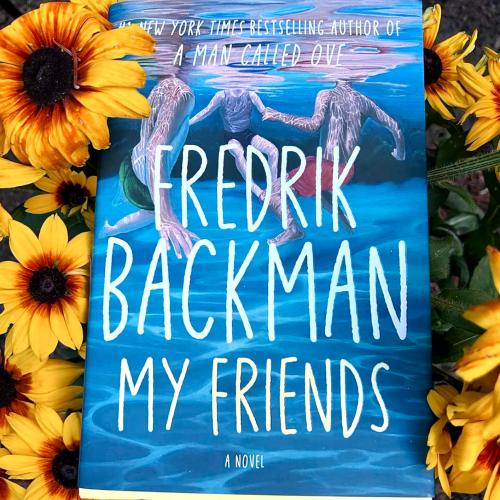
Backman’s “soft-spined tenderness”—cruelty conceals thorns, yet the thorns are soft. He excels at writing about the cracks in life, yet never lets you wallow in them. He lights a bonfire amidst the ruins, summoning all the battered characters to gather around, allowing them to discover the light within themselves through their clashes and ramblings. Thus, reading him is never a matter of “mild pessimism,” but rather a sense of relief born of complete understanding. He first voices the indescribable bitterness in your heart, making you exclaim, “Yes, that’s exactly how it feels!” then uses those awkward hugs and silent companionship to tell you: the pain is real, but so is hope. After finishing, it feels as though the world has slowed down—like walking for a long time on a gloomy day when someone suddenly presses a slightly warm baked sweet potato into your hands. It doesn’t solve all your problems, but in that moment, you know you can make it to the clear skies.
This tenderness is evident not only in what he writes, but also in how he writes it.
The narrative style of this book is the same as in all of Backman’s stories: the story isn’t told from the very beginning, but rather the way people remember things. Because people are always trying to remember some things and forget others, always saying too much or too little, and always missing the most important parts.
So Backman follows this logic to piece together the full picture of the story, capturing the true reality of “how people face loss.” This narrative logic itself is a response to regret: we tell stories this way because we have all lost something.
These techniques all point to the same core: friendship. In this book, friends are the family we choose for ourselves. They aren’t related by blood, and they aren’t perfect, yet they become each other’s light in their darkest hours.
There’s a line in the book: “I’m an abandoned person too, but now that I’ve found you, you’re no longer alone.” This line acknowledges the reality of abandonment without sugarcoating the pain, then offers a simple solution: finding each other.
And another line: “People fear loneliness, but that’s actually a lie, because what we truly fear is being abandoned. You can choose to be alone, but no one chooses to be left behind by others.” This tells me: true friendship is when two abandoned people decide never to leave the other alone again. This clumsy yet fiery friendship left me in tears the moment I finished reading it.
To be honest, when I first read this book, I wasn’t particularly blown away, but gradually, the earlier parts—which felt long and slow—suddenly became deeply moving. I don’t know if it was the helplessness I felt in the face of life and death, or the reliving of decades of joys and sorrows and irreparable regrets, but in an instant, my face was wet with tears.
Perhaps each of us needs a summer like this in our lives, a group of friends like that, and a Seascape that belongs only to us—one that ensures, through the storms of the rest of our lives, we will always remember that we were once deeply understood.
So by the end, I finally couldn’t hold back my tears. It wasn’t because I had grown attached to these characters, but because something inside me—something I can’t quite put into words—flowed out along with my tears.
Perhaps this is what it feels like when a “soft thorn” pierces you: the thorn doesn’t pierce my own flesh, but just looking at it makes me feel the pain.
I didn’t fall in love with this story, but it pierced right through me—and that is enough.
