I went for a walk in the woods near my home last autumn. It was a gray afternoon, the kind where the light never quite arrives. I kicked through a pile of wet leaves and saw something I almost missed. A mushroom. Small, brown, unremarkable. I knelt down and stared at it for a long time. Why had it chosen to grow here, in this forgotten patch of dirt? Why here, and not somewhere easier?
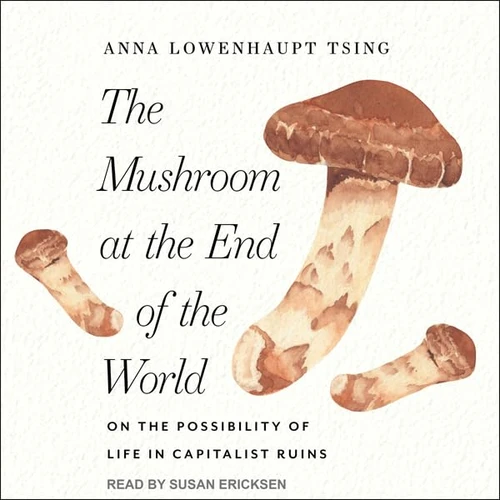
Anna Lowenhaupt Tsing’s The Mushroom at the End of the World asks a similar question, though she scales it up to the whole planet. The book tracks the matsutake mushroom, a prized delicacy in Japan, from the forests of Oregon to the dinner tables of Tokyo. But this isn’t a book about gourmet food. It is a book about ruins. Tsing wants to know: In a world broken by capitalism, deforestation, and climate collapse, what still manages to live? And how?
The Unlikely Hero: A Mushroom That Refuses to Give Up
The matsutake mushroom is a strange protagonist. It grows in disturbed landscapes, places humans have abandoned or destroyed. Old logging sites. Polluted forests. Places where we assumed nothing could grow anymore. Tsing introduces us to the pickers who hunt for it, mostly Southeast Asian refugees, Vietnam veterans, and other displaced people. They work in the margins of the economy, just like the mushroom itself.
I found myself drawn to one picker, a Hmong man named Chai. He arrives in Oregon with nothing but a truck and a dream. He does not speak English well. He does not know the forest. But he learns. He watches. He finds matsutake where others see only dead ground. Tsing writes about him with a tenderness that surprised me. She does not romanticize his struggle. She shows the dirt under his fingernails, the long nights in a cold tent, the fear of being caught by forest rangers.
The core conflict here is subtle but real. The matsutake is a commodity. It gets priced, traded, shipped across oceans. But it cannot be farmed. It refuses domestication. This creates a tension that runs through the whole book. Can a wild thing, a thing that thrives on disorder, survive the relentless order of global capitalism? I kept turning pages wanting to know, even though I knew the mushroom had been around long before us.
The Art of Noticing: What the Mushroom Teaches Us
Tsing’s central idea is something she calls “the art of noticing.” She means paying attention to what we usually ignore. The mold on a fallen log. The mycelium threads underground. The way a fungus and a tree root form a partnership without anyone telling them to. It sounds simple, almost naive. But the deeper I read, the more I realized how radical this act really is.
The core theme is “precarity,” the state of being vulnerable and uncertain. We live in it, most of us, though we pretend we don’t. The mushroom lives in it openly. It does not build walls. It does not hoard resources. Instead, it collaborates. It forms networks. It adapts to poison and drought. Tsing uses this to challenge our obsession with growth, progress, and control. She asks: What if survival is not about getting bigger or stronger? What if it is about learning to live with brokenness?
The key imagery is the “disturbed landscape.” A forest after a clear-cut. A field contaminated by radiation. A parking lot cracked by weeds. These are not wastelands, Tsing insists. They are places of possibility. I remember a passage where she describes a matsutake sprouting from a pile of rusted cans. It should be ugly. But she writes it as a kind of poetry. The mushroom does not need the world to be perfect. It only needs a crack. I think that is the most hopeful thing I have read in years.
How to Live in the End Times: A Quiet Kind of Hope
I finished this book on a Sunday morning. The sun was out, which felt wrong. I wanted rain, some matching gloom. Because the book left me unsettled. It does not offer solutions. It does not tell you to recycle more or buy a different brand of coffee. Instead, it offers a way of seeing. And that is harder than a solution. That requires changing how your mind works.
Tsing’s argument crosses eras because it speaks to something ancient. Humans have always lived after collapses. Empires fall. Forests burn. And something always grows back. The question is not whether we will survive. It is what kind of life we will create in the ruins. The matsutake mushroom is not a metaphor for hope in the triumphant sense. It is a metaphor for hope in the stubborn sense. It does not promise a better world. It just keeps growing, quietly, in the places no one else wants.
I’ll be honest. I read this book because a friend recommended it, and I thought it sounded smart. I expected dry anthropology. I did not expect to feel seen. But there was something about the mushroom’s persistence that mirrored my own clumsy attempts to keep going. I don’t have a clean ending for this review. Maybe that is the point. We are all still in the middle of the story. The mushroom is still growing. And maybe, if we learn to notice, we can too.
