Quick Sibling Bonding Today
If you want to help your kids connect, try these:
- Tell your older child the baby smiled just for them.
- Ask them to help with one small task, like fetching a diaper.
- Notice something kind they did for each other and say it out loud.
- Stop saying “who can do it faster” and start saying “let’s beat the clock together.”
- Let them hear you whisper to your partner, “Look how sweet they are.”
I sat on the kitchen floor while my daughter scribbled on a cardboard box. My partner leaned against the counter, and we were back on That Conversation. Should we have another? We both grew up with siblings we barely speak to now. Our parents never nudged us toward each other. No shared rituals, no “you two are a team,” just parallel childhoods under the same roof. I didn’t want that for my kids. But I also didn’t know how to encourage sibling bonding in a way that felt genuine, not forced.
So I started paying attention. I asked friends whose kids actually seemed to like each other. I read, I lurked in parenting groups. What I’ve gathered is not a perfect system. It’s a collection of small choices, repeated so often they become relationship architecture. Here’s what’s moving the needle in our house.
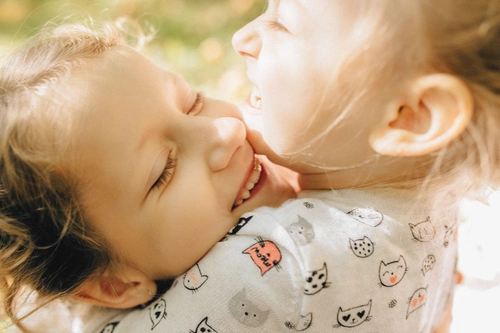
Why Do Some Sibling Relationships Never Get Off the Ground?
Here’s what I noticed in my own family: my brother and I were never put in situations where we needed each other. Our parents compared us. They handed us rewards for outperforming one another. We didn’t have a shared “us against the world” feeling. Psychologists might talk about parental partiality and how it undermines sibling closeness, but all I know is my dad praised me for being the “responsible one” and my brother for being the “funny one,” and those labels calcified into distance.
Without small, repeated moments of cooperation, kids just coexist. They might live in the same house for 18 years and emerge as strangers with shared trauma and an estranged group chat. That’s what I’m trying to avoid.
So what changes the dynamic? It’s not one big speech about family values. It’s the tiny, concrete things you do every week that tell them: this person is on your team.
How to Encourage Sibling Bonding Starting When They’re Tiny
One of the most helpful shifts for us was something my pediatrician said when my second was born: “Make sure your older child sees you looking at them before they have to ask for your attention.” I started doing it. When my toddler walked into the room, I’d already be watching her, smiling. Her whole face would change, like, “Oh, you see me.” It sounds ridiculously simple, but that one habit cut down on the resentment that often poisons a new sibling relationship.
We also hyped up the role of “big sibling” before the baby arrived. We talked about it like an exclusive club. My daughter was convinced this was her baby. When we came home from the hospital, we let her hold the bottle (with help). We asked her to pick out the baby’s pajamas. We didn’t correct her when she said “my baby” with fierce ownership. I see now that this wasn’t parentification. It was inclusion.
And then there’s the translation trick. My three-year-old would ask, “Why is she staring at me?” and I’d say, “Because she thinks you’re the most interesting thing in the world.” When the baby cried, I’d say, “She’s saying she’s so happy you’re her big sister.” I know it’s a little corny. But my older daughter started beaming at the baby. She began narrating her own actions: “I’m getting your rattle, sweetie.”
The “Same Team” Mindset: Ditch the Sibling Rivalry Frame
This is the one mental model I keep coming back to. I call it the Same Team Mindset. Sibling bonding, in my experience, doesn’t grow from forced sharing or constant togetherness. It grows from the feeling that your sibling is not your competitor. So we stopped comparing. We stopped saying, “Look how nicely your sister is sitting!” We stopped splitting praise in ways that set them up as rivals. Instead, we started framing challenges as things they could conquer together.
A classic example: bedtime. Instead of racing to see who brushed teeth first, I’d say, “Let’s see if you two can get ready before the big hand reaches the six.” Suddenly they were collaborators. They’d high-five when they made it. We do this with cleanup, too. “Can you guys pick up all the blocks before I finish this song?” They’re not fighting each other. They’re fighting the clock, together.
I also see parents do the “kids vs. parents” game intentionally. One mom told me her kids whisper and plot after being told to get ready for bed, and she makes a big show of, “Oh no, they’re up to something, better separate them.” The glee on those kids’ faces is the glue. They’re not just siblings. They’re co-conspirators.
When They Fight: Conflict as a Connection Builder
They will fight. My kids have screamed at each other over a single Cheerio. When my older daughter smacked the baby, my first instinct was to yell. But I’ve learned to respond calmly: “You’re the protector in our family. It’s your job to keep her safe, not hurt her. Let’s show her we love her.” Then we model a gentle touch together. I’m not asking her to suppress her frustration. I’m giving her a new role to live up to.
I also don’t let the little one’s missteps slide just because she’s little. If the baby yanks hair, I tell her, “Gentle. Your sister doesn’t like that.” It makes my older child feel seen. She knows the rules flow both ways. And after a fight, I often say, “Can you find a way to help your sister feel better?” Sometimes it’s a hug. Sometimes it’s bringing her a toy. The repair is where the bond actually strengthens.
Some days, all I do is narrate what’s happening with affection: “Look, your sister is sharing her snack with you. That’s how she says ‘I love you.'” Or, “Did you see her face light up when you walked in? She adores you.” It’s not heavy-handed. It’s like constant, gentle translation of their behaviors into love. I’ve noticed that after a few months, my older daughter started doing the same. “Mama, the baby is laughing because I’m funny.”
FAQ: How to Encourage Sibling Bonding
Q: How old do kids need to be before I can encourage sibling bonding?
A: You can start when the younger one is a few months old. Even a newborn’s gaze gets interpreted by you, and that shapes your older child’s narrative. Toddlers benefit from being included in care tasks. School-age kids can handle more collaborative projects. It’s never too early or too late to shift the dynamic.
Q: What if sibling bonding just isn’t happening? My kids seem indifferent.
A: Indifference is okay. Bonding isn’t always loud play. Sometimes it’s quiet coexistence that later becomes friendship. Don’t force it. Create low-pressure opportunities like baking together or building a fort. Pushing too hard can backfire. Some siblings don’t click until they’re adults, and that’s fine. Keep the door open, not forced.
Q: How to encourage sibling bonding when there’s a big age gap?
A: Older kids can take on a mentor role. Ask them to teach the younger one a skill, like tying shoes or drawing a cat. Frame it as a privilege, not a chore. One family I know does a monthly “big sibling date” where the older child plans a special activity for the younger one. The older sibling feels proud, not burdened.
Q: Should I make my kids share a room to encourage sibling bonding?
A: Sharing a room can build closeness, but it’s not necessary. Some siblings bond in shared chaos. Others need space to get along. Respect individual temperaments. What matters more is daily shared experiences, not square footage.
Q: My own parents didn’t model sibling bonding. Can I still learn how to encourage it?
A: Absolutely. Most of us are learning as we go. The fact that you’re asking this question means you’re rewriting the script. You don’t need a perfect family blueprint. You just need small, consistent signals that say: “You two are connected, and I’ll help you see it.”
One Last Thing
A few nights ago, my older daughter crawled into bed next to the baby and whispered, “You’re my favorite person.” The baby grabbed her nose. I stood in the doorway, remembering all the family dinners where my own brother and I never looked at each other. It’s not that every moment is like this. But when I see them choosing each other, it feels like breaking a cycle. Those small, repeated choices are the real answer to how to encourage sibling bonding.
References
- Faber, A., & Mazlish, E. (2012). Siblings Without Rivalry: How to Help Your Children Live Together So You Can Live Too. W. W. Norton & Company.
- American Academy of Pediatrics. (2019). Caring for Your Baby and Young Child: Birth to Age 5. Bantam.
- Gottman, J. (2011). The Relationship Cure: A 5-Step Guide to Strengthening Your Marriage, Family, and Friendships. Crown.
