Last Tuesday, I sat on the kitchen floor next to my daughter. She had just scribbled over yet another drawing of a girl with glasses. The glasses were a little crooked. “It’s ruined,” she whispered. Her voice cracked. I watched her tiny hands shake before she crumpled the paper into a tight ball. I wanted to say, “Art doesn’t have to be perfect.” But I’d said that a hundred times. It never helped. That was the moment I realized: I didn’t need to tell her mistakes were okay. I needed to show her how to survive them. If you’re here wondering how to help a perfectionist child, you might be kneeling on your own kitchen floor right now, heart aching because your kid can’t seem to give themselves any grace.
Quick Help for Your Perfectionist Child Today
If your child is spiraling over a mistake, try these:
- Model making mistakes and laughing at them.
- Ask “What would happen if you left it as is?” instead of fixing it.
- Celebrate finished, not flawless.
- Use a simple cleanup ritual when frustration hits.
- Keep a “messy art” journal where mistakes are the feature.
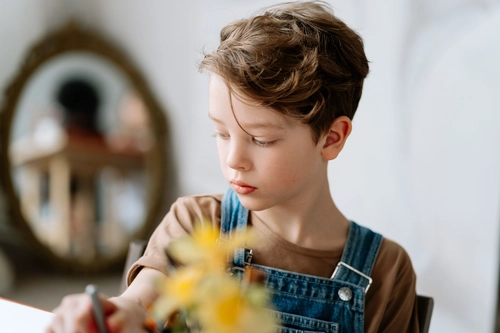
Why Do Some Kids Fall Apart When Things Aren’t Perfect?
My daughter’s perfectionism didn’t start with art. It started with a feeling I couldn’t name at first: a tightness in her whole body whenever she didn’t get something right the first time. Reading a new word and guessing wildly instead of sounding it out. Walking away from a kitchen task when she didn’t understand the instructions. She wasn’t just stubborn. She was terrified.
Many children like her aren’t simply being picky. They’re caught in a loop where a small error feels like a personal failure. For some, it’s linked to big feelings of anxiety. A child who thinks, “If I can’t do this perfectly, I’m not good enough,” is carrying a heavy weight. Other kids might be highly sensitive to visual messiness. Or they’ve absorbed the idea, somewhere, that being loved means being excellent. I had to stop saying “don’t worry about it” and start understanding that her brain was treating a crooked line like a crisis.
What Can You Actually Do When Your Child Says “It’s Ruined”?
The key isn’t to argue with the feeling. It’s to get curious about the fear behind it. When my daughter erupted over a craft because the paint splattered in one “wrong” spot, I said something new. I spoke quietly: “I can see this splatter is really bothering you. Can you tell me what it would need to look like for you to feel done?” She squinted at the canvas. “The bubbles should be only in the middle.” I nodded. “Show me where you want them.” Then we practiced making bubbles float there. She still shredded the first canvas. But the second one? She finished it. And she pointed to the one little stray splatter on the edge and said, “That one’s the sneaky bubble. He escaped.” I nearly cried.
Here’s what I’ve learned helps in those heated moments:
- Name the feeling, not the mistake. Say, “You seem really frustrated right now,” not “It’s just a small smudge.”
- Ask about the story they’re telling themselves. “What does that crooked glasses line make you think about the whole drawing?” You might hear, “It means I’m not a good artist.” Then you can offer a different story.
- Give a tiny tweak, not a do-over. “Can you add a funny hat to the girl so the glasses look part of a silly outfit?” Turning the error into new material shifts the brain from failure to creation.
- Let them see you fail. I started drawing next to her in my own sketchbook. I’d deliberately mess up a cat’s whisker and say out loud, “Well, now it’s a cat with a fancy mustache. I’m kind of liking it.” Hearing me narrate my own recovery planted a seed.
A Simple Game to Rewire Perfectionism
After that painting, we gave it a name. The Sneaky Bubble became our shorthand for any unexpected mistake in art, reading, even getting dressed. The game is simple: whenever something doesn’t go as planned, we look for the “sneaky” part that’s actually interesting. A torn page? “Sneaky window for a tiny bug to peek through.” A word read wrong? “Sneaky word that tried to trick us. Let’s catch it!”
You can adapt this for your family. Call it the “Unexpected Guest” or “Beautiful Oops.” The ritual works because it separates the child’s identity from the error. The mistake becomes an outside visitor, not a reflection of who they are. With repetition, the brain starts to anticipate the guest instead of dreading the judgment.
When Perfectionism Shows Up Outside of Art
I noticed the same rigidity when my daughter read. If she encountered an unfamiliar word, she’d blurt any word starting with the same letter and race on. Guessing was safer than stumbling. She’d flinch if I said, “Let’s sound it out together.” At first, I thought she was being lazy. Really, she was protecting herself from the feeling of “I don’t know.” So I started reading aloud and deliberately misreading a word. “The cat sat on the moo—wait, that’s not right. M-o-o-n, oh, moon!” I would pause, correct myself, and even laugh. She relaxed. Mistakes became a puzzle instead of proof of failure.
In the kitchen, when she walked away from a task after one confusing instruction, I stopped explaining and started asking. “What part do you already understand?” That gave her a toehold. Then, “Let’s do the first step together, and you tell me if I’m doing it the way you pictured.” Sharing control lowered the stakes.
What If You Only Have Your Child Part of the Time?
If you’re in a co-parenting situation, consistency across homes is tough. We have her for part of the year, often during school breaks. I can’t control what happens at her other home. So I focus on micro-moments. A five-minute drawing session where I’m intentionally messy and upbeat. A silly bedtime story where the main character makes a horrible mistake and it saves the day. I send her little postcards with a drawing I “ruined” and turned into something funny. She writes back with her own. It’s small, but it builds a bridge. And I let her see that I love her the same whether she presents me a perfect painting or a crumpled ball of frustration.

FAQ: How to Help a Perfectionist Child
Q: What causes perfectionism in children?
A: Perfectionism can come from many places—anxiety, temperament, or the belief that being loved means being excellent. Some children are wired to be more sensitive to mistakes. Others absorb the message that “good enough” isn’t enough. It’s rarely about the artwork itself. It’s about the fear underneath.
Q: How do I get my perfectionist child to keep trying when they want to quit?
A: Don’t push them to “keep going.” Instead, lower the stakes. Say, “Let’s do one more tiny thing together.” Or, “We can stop after this. Just one.” Small, low-pressure requests often work better than encouragement to “not give up.”
Q: Is perfectionism a sign of anxiety in children?
A: Often, yes. When a child can’t tolerate mistakes, it’s usually rooted in fear—fear of failure, of judgment, of losing love. If perfectionism is severe or interfering with daily life, it’s worth checking in with a child therapist.
Q: What if I’m a perfectionist too?
A: That’s actually helpful. You can model imperfection. Let your child see you make a mistake, laugh, and recover. Say out loud, “I messed that up. Oh well, I’ll try again.” Your actions speak louder than any lesson.
Q: Should I praise my child less to reduce perfectionism?
A: It’s not about praising less—it’s about praising differently. Instead of “You’re so talented,” try “I noticed how hard you worked on that.” Praise effort and process, not just the finished product. This shifts the focus from outcome to growth.
One Last Thing
The crumpled girl-with-glasses drawing is taped to my fridge now. A little wrinkled, a little crooked. She put a sticker on the glasses that says “oops.” It’s my favorite piece of art in the house. Not because it’s perfect. Because it survived. And every morning, it reminds us both: we are more than our mistakes.
References
- Lahey, J. (2015). The Gift of Failure: How the Best Parents Learn to Let Go So Their Children Can Succeed. Harper.
- Siegel, D. J., & Bryson, T. P. (2012). The Whole-Brain Child: 12 Revolutionary Strategies to Nurture Your Child’s Developing Mind. Delacorte Press.
- Washington University School of Medicine. (2016). Perfectionism in young children may indicate OCD risk. Medicine & Health.
