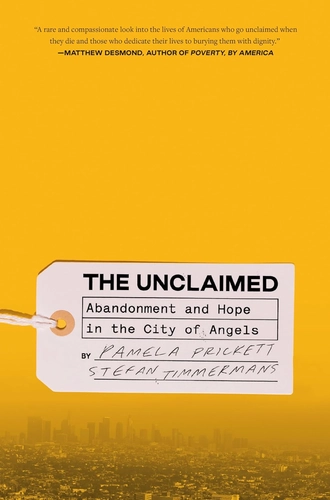
I was standing at a crosswalk in downtown LA last month. A man was muttering to himself, clutching a shopping cart full of things I couldn’t identify. I looked away. I always look away. That’s the thing about cities, isn’t it? We learn to see without really seeing. I picked up The Unclaimed the next day, and I haven’t stopped thinking about that man since. The question this book asks is simple and devastating: what does it mean to die alone, with no one to claim your body?
The People We Forgot to See
The book centers on the dead, mostly. But really, it’s about the living who forgot them. Prickett and Timmermans, two sociologists, spent years investigating the lives of people who died in Los Angeles County and whose bodies went unclaimed. You expect stories of addicts and drifters. You get that. But you also get a retired teacher, a man who ran a small business, a woman who had a family once. They weren’t monsters. They were people who slowly, quietly slipped through the cracks. The cracks in our healthcare system, our housing policies, our families. The authors follow a handful of these cases backward, from the morgue to the last known address. You watch a life unravel, thread by thread. A lost job. A divorce. A mental health crisis that no one caught. A landlord who stopped caring. The suspense is not about what happened to them. It is about whether anyone, anyone at all, will show up to say goodbye. I will not tell you who does. But I will say this: the moment a body is claimed, even by a stranger, something shifts in the air. It is a small act of grace. It is also a terrifying indictment of how we live.
The Fragile Thread of Belonging
The core theme here is visibility. Or rather, the lack of it. The book’s key imagery is the unclaimed body itself. A body in a drawer. A name on a list. A life reduced to a case number. But the authors do something remarkable. They refuse to let these people become statistics. They dig into the details. The favorite sweater. The last phone call. The photograph found in a wallet. You realize that every unclaimed person was once claimed by someone. A mother. A lover. A child. The question is not how they ended up alone. The question is how we, as a society, allowed the thread to break. Prickett and Timmermans show us the system. The bureaucratic labyrinths. The overworked coroners. The shelters that turn people away. The families too ashamed or too poor to take the call. It is not a story of evil. It is a story of indifference. And indifference, the book argues, is a kind of slow violence. It is the way we erase people without ever laying a hand on them. This character’s struggle is not just theirs. It is ours. It is a universal pattern of disconnection that plays out in every city, every neighborhood, every day. You walk past it. I walk past it. The book is a mirror, and it is not flattering.
What We Owe Each Other
This book is not a feel-good read. It is not a call to donate to a charity. It is a reckoning. The authors do not offer easy solutions. They do not pretend that a few kind gestures will fix a broken system. But they do offer something. They offer a name. A story. A recognition that every unclaimed person was once claimed, and that we are all, in some way, only a few steps from becoming unclaimed ourselves. The book has a weakness, I think. It sometimes gets lost in the data. The sociologist’s voice can be too clinical. You want more of the raw human moments. But maybe that is the point. Maybe the clinical voice is the only way to make us see the scale. The book is for anyone who has ever felt invisible. For anyone who has ever worried about a neighbor. For anyone who has ever wondered what it means to be alone. What you get from it is not hope, exactly. It is a kind of clarity. A reminder that visibility is not a given. It is something we give each other. The final question, the one I cannot shake, is this: who will claim you when you die? And more importantly, who are you failing to claim right now?
