I met this book on a Tuesday night, sitting alone in my kitchen while rain slid down the window. I had picked it up because someone online called it “the most important environmental book since Silent Spring.” That sounded like hype. I was skeptical. I opened it preparing to be annoyed.
Three hours later, my tea had gone cold. I had not moved. And I was crying over a story about strawberries.
Here is the thing about Robin Wall Kimmerer. She is a botanist with a PhD and a member of the Citizen Potawatomi Nation. She spent her career trying to reconcile two ways of seeing the world. One says plants are objects to be studied, measured, and managed. The other says plants are teachers, elders, and relatives. Most of us living in modern cities have only ever learned the first way. Kimmerer wants us to remember the second.
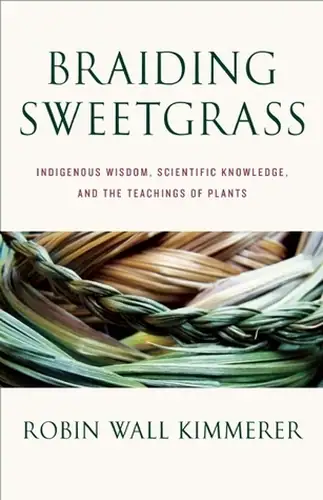
The book is a collection of essays. They move from her childhood in upstate New York to her work restoring a polluted lake with indigenous elders to the simple act of picking sweetgrass by a stream. There is no single plot. The plot is the slow unlearning of how we see the world.
The Scientist Who Learned to Listen Again
The protagonist here is Kimmerer herself. She is a woman who loved plants as a child, was told that love was not scientific enough, and spent years training herself to be objective. She succeeded. She got the PhD, the tenure, the grants. She could name every plant in Latin.
But something was missing.
She tells a story about teaching ecology to college students. They know all the facts about climate change and habitat loss. They are paralyzed by despair. She realizes that knowing the facts does not make people care. What makes people care is relationship. You cannot love something you have never been in relationship with.
This is where the book hooked me. Kimmerer does not argue that science is bad. She argues that science alone is not enough. It gives us knowledge without responsibility. It gives us data without gratitude. It gives us the power to manipulate nature but not the wisdom to know when to stop.
The core conflict in the book is the tension between what she calls the “scientific worldview” and the “indigenous worldview.” One separates the observer from the observed. The other sees them as connected in a web of mutual obligation. Kimmerer does not pretend this tension is easy. She wrestles with it on every page.
What It Means to Receive a Gift
The central image of the book is sweetgrass itself. It is a plant that grows best when it is harvested regularly by humans. If you leave it alone, it gets weak and thin. If you come back every year and take only what you need, it thrives.
This is the core theme. Reciprocity is not just a nice idea. It is how living systems actually work.
Kimmerer writes about the “Honorable Harvest.” It is an indigenous practice that asks: before you take anything from the Earth, ask permission. Listen for the answer. Take only what you need. Use everything you take. Leave something in return. This is not a metaphor. She means it literally.
There is a chapter where she wants to cook wild leeks for her daughters. She goes to a patch she knows, kneels down, and asks if she can take some. The leeks look weak, the bulbs small. She puts them back, tucks the soil around them, and walks away without taking anything. She does not complain about the leeks being bad this year. She accepts the no.
Reading this, I felt something shift in my chest. I have never once asked a plant for permission. I have never even thought to. That is the gap Kimmerer is pointing at. We have forgotten that the Earth is a gift, not a commodity. We have forgotten that gifts come with obligations. We take and take and never say thank you.
What the Book Leaves You With
I will be honest. This book is not perfect. Some chapters ramble. Kimmerer’s gentleness can frustrate. I wanted her to be angrier about the destruction she describes. She has every right to be furious. Her people were nearly wiped out. Their language was stolen. Their land was taken. Their knowledge was dismissed as primitive.
But she is not angry in the book. She is sad. She is patient. She is hopeful in a way that feels almost naive—until you realize that hope is not naive for someone who has already survived an apocalypse. Indigenous peoples have already lived through the end of their world. They are still here. They are still planting sweetgrass.
This book is for people who feel overwhelmed by environmental despair. It is not for people who want a quick fix or a policy solution. It will not give you a plan. It will give you something harder. It will give you a different way to see.
After finishing, I started noticing things I had walked past for years. The shape of a maple leaf. The way moss grows on the north side of a tree. The fact that the air I breathe is the same air that passed through a forest an hour ago. I am not suddenly an activist. I am just paying attention. That feels like enough for now.
The question this book left me with is not “what can I do to save the planet.” It is simpler and harder: what would change if I treated the Earth as a person I loved, instead of a resource I used?
