You know exactly what you want to say. The words are clear in your head. But when you open your mouth, something else comes out. You sound defensive when you meant to sound firm. You ramble when you meant to be concise. You walk away replaying the conversation, thinking: “Why did I say it like that?”
Two books are often recommended for this problem: Say It Right Every Time and Crucial Conversations. Both are practical. Both are built for different people and different problems. Which one you need depends on what is tripping you up.
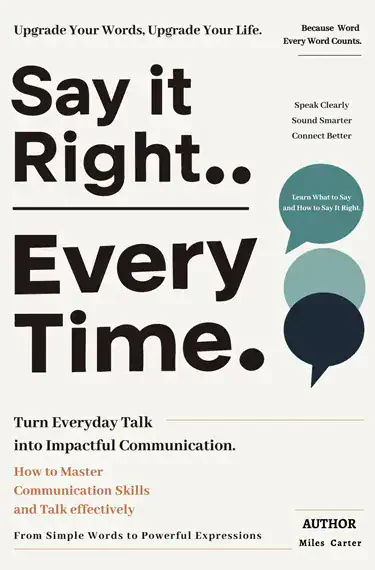
Say It Right Every Time by Miles Carter
Say It Right Every Time is built for a specific problem. You know what you want to say. You are not confused about the stakes or the outcome. But when the pressure hits, the words come out wrong. Or they do not come out at all. You freeze in job interviews. You sound defensive when you meant to sound firm. You walk away from conversations replaying them in your head, thinking, “I should have said that differently.”
This book solves a very specific problem: how to speak clearly and confidently when your nerves are working against you.
It does not give you a step-by-step framework for conflict resolution. It gives you something more immediate: language patterns that work in moments of pressure. Carter structures the book around before-and-after comparisons. He shows you how the same idea can land completely differently depending on how you phrase it. One version escalates tension. The other diffuses it. One version puts the other person on the defensive. The other invites them into your perspective.
The book covers a wider range of situations than Crucial Conversations. Job interviews. Salary negotiations. Team meetings. Speaking up in rooms full of authority figures. Everyday exchanges that carry their own kind of pressure. It is not just about conflict. It is about any moment where you need to say something important and want to be heard.
Carter also emphasizes something other communication books often miss: mental preparation. He teaches you how to build a quick mental filter before you speak, so you stop regretting what came out of your mouth. The book does not just teach you lines. It teaches you how to think differently about the act of speaking itself.
This book is for professionals in their late twenties to fifties who have good ideas but struggle to articulate them clearly under pressure. If you constantly replay conversations wishing you had said it differently, this is your starting point.
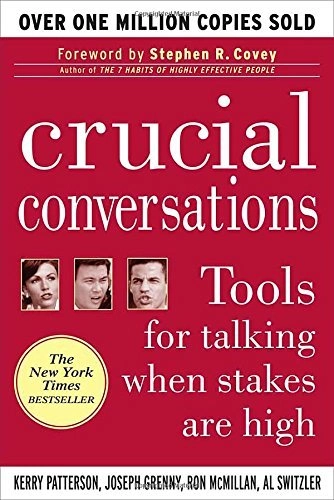
Crucial Conversations by Patterson, Grenny, McMillan, and Switzler
Crucial Conversations is built for high-stakes moments. A promotion is on the line. A relationship is at a breaking point. A team is headed for a disaster that everyone sees coming but no one wants to name. These are the conversations where the cost of getting it wrong is high, and the cost of avoiding it is higher.
The book gives you a structured framework for navigating these moments. It introduces concepts like “start with heart.” Before you open your mouth, check what you really want. Do you want to win the argument? Do you want to avoid conflict? Or do you actually want a resolution that works for everyone involved? This single question changes everything about how the conversation unfolds.
When people feel unsafe, they shut down or lash out. The book gives you specific techniques to restore safety in the middle of a tense exchange. It teaches you to step back, acknowledge what the other person might be feeling, and then continue making your point. One of its most useful tools is the “STATE” framework. It walks you through how to state your views without sounding rigid, how to tell your story without presenting it as the only story, and how to turn confrontation into dialogue.
This book is for people who have a specific high-stakes conversation they keep avoiding. It gives you a repeatable process. You follow the steps, the conversation goes better than it would have otherwise. But it is not about the day-to-day moments. It is about the big ones.
Where They Overlap
Both books care about the gap between intention and delivery. Both are practical and grounded in real situations. Both give you tools you can use immediately after reading. But that is where the similarity ends.
Where They Diverge
The main difference is the question they assume you are asking.
Crucial Conversations assumes you are asking: “How do I handle this one big conversation that I am terrified to have?”
Say It Right Every Time assumes you are asking: “Why do I keep sounding worse than I actually am, and how do I fix it?”
One is about managing a specific high-stakes event. The other is about improving how you show up in any pressure moment. One gives you a framework for navigating conflict with another person. The other gives you the language to express yourself clearly regardless of who you are talking to.
Another difference is scope. Crucial Conversations is narrower. It focuses on situations where stakes are high, opinions diverge, and emotions are strong. It does not help much with a job interview or a team presentation. Those are not really crucial conversations in the book’s sense.
Say It Right Every Time is broader. It applies to almost any moment where you feel pressure to speak. The stakes do not have to be life-changing. They just have to be high enough to make your voice shake.
If you have a specific conversation you keep avoiding, the kind where the relationship or outcome matters deeply and you are not sure how to approach it, Crucial Conversations gives you a structured path. It is a framework you can follow when you do not know where to start.
If you feel like you generally struggle to express yourself in pressure moments, if you leave conversations thinking “I should have said that differently” more often than you would like, Say It Right Every Time is the better fit. It gives you the language and the mental habits to show up better in any high-pressure exchange.
If you are in a leadership or management role, both are useful. Crucial Conversations helps you with the hard talks you cannot avoid. Say It Right Every Time helps you communicate more effectively in the daily interactions where you need to be heard without sounding defensive.
You can also read both. They do not conflict. They solve different problems. But if you are only buying one right now, ask yourself a simple question: are you avoiding a conversation, or are you struggling to say what you mean when it matters? Your answer tells you which book to pick.
