You know what you want to say. You have rehearsed it in your head a dozen times. The words are clear, the logic is sound. But when you open your mouth, your voice comes out thin. Your mind goes blank. You hear yourself rambling and you cannot stop it. You know the material. You just cannot deliver it.
This is not a knowledge problem. It is a confidence problem. Two books approach it from completely opposite directions: Say It Right Every Time and Presence. Both are about showing up better when it matters. But one starts from the outside in, the other from the inside out.
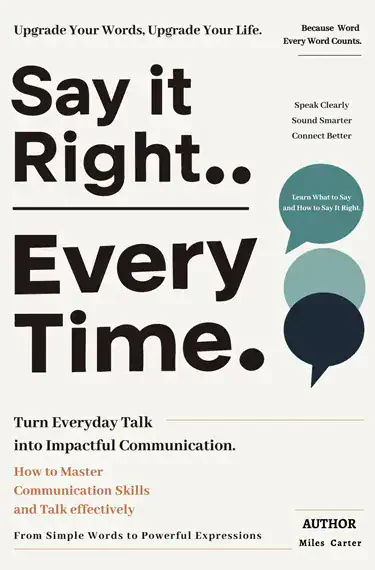
Say It Right Every Time by Miles Carter
This book works from the outside in. It assumes you know what you want to say but the pressure is making you fumble the delivery. The solution is not to fix your inner state first. It is to give you better tools on the outside: language patterns that work even when you are nervous.
The book is built around before-and-after comparisons. It shows you the difference between phrasing that escalates tension and phrasing that diffuses it. Between sounding defensive and sounding firm. Between inviting someone into your perspective and putting them on the defensive.
If you freeze in job interviews, Carter gives you a way to pause and reframe before you speak. If you sound unsure in team meetings, he gives you language patterns that project clarity. If you walk away from conversations replaying them in your head, he gives you a mental filter to run your words through before they leave your mouth.
The book does not ask you to change who you are. It asks you to change what you say. The logic is simple: the right words, delivered at the right time, will help you feel more confident. Confidence follows competence.
This book is for people who have the knowledge but cannot access it under pressure. If you constantly think “I should have said that differently,” this is your starting point.
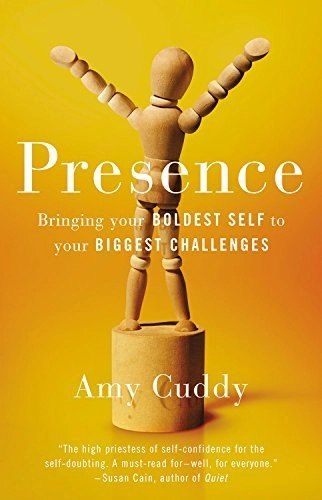
Presence by Amy Cuddy
Cuddy works from the inside out. Her argument is that confidence does not start with the right words. It starts with the right body and the right mental state. When you feel powerful, the words follow naturally. But when you feel small, no amount of rehearsed phrases will save you.
Cuddy is best known for her research on “power posing.” Standing in an expanded posture for two minutes changes your hormone levels: testosterone goes up, cortisol goes down. You actually become more confident physically. But the book goes beyond posing. It explores how you can show up as your best self in any high-pressure situation by shifting your internal state.
The book introduces the concept of “presence.” Not confidence as something you fake until you make it. Presence is alignment. It is when your internal state matches your external expression. You are not performing. You are simply being yourself at your best.
Cuddy draws on research from psychology, neuroscience, and behavioral science. She shows how our bodies shape our minds, and how small adjustments to posture and body language can change how we think, feel, and perform. The book is not about what you say. It is about who you are when you say it.
This book is for people who feel like they are performing when they speak. If you feel like a fraud or an imposter in high-stakes moments, if no amount of preparation seems to help, this is your starting point.
A Scene That Shows the Difference
Imagine you are about to walk into a job interview. Your heart is racing. Your palms are sweating. You have prepared for this for weeks, but now that it is here, your mind feels blank.
Carter’s approach: you have a few ready-to-use phrases in your back pocket. “Let me take a moment to think about that.” “That is a great question, here is how I would approach it.” “To give you a fuller picture, let me walk you through…” You do not have to be calm. You just have to have the right words to say when your brain freezes.
Cuddy’s approach: before you walk in, you find a private space. You stand with your feet apart, your shoulders back, your arms open. You hold that posture for two minutes. You are not practicing answers. You are shifting your physiology. By the time you walk in, your body is sending signals to your brain: you are not in danger. You are in control.
Both work. Both are backed by different kinds of evidence. But they are operating on different levels.
Where They Diverge
The main difference is what they ask you to change.
Say It Right Every Time asks you to change what you say. It gives you external tools. You learn new phrases, new patterns, new ways to frame your thoughts. The change happens at the level of language.
Presence asks you to change how you feel. It gives you internal tools. You learn to shift your physiology, your posture, your mental state. The change happens at the level of your body and your sense of self.
One is tactical. The other is foundational. One you can learn in an afternoon and use that evening. The other takes practice but changes how you show up in every conversation.
Another difference is scope. Carter’s book covers specific scenarios: interviews, negotiations, team meetings, difficult conversations. It is practical and situational.
Cuddy’s book is broader. Presence applies to any moment where you need to perform at your best. It is less about what to say and more about who to be. But it takes more work to integrate into your daily life.
If you have a specific conversation coming up and you need to nail it, Say It Right Every Time gives you language you can practice tonight and use tomorrow. It is quick, practical, and targeted.
If you feel like the problem runs deeper, if you constantly feel like an imposter in high-stakes moments, if no amount of preparation stops you from choking, Presence addresses the root cause. It takes more time to apply, but it changes how you show up in every situation, not just one.
If you are a professional who speaks regularly in public or high-stakes settings, both are useful. Carter gives you the words. Cuddy gives you the state of mind to deliver them. They work better together than alone.
You can read both. They solve different layers of the same problem. But if you are only buying one right now, ask yourself this: do I need better lines, or do I need to feel more like myself when I say them?
