I have always been fascinated by why people do what they do. Not in a clinical way. In a practical, slightly desperate way. Because for most of my life, I was terrible at reading people. I walked into conversations blind. I missed signals. I said the wrong thing. I left every interaction feeling like an idiot.
I read a lot of books to fix this. Some were brilliant. Some were a waste of time. The ones that actually helped did not just give me facts. They gave me a new pair of glasses. They made me realize that most of what we call “human nature” is just patterns. And patterns can be learned, spotted, and understood.
Here are five books that reshaped how I see other people, myself, and the strange things we do when we think no one is watching.

How to Read Someone’s Mind by Miles Carter
I used to think I was just bad with people. Someone would say they were fine, but I knew they were not. I just could not tell you how I knew.
Carter gave me a way to name what I was already sensing. He does not give you a list of gestures to memorize. He gives you a four-layer framework: face, body, voice, and context. The section on contempt hit me hard. It is an emotion that does not shout or argue. It shows up as a flicker in the eyes, a slight pull at the corner of the mouth, a moment when the other person looks through you instead of at you. I started noticing this in conversations I had been having for years. Suddenly I understood why certain relationships felt off in ways I could never explain.
The book also teaches you to look for shifts in baseline behavior. People have patterns. When those patterns change, something has changed underneath. Most body language books stop at “this gesture means that.” Carter does something different. He does not give you answers to memorize. He teaches you to ask a better question, not “is he lying because he touched his nose?” but “what is different about today compared to how he usually is?” That shift in thinking made me more relaxed in real conversations. I stopped trying to be a decoding machine and started paying attention to a living person.
If you have ever walked away from a conversation feeling unsettled and could not say why, this book will give you a name for what you already know.
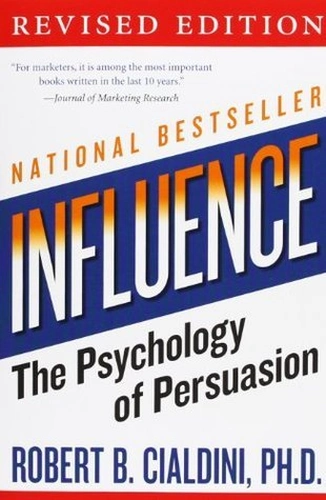
Influence by Robert Cialdini
This book changed how I see the world. That is not an exaggeration.
Cialdini spent years studying why people say yes. He embedded himself in sales, fundraising, and advertising situations to observe firsthand. He identified six principles: reciprocity, scarcity, authority, consistency, liking, and social proof. Each one is a lever that gets pulled on you every day without you noticing.
After reading this, I started seeing these levers everywhere. The free sample that made me feel obligated. The email that said “only three left” and made me panic. The meeting where everyone nodded and I nodded too, even though I disagreed. It is not because the book contains any deep magic. It is because these principles are so basic that we do not even realize they are operating on us.
What I appreciate about this book is that it is not teaching you to manipulate people. It is teaching you to recognize when you are being manipulated. Once you see the patterns, you have a choice. You can play along or you can refuse. But at least you are not nodding blindly. I think about this book almost every day. Not because I use the principles. Because I resist them.
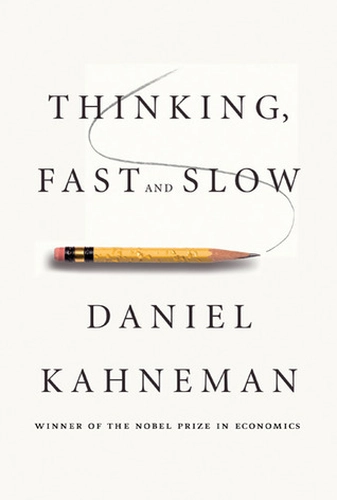
Thinking, Fast and Slow by Daniel Kahneman
This book made me realize how little I actually know about my own mind. Reading it was a continuous process of getting humbled.
Kahneman shows that our brains have two systems. System one is fast, intuitive, and emotional. System two is slow, deliberate, and logical. Most of the time, we think we are using system two. But we are actually running on system one, making snap judgments based on bias. The problem is that system one is quick and efficient, but it is full of blind spots. System two is more accurate, but it is lazy. It avoids work whenever it can.
The book is dense. It took me a while to get through. But every chapter made me feel less smart than I thought I was. The availability heuristic. The anchoring effect. Loss aversion. These are not abstract concepts. They explain real things I do all the time. Like overestimating the risk of plane crashes because I saw one on the news. Like letting the first number I hear anchor my expectations, and then every adjustment I make is still tethered to that number.
Kahneman admits he falls for these biases too. No one is immune. The goal is not to become a perfectly rational machine. It is to catch yourself before you do too much damage. Even a few seconds of delay is better than none. This book changed how I make decisions. More slowly. More carefully. Less confidently in my own instincts.
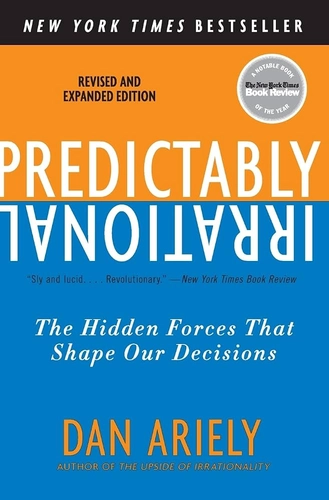
Predictably Irrational by Dan Ariely
If Kahneman is the professor, Ariely is the storyteller. This book is full of experiments, and every single one made me laugh and cringe at the same time.
One experiment asked students to write down their social security numbers. Then they bid on items. Students with higher numbers bid more. The number had nothing to do with the item’s value, but it became an anchor anyway. Another experiment showed that the word “free” makes us irrational. We take things we do not need. We wait in lines that are not worth it. We prioritize free stuff over better stuff that costs a little money.
Reading this book is like watching a magician reveal his tricks. You start to see your own irrational patterns everywhere. Why you bought something on sale that you did not need. Why you stayed in a relationship that was not working because you had already invested time. You are not stupid. You are just predictably irrational.
This book is much easier to read than Kahneman’s. Shorter chapters. More stories. More humor. But the message is just as solid. You will not become a perfectly rational person after reading it. But you will start noticing those moments when you are about to do something that makes no sense. And noticing alone is already worth the price of the book.
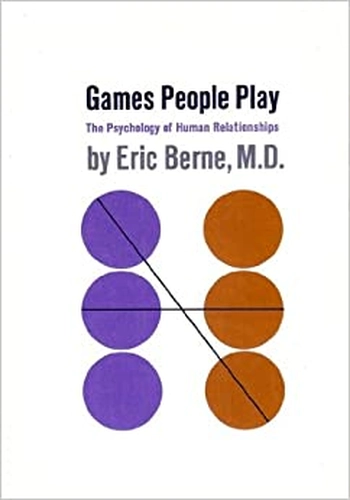
Games People Play by Eric Berne
This is the oldest book on this list. Published in 1964. Also the strangest, and the most uncomfortable to read. But precisely because it is uncomfortable, it stayed with me.
Berne developed a framework called transactional analysis. The idea is that people interact in predictable patterns, and many of these patterns are dysfunctional games. Each game has roles: victim, persecutor, and rescuer. People unconsciously assign themselves and others to these roles over and over.
One famous game is “Why Don’t You — Yes But.” One person presents a problem. Another offers a solution. The first rejects it. Another solution. Another rejection. The person is not actually looking for a solution. They are looking for validation that their problem is unsolvable. Another game is “Now I’ve Got You, You Son of a Bitch.” Someone waits for you to make a mistake, then pounces. It happens in workplaces, in relationships. Once you see it, you cannot unsee it.
Berne writes in a clinical, unsentimental tone. He does not sugarcoat anything. Reading this made me uncomfortable because I saw myself in too many of the games. Some of the content does feel dated, especially his descriptions of gender roles. But his core insight is still useful: many of our relationship problems are not personal. They are patterns. Name the pattern, and you can stop playing the game. You do not have to win. You can choose not to enter the game at all.
I read these books over several years. Each one changed how I see people, including myself. They did not make me perfect. They just made me less confused. I still misread people sometimes. I still make irrational decisions. I still get pulled into games I should have walked away from. But I notice it faster. And that is the real value. You do not stop making mistakes. You just catch them sooner.
