There are two ways to understand why people do what they do. One looks inward at emotions and psychological states. The other looks outward at behavioral patterns and external triggers. Both are useful, but they give you very different kinds of information.
Two classic books represent these approaches perfectly. Here is what each one offers—and what happens when you put them side by side.
How to Read Someone’s Mind by Miles Carter

Carter’s book answers a specific question: what is this person feeling in this exact moment, and how can I tell?
His approach is built around a four-layer framework: face, body, voice, and context. You learn to read emotional signals in real time. You learn to spot contempt before it becomes obvious. You learn to observe baseline behavior—what is normal for this person—and detect meaningful shifts.
The book does not give you a list of gestures to memorize. It trains you to pay attention. It teaches you to ask: what is different about today compared to how they usually are? That one question opens up a layer of understanding that most people never access.
Where Cialdini shows you universal patterns of human behavior, Carter shows you how to read the individual variations. The person in front of you may be responding to something that has nothing to do with the six principles of influence. They might be distracted, upset, or hiding something. Carter gives you the tools to figure out which one it is.
What you will learn from ‘How to Read Someone’s Mind’:
- A four-layer framework for reading people in real time (face, body, voice, context)
- How to spot contempt and other subtle emotional signals
- How to read baseline behavior and detect meaningful shifts
- How to combine multiple signals into a complete picture
Influence by Robert Cialdini
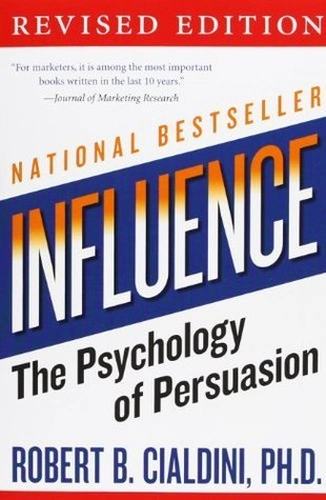
Cialdini spent years studying why people say yes. He identified six universal principles of influence that shape human behavior across almost every context.
Reciprocity. If someone gives you something, you feel obligated to give back. Scarcity. People want what is rare. Authority. People defer to experts. Consistency. Once people commit, they follow through. Liking. People say yes to people they like. Social proof. People look to others for guidance on how to behave.
The book is full of research and real-world examples. Reading it feels like someone is showing you the code that runs behind human interaction. You start noticing these levers everywhere. The email that says “only three left.” The salesperson who gives you a small favor before asking for a big one. The meeting where everyone nods along and you find yourself nodding too.
This book will make you harder to manipulate—and more aware of how often you are being manipulated without realizing it.
What you will learn from ‘Influence’:
- The six universal principles of persuasion
- How to recognize when you are being influenced
- Why people comply even when they do not want to
- How to protect yourself from manipulation
The Same Scenario, Two Different Lenses
Imagine you are in a negotiation. You present your offer. The other person pauses, looks down, and says they need to think about it.
Cialdini’s lens: this is a negotiation tactic. They are creating space. They may be testing your commitment or weighing their options. The pause is predictable behavior in a predictable context.
Carter’s lens: look at the pause itself. Is it longer than their normal reaction time? What is their face doing? Is there tension in their jaw? Is their voice flat or measured? Is this pause different from how they usually behave in meetings?
Both lenses are valid. Cialdini tells you what is likely happening at the level of the situation. Carter tells you what is happening at the level of the person. One helps you understand the game. The other helps you understand the player. You need both to make a real judgment.
If you want to understand the universal patterns that shape human behavior, Cialdini’s book is a fascinating read. It will change how you see marketing, sales, and persuasion. You will start noticing the levers being pulled on you every day.
But here is the thing. Knowing the patterns does not mean you can read the person. You can know all six principles of influence and still miss the fact that the person across from you is distracted, upset, or hiding something. You can spot a negotiation tactic and completely miss the emotional shift happening in real time.
That is where Carter’s book matters. It does not just teach you what to look for. It trains you to pay attention to what is actually happening in the person in front of you, not what you expect to happen based on general rules. The patterns are useful. But they are not a substitute for reading the individual. And if you have to choose where to start, start with the person. The patterns will still be there when you are ready for them.
