Most of us are trained to listen to words. We are not trained to read the signals underneath them. You can know that over 60% of communication is nonverbal and still walk away from a conversation feeling like you missed something important.
If you want to actually understand body language, you need books that go beyond lists of gestures. You need frameworks you can use in real conversations. The three books below do exactly that.

1. How to Read Someone’s Mind by Miles Carter
Most body language books give you a dictionary. This one gives you a framework.
Carter does not teach you to memorize individual gestures. He teaches you to read emotional signals in real time. His approach is built around four layers: face, body, voice, and context.
The section on contempt changed how I see relationships. Contempt is an emotion that does not shout or argue. It shows up as a flicker in the eyes, a slight pull at the corner of the mouth, a moment when the other person looks through you instead of at you. Once you learn to recognize it, you stop wasting time wondering whether something is wrong.
The book also teaches you to observe baseline behavior. People have patterns. When those patterns shift, something has shifted underneath.
What you will learn from ‘How to Read Someone’s Mind’:
- A four-layer framework for reading people in real time
- How to spot contempt and other subtle emotional signals
- How to read baseline behavior and detect meaningful shifts
- How to combine facial expressions, body language, voice, and context into a complete picture
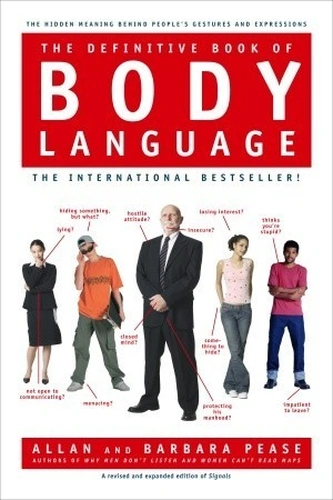
2. The Definitive Book of Body Language by Allan and Barbara Pease
If you want the encyclopedia, this is it.
The Peases have written one of the most comprehensive guides to body language available. It covers everything—from posture and gestures to eye contact and personal space. Each chapter covers a specific part of the body or a specific situation.
What makes this book useful is the sheer breadth of content. If you have ever wondered what a specific gesture means, it is probably in here. The writing is accessible and often humorous.
The limitation is that the book can feel like a list. It tells you what signals mean in general, but it does not spend much time on context. A gesture that means one thing in one situation might mean something completely different in another.
What you will learn from ‘The Definitive Book of Body Language’:
- What different gestures, postures, and movements typically mean
- How to read eye contact, personal space, and facial expressions
- The cultural differences in body language
- How to use your own body language to project confidence
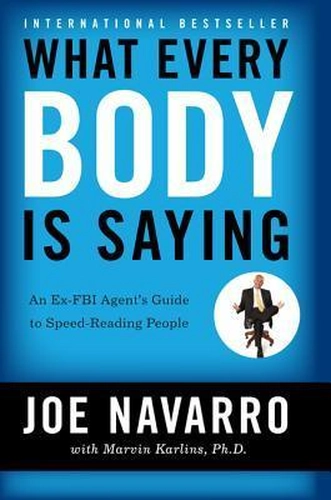
3. What Every Body Is Saying by Joe Navarro
Navarro spent twenty-five years in the FBI as a counterintelligence officer. His job was to read people—especially people who did not want to be read.
Navarro’s approach is systematic and grounded in real cases. He organizes body language by body part: feet, legs, torso, arms, hands, face. His examples come from interrogations and real FBI work.
The book teaches you to spot “comfort” and “discomfort” signals. When people are comfortable, they relax. When they are not, they fidget, block, or withdraw. Learning to read those signals gives you an immediate sense of how someone is responding to you.
The strength of this book is its practicality. The weakness is that it focuses more on identification than interpretation.
What you will learn from ‘What Every Body Is Saying’:
- How to read comfort and discomfort signals in real time
- Why feet are often more honest than faces
- How to spot deception through body language
- Practical observation techniques from an FBI veteran
Frequently Asked Questions
Which book should I start with if I have never read anything on body language?
Start with How to Read Someone’s Mind. It gives you a framework you can use immediately. The other two books are useful, but Carter gives you the foundation that makes the rest easier to apply.
Can I read just one of these books and still get value?
Yes. Each book works on its own. But they cover different aspects. Carter gives you a framework. The Peases give you a catalog. Navarro gives you observation skills. The right one depends on what you are looking for.
How long does it take to get better at reading body language?
You will notice improvements immediately because you will start paying attention to things you previously missed. But like any skill, reading body language takes practice. The books give you frameworks. The more you practice, the more natural it becomes.
These three books each take a different approach. Carter gives you a framework for interpreting body language in context. The Peases give you the comprehensive catalog. Navarro gives you the practical observation skills. Start with the one that matches where you are stuck.
